What was actually unveiled
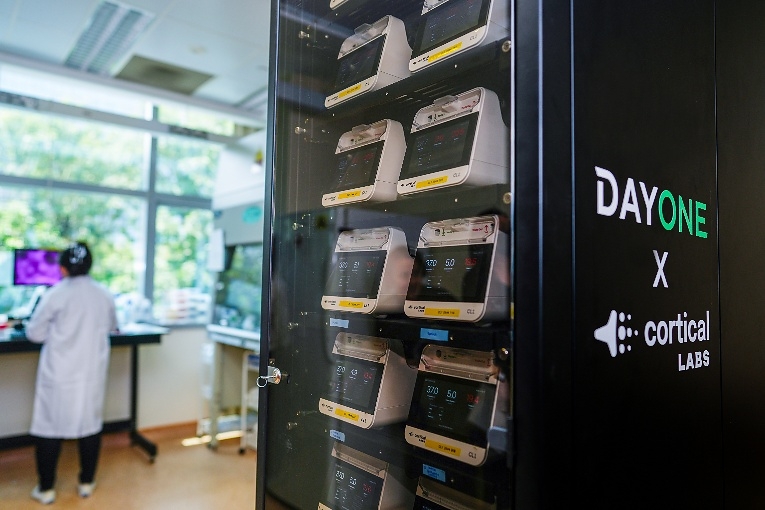
NUS Medicine, data center developer DayOne, and Australian biotech firm Cortical Labs unveiled a Biological Data Center prototype at the NUS Life Sciences Institute in Singapore, announced August 17 following an initial showcase on August 6. The system uses a 20-unit CL1 biological computing platform, in which lab-grown human neurons derived from stem cells, sometimes called wetware, are integrated directly with silicon hardware inside a standard data center rack rather than a standalone lab bench setup, a design choice meant to prove the technology can survive real facility conditions, including power delivery, environmental controls, and physical security, rather than only a tightly controlled research environment built to run a single narrow experiment for a limited window of time.
The organizations describe it as the first independently operated biologically integrated server rack in the world. Unlike earlier biological computing demonstrations that ran in isolated academic settings, this system is built to operate within real data center infrastructure and power delivery, which is the detail that makes it more than a laboratory curiosity for infrastructure planners tracking emerging compute alternatives worth watching over a multi-year horizon rather than dismissing outright.
The power argument that gets a CTO's attention
The entire premise of biological computing rests on one number: the human brain performs enormously complex processing on roughly 20 watts of power, several orders of magnitude below what silicon-based AI training and inference require for comparable tasks. Cortical Labs and its partners are betting that even a crude, early-stage biological system can capture some fraction of that efficiency advantage for specific workload types, at a moment when power availability, not chip supply, has become the binding constraint on AI infrastructure growth industry-wide.
NUS Medicine's Professor Rickie Patani framed the ambition beyond raw efficiency, saying, 'We're not only building a more efficient alternative to silicon, we're creating a platform that can help us understand learning and adaptation.' That framing matters because it signals the research is aimed at understanding biological computation itself, not simply repackaging neurons as a drop-in GPU replacement, which tempers how quickly this technology could realistically reach production infrastructure regardless of how compelling the power efficiency argument looks on paper today.
Where the commercial case actually points
None of the partners are pitching this as a replacement for general-purpose cloud compute. Cortical Labs CEO Hon Weng Chong was specific about the target use cases: 'Our aim is to uncover use cases where that advantage matters most, in areas such as drug discovery, humanoid robotics, cybersecurity and fraud detection.' Those are workloads where pattern recognition and adaptive learning under power constraints matter more than raw throughput, a much narrower commercial thesis than displacing hyperscaler GPU fleets.
DayOne CEO Jamie Khoo tied the project to the same infrastructure math every hyperscaler is currently wrestling with, stating that 'scaling compute and reducing resource intensity are goals we can pursue together.' For a data center developer, backing a biological compute research program alongside conventional silicon buildouts is a hedge, a way to stay positioned on the efficiency frontier if biological or hybrid approaches mature faster than current power infrastructure can scale to meet silicon demand.
How seriously enterprise buyers should take this
This is unambiguously early-stage research, not a procurement option. A 20-unit prototype rack in a university life sciences institute is nowhere near the reliability, scalability, or regulatory clarity that enterprise production workloads require, and none of the partners have offered a commercial timeline for when, or whether, this moves beyond a research setting. Enterprise infrastructure leaders should not adjust any near-term capacity or vendor strategy based on this single announcement, however compelling the underlying science looks.
What it does warrant is a place on the standing list of alternative compute paradigms that technology leadership teams track alongside optical computing, neuromorphic chips, and quantum-assisted approaches, particularly for organizations in drug discovery, fraud detection, or robotics where the named use cases directly overlap with existing workloads. A quarterly review of emerging compute research is a reasonable governance practice for any CTO managing a multi-year AI infrastructure roadmap, and this prototype now belongs on that list.
The bigger signal about the power constraint
The fact that a serious research consortium is pursuing biological neurons as a power efficiency strategy is itself a signal worth sitting with. It confirms that the industry's power constraint is severe enough to justify genuinely unconventional research bets, not just incremental efficiency gains in cooling or chip design that shave a few percentage points off total draw. When gas turbines, nuclear power purchase agreements, and now lab-grown neurons are all live strategies for the same underlying problem, the message for enterprise leaders is that power availability will remain the dominant constraint on AI capacity for years, not quarters.
That reality should inform how enterprises negotiate long-term cloud capacity commitments today. Providers that are diversifying their power and compute research portfolios, rather than betting entirely on incremental silicon efficiency, are signaling a more realistic read on how long the constraint will last and how seriously they are hedging against it. Asking a cloud vendor what they are doing beyond conventional efficiency measures, and whether they are tracking alternative compute research at all, is a fair diligence question heading into any multi-year infrastructure commitment negotiated this budget cycle.