What Snowflake actually shipped
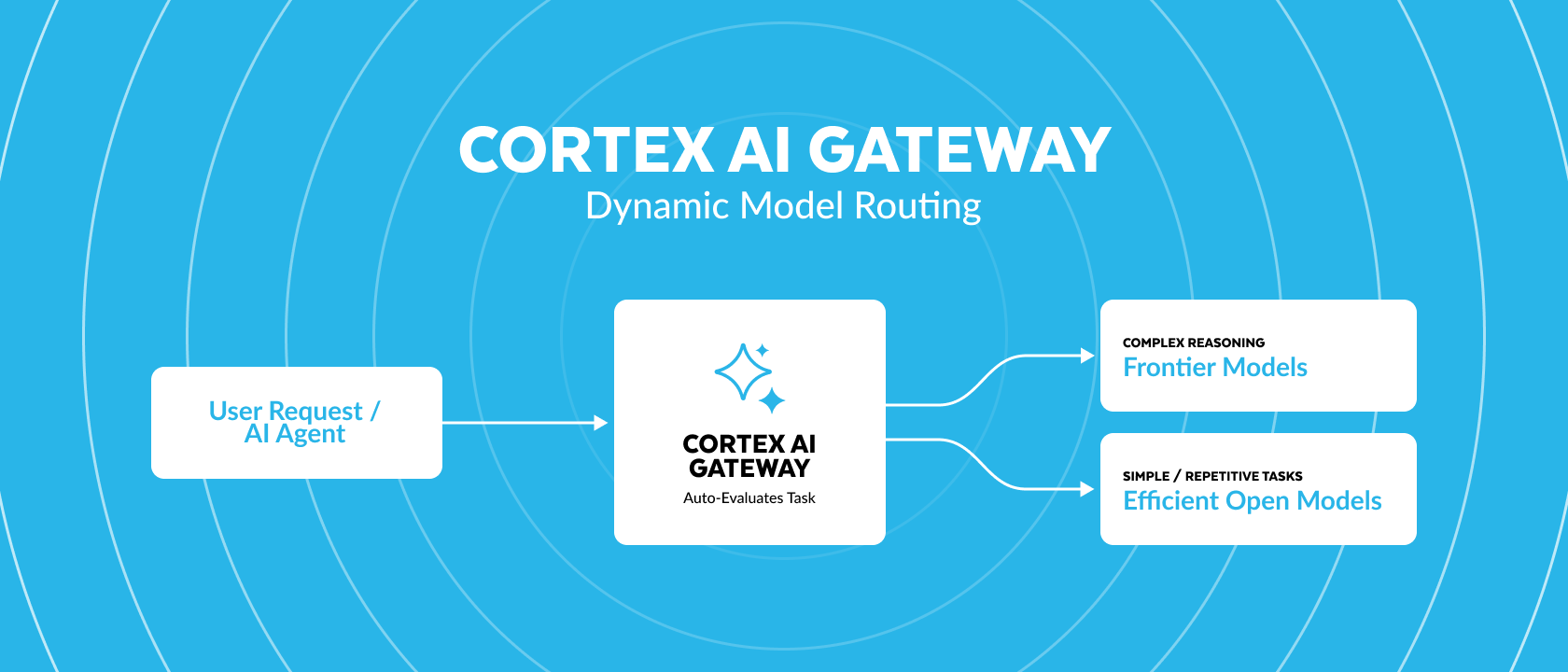
Snowflake announced dynamic model routing within its Cortex AI Gateway on August 18, a feature that automatically selects which underlying model handles a given AI task based on a combination of output quality, latency, cost, and administrator-set policy. Rather than a developer hardcoding a call to a specific frontier model for every task and living with whatever that model costs regardless of task complexity, the gateway evaluates each request as it arrives and routes it to whichever model, proprietary or open source, meets the quality bar most cheaply for that specific job.
The company is simultaneously widening the roster of models available inside that gateway, adding open models including DeepSeek-V4-Flash 0731 and GLM-5.3 to sit alongside frontier proprietary options from the major model labs. DeepSeek-V4-Flash reportedly scored 74.4% on data engineering benchmark tasks, giving Snowflake a credible, materially cheaper alternative to route lower-complexity requests to automatically, while still reserving frontier models for the smaller share of tasks that genuinely require their added capability and cost.
The economics case Snowflake is making
Snowflake CEO Sridhar Ramaswamy framed the announcement around cost discipline rather than raw capability: enterprises are becoming far more rigorous about the economics of AI as spend scales, and Snowflake's stated role is to absorb the operational complexity of model selection so customers can focus on outcomes instead of continuously comparison-shopping between model providers on every individual task. The company reports agents using dynamic routing achieved 3x greater token efficiency than approaches that default to frontier models for every request, while maintaining output quality, and that engineering teams building software with Cortex saw pull requests completed with 25% greater token efficiency than before. Both figures come from Snowflake's own internal benchmarking rather than an independent third party, which is worth keeping in mind when weighing the claim against a specific workload.
Independent analyst Sanjeev Mohan of SanjMo put the underlying problem succinctly: enterprises are drowning in model choices, and the real difficulty was never picking the right model in isolation, it was the operational overhead of picking correctly every single time, at scale, across every workload, without a team dedicated to tracking model releases full time. Automating that choice inside the platform removes a decision point that had been quietly consuming engineering time without adding any differentiated value back to the business in return, freeing that time for work that actually moves a product forward.
Why this is a governance play as much as a cost play
Routing decisions made inside Cortex AI Gateway inherit Snowflake's existing governance controls, meaning a routed call to an open model still runs inside the same access policies, audit logging, and data boundary as a call to a proprietary frontier model would. That matters more than the token savings for regulated enterprises specifically: the alternative, wiring a separate AI orchestration or LLM gateway product on top of the data platform, means governance now has to be reconciled and kept in sync across two independent systems instead of being enforced consistently by one that already owns the underlying data. Auditors and compliance teams generally prefer fewer systems of record to reconcile during a review, not more, which gives this approach a practical advantage beyond the raw cost argument.
It also lets Snowflake's roughly 13,900 AI Data Cloud customers adopt cheaper or newer models incrementally, through policy configuration, without every application team having to rewrite integration code each time a new model becomes competitive on price or quality. That is a meaningful reduction in the switching cost that has historically kept enterprises locked into whichever model they happened to integrate first, simply because the engineering cost of re-integrating a new one was never worth the marginal savings on its own.
The build-versus-buy question this creates
Every major data platform vendor is converging on the same pitch: let the platform you already trust with governance also own model routing, rather than adding a third-party AI gateway that has to be independently secured and audited. Databricks makes a similar argument through Unity AI Gateway, and both companies are betting that CTOs will prefer one governed control point over a best-of-breed AI infrastructure stack assembled from multiple vendors.
That bet is not without risk for the buyer. Routing logic embedded in a proprietary gateway is harder to audit and harder to migrate away from than a routing layer you own independently. CTOs evaluating this feature should ask what visibility they get into routing decisions after the fact, not just before, since an automated system that silently downgrades a compliance-sensitive workload to a cheaper model to save cost is exactly the kind of failure mode that only surfaces in an incident review.
What to watch next
Expect Databricks, AWS, and Google Cloud to respond with comparable routing features inside their own AI gateways within one to two quarters, since none of them can afford to let Snowflake own the cost-optimization narrative on agentic AI spend for long. The competitive question will shift fairly quickly from which vendor offers access to the most models toward which vendor's routing logic is most transparent and auditable when something goes wrong under a real, high-stakes production workload rather than a controlled demo.
For enterprises already committed to Snowflake, dynamic routing is a comparatively low-risk feature to test on non-critical workloads first, since it applies automatically once configured and the token-efficiency gains should compound as usage scales up over time. For enterprises still deciding on a primary data and AI platform, this announcement is one more data point confirming that the platform decision and the AI cost-governance decision are becoming inseparable, no longer two purchases evaluated and negotiated on separate tracks.