A Number Retailers Have Been Missing
Most of the public conversation about agentic commerce has focused on whether AI agents can complete a purchase. RTB House's new survey of more than 1,800 consumers across the US, UK, Japan, and France asks a more useful question for anyone actually building agent checkout flows: how much are shoppers willing to let an agent spend without a human double-checking first. Among American millennials, the answer clusters around 250 dollars, and only when that spend comes with a 7 day return window attached. Below that line, autonomy feels acceptable. Above it, shoppers want back in the loop.
That is a specific, actionable number, and it is the kind of detail that gets lost when agentic commerce gets discussed purely in terms of total addressable market. A retailer or brand designing an AI checkout experience now has a rough dollar threshold to design around, along with a clear signal that a return guarantee is doing real work to earn trust. Treat that ceiling as a floor for minimum viable trust, not as a number to engineer around with better prompts.
Where the Trust Ceiling Sits Across Generations
The generational split is sharp. While 42 percent of millennials will hand an agent a few hundred dollars of discretion, 35 percent of respondents overall said they want human review before any AI-completed purchase, a figure that climbs to 44 percent among baby boomers. That represents more than a third of the shopping population telling retailers directly that full autonomy is the wrong default to ship, and it spans every country RTB House surveyed, not just the more AI-skeptical US market. Retailers building a single global checkout flow will need to account for that variance rather than assume it evens out.
For enterprise commerce teams, that argues for a tiered permission model rather than a single agentic checkout toggle: low-friction autonomy under a defined spend cap, a confirmation step above it, and an explicit opt-in for shoppers who want a human-reviewed flow regardless of amount. Building only the fully autonomous version because it is the more impressive demo risks alienating the largest and most loyal customer segments, who are also frequently the highest lifetime value cohort in a retailer's file.
AI Already Does the Research, Even Where It Doesn't Buy
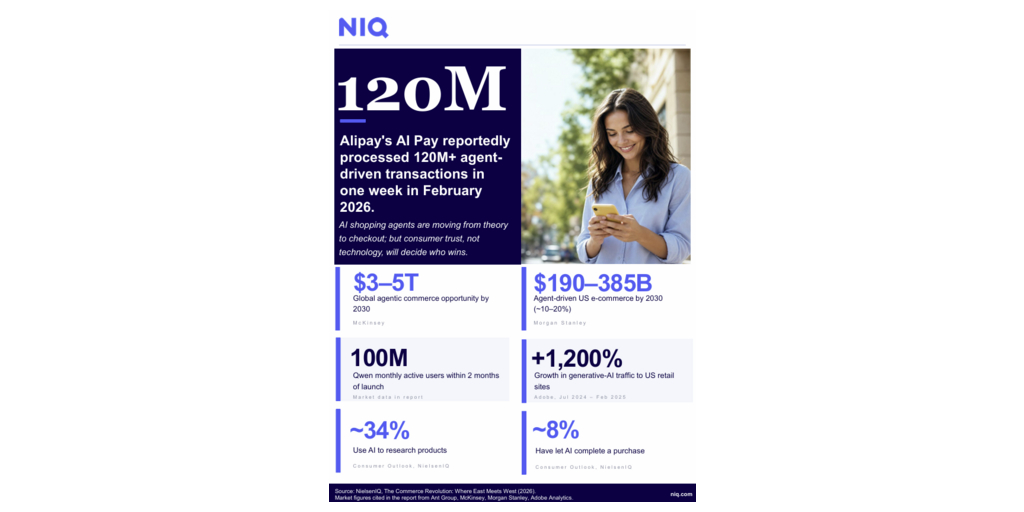
The caution around autonomous purchasing sits alongside heavy AI usage earlier in the funnel. 68 percent of respondents used at least one AI platform for shopping in the past three months, 62 percent have used AI to compare prices, brands, and reviews, and 59 percent credit AI tools with helping them discover brands they did not previously know. Discovery and comparison are where AI has already won the argument with consumers, well ahead of checkout.
That gap between research trust and purchase trust is the actual shape of agentic commerce right now, and it cuts against the narrative that agents are about to replace the entire shopping journey end to end. RTB House VP Jaysen Gillespie put the shift bluntly: "For more than a decade, e-commerce growth was driven by buying attention on social feeds and optimizing for instant checkouts. This research proves that era is coming to an end." The discovery layer is moving to AI faster than the transaction layer is.
Not All AI Platforms Earn Equal Trust
Platform matters as much as capability. Among US consumers, Google's AI Overviews and ChatGPT are tied as the most trusted AI shopping tools at 43 percent each, with Claude at 23 percent and Grok at 21 percent well behind. That gap is large enough that a retailer's agentic commerce integration strategy cannot treat all AI platforms as interchangeable distribution channels, and it should shape which partnerships get engineering resources first, second, and not at all this year.
Separately, Amazon's Alexa for Shopping reached more than 350 million customers over the past year, with interactions increasing roughly fivefold year over year, evidence that platform trust compounds once an assistant is embedded in a purchase habit rather than pitched cold. Retailers choosing where to invest integration effort should weight these trust gaps directly rather than spreading engineering time evenly across every emerging agent surface. Being present on the highest-trust discovery platforms will matter more for eventual conversion than being present everywhere at once, and the survey gives commerce teams a defensible reason to say no to lower-trust integrations this budget cycle.
The Money Behind the Behavior Shift
The stakes attached to these trust numbers are large. McKinsey and the International Council of Shopping Centers project the US agentic commerce market will reach 1 trillion dollars by 2030, a figure that assumes shoppers keep expanding how much autonomy they extend to AI agents over the back half of this decade. The survey data suggests that expansion is real but slower and more conditional than the market projection implies on its own.
That gap between the aggregate market forecast and the individual trust ceiling is where the actual product decisions get made. A trillion dollar market built mostly on 250 dollar autonomous transactions with return guarantees looks very different, architecturally and operationally, than one built on unconstrained agent spend at any price point. Retail leaders modeling agentic commerce revenue should build both scenarios into their planning rather than assuming the more aggressive one by default, and should stress test what happens to conversion and margin if the trust ceiling barely moves through 2030 instead of expanding on schedule.
What to Build Before the Next Budget Cycle
The practical takeaway for enterprise retail and commerce teams is to stop treating agentic checkout as a single feature to launch and start treating it as a trust ladder to climb. Ship spend-capped autonomy with strong return guarantees first, since that is where the survey shows shoppers already comfortable. Layer confirmation steps and human review paths above that threshold rather than forcing a binary choice between full autonomy and no AI checkout at all.
Prioritize integration with the AI platforms shoppers already trust most before chasing every emerging agent protocol, and revisit the dollar thresholds regularly since RTB House's data is a snapshot, not a ceiling that will hold still through 2030. The retailers that win the agentic commerce transition will likely be the ones that matched their checkout autonomy to actual measured trust, not the ones that shipped the most technically impressive agent first.