A Scale Western Boardrooms Have Not Registered
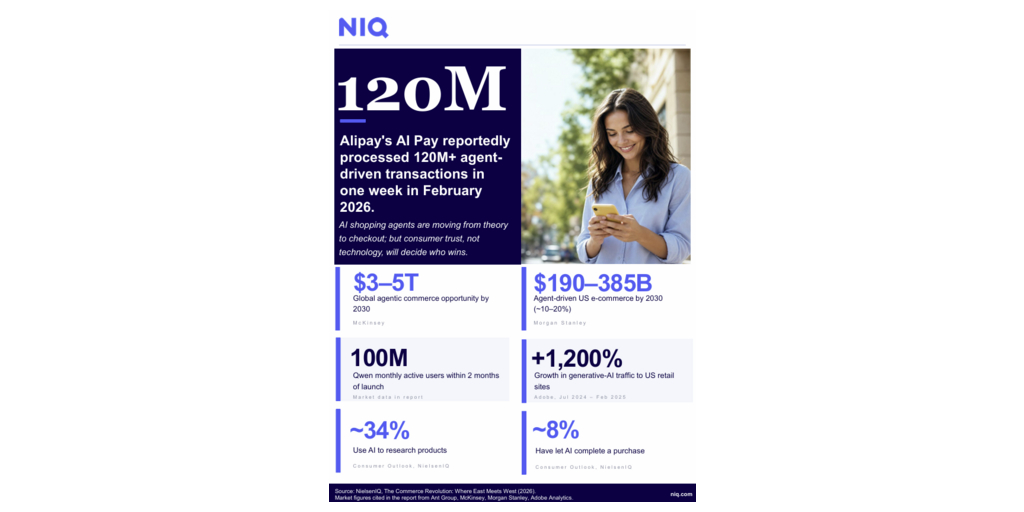
NielsenIQ's new report, The Commerce Revolution: Where East Meets West, puts a number on a gap most Western retail executives have not fully absorbed. During the single week of February 5 through 11, 2026, Alipay's AI Pay processed 120 million transactions initiated or completed by AI agents. Alibaba's Qwen assistant, meanwhile, reached 100 million monthly active users within two months of its launch, a growth curve steeper than almost any consumer app in either market has posted at that stage.
NielsenIQ's Emilie Darolles, President West Europe, framed the disconnect directly: "While much of the West is still debating whether AI will shop for us, in parts of Asia it already is, quietly completing purchases at a scale most boardrooms haven't registered." That is not a marketing line so much as a warning about competitive lead time, since the infrastructure and consumer habits being built in China now are the ones Western retailers will eventually have to match or interoperate with.
Where the US Actually Stands
The Western side of NielsenIQ's comparison is real momentum, just earlier stage and weighted heavily toward research rather than transactions. Generative AI referral traffic to US retail websites grew 1,200 percent between July 2024 and February 2025, and roughly a third of US consumers now use AI to research products with about a quarter using it to summarize reviews. Only around 8 percent of US shoppers, however, have actually let an AI agent complete a purchase on their behalf, and that single figure is the clearest measure of how far the funnel still narrows between browsing and buying in the US market today.
That funnel, heavy research usage narrowing sharply at the actual transaction, mirrors what RTB House's separate consumer survey found this month: American and European shoppers trust AI to inform a decision well before they trust it to execute one. The US gap is best read as a trust and infrastructure gap rather than a technology gap, and it is narrowing more slowly than the research-stage adoption numbers alone would suggest, since building the confidence and payment plumbing for autonomous purchases takes considerably longer than building the recommendation engine that gets a shopper to consider a product in the first place.
Why Alipay's Rails Move Faster
Part of the speed difference is structural rather than cultural. Alipay operates as a closed-loop super-app where identity, payment credentials, merchant catalogs, and now AI agents all sit inside one system Alibaba controls end to end. An agent transacting through AI Pay is moving through infrastructure built specifically for that purpose from day one, with no separate card network, no separate identity provider, and no separate merchant integration layer standing between the agent's intent and a completed transaction. That vertical integration is a large part of why Chinese agentic commerce scaled to 120 million weekly transactions faster than any comparable Western system has managed.
US agentic commerce, by contrast, has to route through a fragmented stack of card networks, individual retailer checkout systems, and now competing AI platform protocols from OpenAI, Google, and Microsoft, none of which fully controls the path from agent intent to settled payment. That fragmentation is exactly what standards efforts around agentic checkout are trying to solve, and it is a meaningful part of why 120 million agent transactions in a single week remains a distinctly Asian data point for now rather than a global one. Every additional intermediary in that chain is another place for a transaction to stall, another integration a retailer has to build, and another reason US adoption is compounding on a slower curve than the underlying consumer interest alone would predict.
The Money on the Table
The projections attached to this gap are large enough to reorder budget priorities. McKinsey estimates a global agentic commerce opportunity of 3 to 5 trillion dollars by 2030, and Morgan Stanley puts the US e-commerce share of that specifically at 190 to 385 billion dollars. Even the low end of that range represents a meaningful share of total US e-commerce within four years, and it is large enough that treating agentic commerce as a side experiment rather than a core channel is already a risk most retail finance teams have not fully priced into their multi-year planning.
Those figures assume the US adoption curve eventually approximates something closer to what Alipay and Qwen are already demonstrating in China, not that the two markets stay permanently on separate tracks. Retailers and CPG brands planning multi-year technology roadmaps should treat the China data less as a foreign curiosity and more as a preview of the infrastructure demands, catalog readiness, and payment integration work the US market will require once its own adoption curve steepens, and should size their agentic commerce investment against the trillion dollar range rather than against today's 8 percent completion rate.
What This Means for CPG and Retail Supply Chains
For CPG brands specifically, agent-driven commerce at this scale changes what good product data looks like. An AI agent completing a purchase on a shopper's behalf needs machine-readable specifications, accurate stock and pricing data, and clean fulfillment logistics behind every SKU, since there is no human in the loop to interpret an ambiguous listing or forgive a stale price. Brands whose catalog and supply chain data are not agent-ready today are effectively invisible to a transaction channel that is compounding fast in one major market already.
That is a data and operations problem before it is a marketing problem, and it sits upstream of the retail media and personalization investments most CPG companies are currently prioritizing. Getting product data, inventory visibility, and payment integration agent-ready is the less visible, less exciting work that determines whether a brand can even participate in this channel once US volume starts to resemble what NielsenIQ is already measuring in Asia.
The Window Before This Becomes Table Stakes
The practical read for enterprise retail and CPG leaders is that the East-West gap NielsenIQ documents is a lead time, not a permanent divergence, and lead time is exactly the resource competitive advantage gets built from. Retailers and brands that treat Alipay's numbers as evidence of what agentic commerce infrastructure eventually requires, rather than as evidence the US market is fundamentally different, will be better positioned when American adoption inflects.
Concretely, that means auditing whether product catalogs, payment systems, and fulfillment data could support agent-initiated transactions today, not in three years, and fixing the gaps now while competitive pressure is still low. The US market's 8 percent completion rate will not stay at 8 percent, and the gap between preparation and reaction is where the winners of this transition will be decided, likely well before the market projections retailers are currently treating as a distant 2030 milestone actually arrive.