What Schnucks Launched
Schnucks, the St. Louis based grocer operating 112 stores across Missouri, Illinois, and Indiana, rolled out two connected digital tools this week: an agentic AI shopping assistant and a fully interactive version of its weekly ad. Both launched within weeks of their initial announcement, a fast turnaround for a regional chain without the engineering headcount that national grocers can throw at a similar project. The pairing is deliberate. The shopping assistant handles open-ended planning and recommendations, while the interactive ad handles the more transactional job of turning a promotion into a cart addition in one step.
The AI shopping assistant runs on the Schnucks app and website and was built in partnership with VitalityIP, a nutrition guidance platform, rather than developed entirely in-house. That partnership choice reflects a broader pattern among mid-size grocers: build the customer-facing experience internally, but license the underlying data and modeling layer from a specialist vendor rather than trying to replicate years of nutrition and health data work from scratch. It also means Schnucks is making a long-term bet on a partner it does not fully control, a trade-off every mid-size retailer weighing build versus buy on agentic AI eventually has to accept in one form or another.
How the Assistant Actually Works
The assistant draws on more than 6 billion lines of shopping, health, and nutrition data to build shopping lists, suggest meals based on ingredients a customer already has, and offer nutritional guidance tailored to individual preferences or restrictions. That data scale is the real product here. A shopping assistant that only knows a store's own catalog can build a list, but one trained on billions of lines of shopping and nutrition data can plausibly answer questions like what to cook with what is already in the fridge, or what substitute fits a specific dietary restriction, tasks that require reasoning across categories rather than simple keyword matching.
COO Ted Schnuck described the ambition directly, saying the tool goes well beyond a simple search bar and instead functions as a personalized digital shopping assistant that understands Schnucks aisles, sales, promotions, and customers' lifestyles. That framing sets a high bar. Search bars are easy to build and easy to compare against competitors. A system that claims to understand a shopper's lifestyle invites a much higher standard of evaluation, and Schnucks will need usage data over the coming months to show the assistant clears that bar rather than functioning as search with extra steps.
The Interactive Weekly Ad Keeps One Foot in the Old World
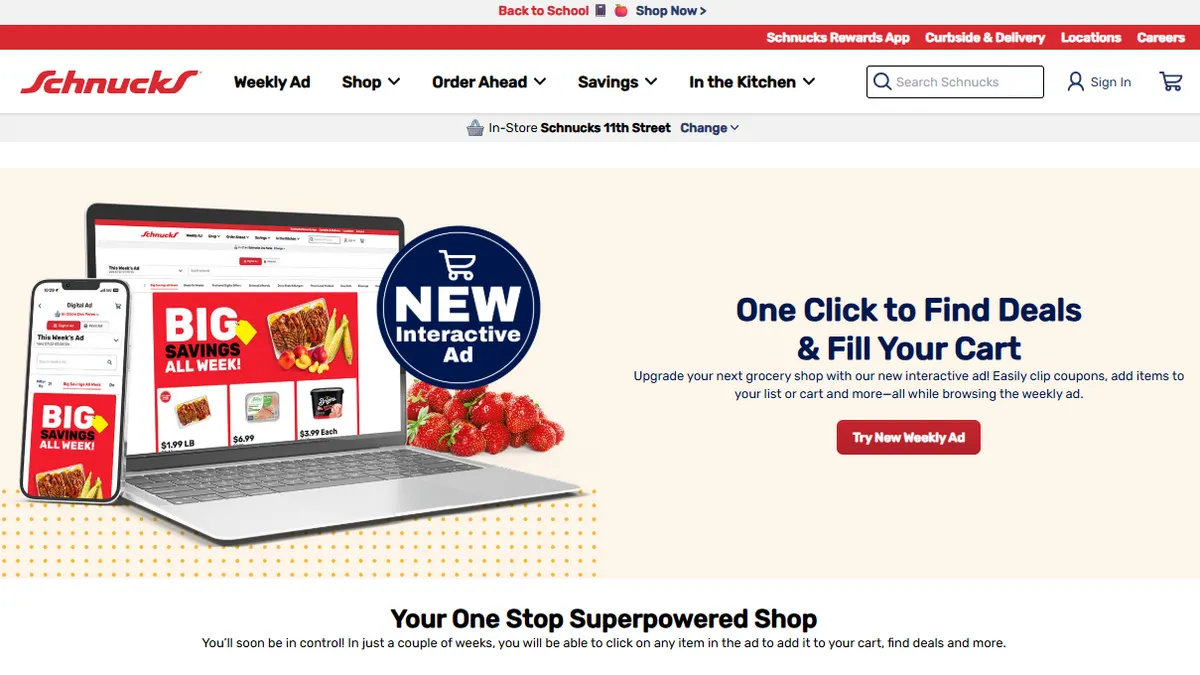
The revamped weekly ad lets customers clip digital coupons directly, add items to a shopping list or online cart, search and filter products, and check availability across in-store, delivery, and pickup channels, all from what used to be a static circular. Customers can toggle between the new interactive format and a traditional layout, and Schnucks confirmed it will keep printing paper copies of both the current and upcoming weekly ads alongside the digital version.
That decision to keep paper ads running is notable given how aggressively other retailers have cut print marketing to fund digital investment. It signals Schnucks is treating this as an addition to its existing shopper relationship rather than a replacement, likely because a meaningful share of its customer base, particularly older shoppers in smaller Midwest markets, still relies on the printed circular to plan a shopping trip. Digital-first retailers serving younger, more urban customers do not usually face that same trade-off.
Why a Regional Grocer Is Making This Bet
Schnucks is entering a category where the biggest national players already have a head start. Kroger has deployed an AI shopping assistant storewide across its banners, and Albertsons built its own AI shopping assistant to redefine the grocery experience across its footprint. Both chains operate thousands of stores and can spread the cost of building or licensing this technology across a far larger revenue base than Schnucks can. A 112-store chain competing on the same technological terrain has to make the case that depth of personalization, not breadth of stores, is what wins loyalty.
That is a real strategic bet, not just a marketing claim. National chains optimize AI shopping tools for consistency across thousands of locations, which tends to push toward generalized recommendations that work reasonably well everywhere. A regional grocer with a smaller, more geographically concentrated customer base can plausibly tune its assistant more tightly to local tastes, local promotions, and repeat shopping patterns, if the underlying data and modeling actually support that level of specificity rather than just running the same generic assistant with a Schnucks logo on it.
What It Signals for Mid-Size Grocers Generally
Schnucks is not alone among regional grocers experimenting with agentic AI. Other mid-size chains have partnered with startups building similar cart-building and recommendation tools rather than developing comparable systems from scratch, a pattern that reflects the economics of the category: the data and modeling work behind a credible shopping assistant is expensive enough that few chains below national scale can justify building it internally, but cheap enough to license that regional grocers can compete on the customer experience layer without matching Kroger's or Albertsons's engineering budgets.
The test for Schnucks, and for the broader wave of regional grocers making the same bet, is whether the personalization actually shows up in basket size, visit frequency, or customer retention over the next several quarters. VoCoVo's survey earlier this month found that food retailers already consider AI vital to operations, but adoption and impact are two different things, and a regional chain betting its differentiation strategy on this technology will need results, not just a launch announcement, to justify the investment against its national competitors.