What the roadmap commits to
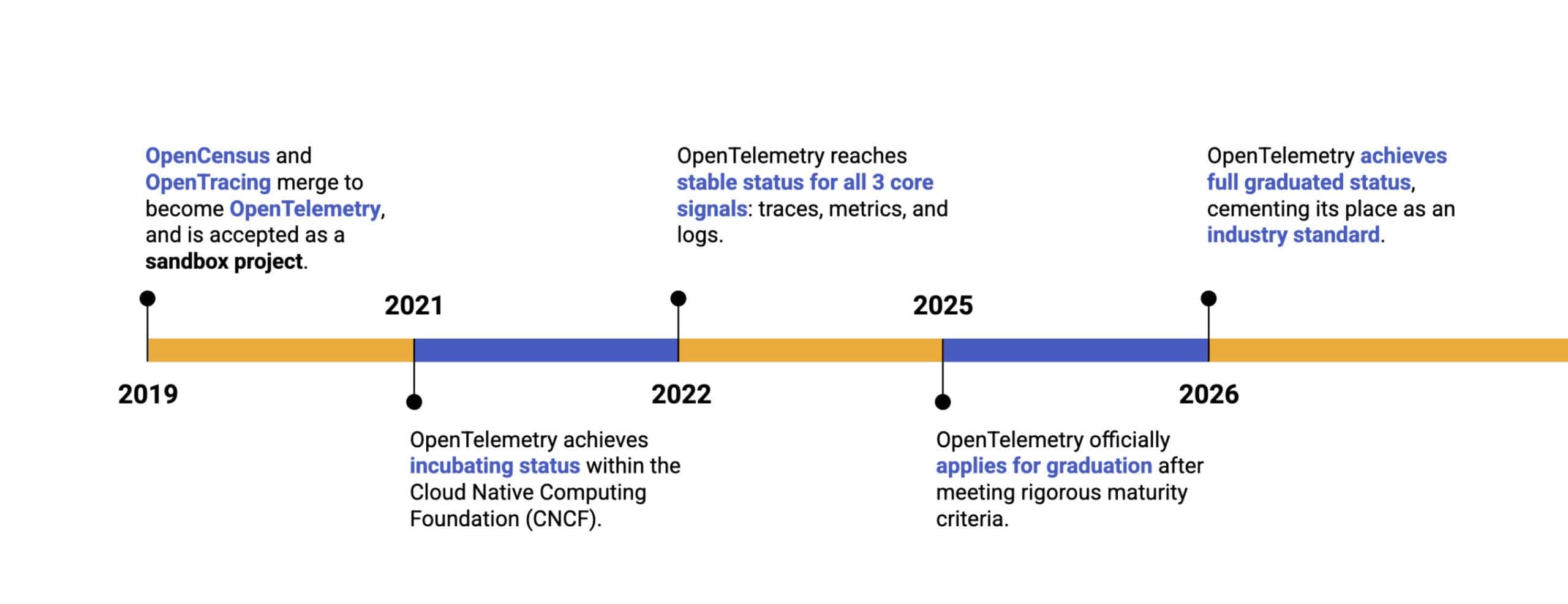
On July 24, two months after its CNCF graduation was announced on May 21, OpenTelemetry published a roadmap setting out its priorities. The document is authored by maintainers Adriana Villela of Dynatrace and Reese Lee of New Relic, which itself signals something healthy: two competing observability vendors steering a shared standard. Graduation is the CNCF's highest maturity tier, and a project that reaches it often coasts. This roadmap reads as the opposite, a deliberate statement of where the effort goes next.
The top priority is generative-AI observability, delivered through new semantic conventions for agentic workflows. Around that sit expanded browser and mobile observability and a push toward enterprise-scale tooling. The through-line is that OpenTelemetry intends to be the instrumentation layer for the workloads teams are actually deploying in 2026, including the agentic systems that have been notoriously hard to trace. For anyone trying to get AI from pilot to production, that is a directly relevant commitment.
Why agentic observability is the hard problem
Agentic workflows break the assumptions that traditional tracing was built on. A single user request can fan out into a chain of model calls, tool invocations, retrieval steps, and retries, with non-deterministic control flow and latency that varies by an order of magnitude call to call. Without a shared vocabulary for spans, attributes, and events, every team reinvents its own schema and every observability vendor captures a slightly different slice, which makes cross-tool analysis painful.
This is exactly the gap semantic conventions are meant to close. By standardizing how an agent step, a model call, or a token count is represented in telemetry, OpenTelemetry lets tools agree on meaning rather than just format. That is the difference between telemetry you can correlate across your stack and telemetry that fragments the moment it leaves the emitting service. For platform teams staring at opaque agent behavior in production, a common convention is the foundation everything else rests on.
The building blocks that make it operational
The roadmap names concrete new components. Weaver handles telemetry-schema governance, which is how an organization keeps its conventions consistent as teams and services multiply. The OpenTelemetry Injector delivers zero-code instrumentation, lowering the barrier for teams that cannot or will not modify every application. Modular OpenTelemetry Packaging aims to make the project easier to adopt in pieces rather than as a monolith. Continuous Profiling has already been added as a signal, extending the data types the standard covers beyond traces, metrics, and logs.
Taken together these pieces address the practical friction that has slowed OpenTelemetry adoption in the past: instrumentation effort, schema drift, and deployment complexity. Weaver in particular speaks to a real enterprise pain, because governance of telemetry schemas is where large observability programs quietly fall apart. A project investing in the boring plumbing of governance and packaging is a project that understands its enterprise users, and that is a good sign for anyone standardizing on it.
The adoption numbers are the real moat
The scale here is hard to argue with. OpenTelemetry reports more than 12,000 contributions from over 2,800 companies. In the prior twelve months the JS API was downloaded more than 1.36 billion times and the Python API more than 1.3 billion times. The maintainers describe it plainly: "OpenTelemetry is the second-highest velocity project in the CNCF, just behind Kubernetes," write Adriana Villela and Reese Lee on the CNCF blog. When the only project moving faster is Kubernetes itself, you are looking at de facto infrastructure.
That gravitational pull is the strongest argument for adopting the standard now. An open standard with this level of vendor-neutral participation is unlikely to leave you stranded, and it gives you leverage against lock-in from any single observability vendor. The maintainers are blunt about it: "If your organization was holding out on using OpenTelemetry, you have no more excuses!" write Villela and Lee. That is marketing language, but the underlying data supports the confidence behind it.
The lock-in question turned on its head
For years, observability was one of the stickiest categories in the stack, because instrumentation was proprietary and ripping it out to switch vendors was prohibitive. OpenTelemetry inverts that dynamic. Instrument once against the standard, and the telemetry becomes portable across any backend that speaks it. The fact that maintainers from Dynatrace and New Relic co-author the roadmap tells you the vendors have accepted this reality and are competing on backend value rather than on capturing your instrumentation.
For a technology leader, this reframes a procurement risk into a strategic asset. Standardizing on OpenTelemetry means your future vendor negotiations start from a position of portability. It also means the observability tooling you build around agentic AI today is not hostage to a single provider's roadmap. The cost is the upfront work of instrumenting to the convention, and the roadmap's zero-code and packaging investments are aimed squarely at reducing that cost.
The standardization decision on your desk
The practical takeaway is a standardization call, and the roadmap makes it easier to justify. If your organization has been running a patchwork of proprietary agents and ad hoc AI logging, this is the moment to converge on OpenTelemetry as the instrumentation layer, especially for the agentic workloads whose semantic conventions are now a first-class priority. Doing so early means your production AI telemetry is portable, correlatable, and governed from the start rather than retrofitted under duress.
The concrete next steps are modest. Pilot the Injector for zero-code coverage on a service or two, evaluate Weaver if you have schema governance pain, and align your AI teams on the emerging agentic conventions before they harden their own bespoke formats. A project with graduation behind it, Kubernetes-adjacent velocity, and a clear AI-observability agenda is about as safe a foundation as this domain offers. Standardizing now is the low-regret move.