A deal, a denial, and a guessing game
Ocado signed an agreement to build a large customer fulfilment centre for what it describes only as a "fast-growing European national retailer," with the site targeted to go live in Ocado's 2028 financial year. Industry speculation quickly settled on Lidl, which overtook Morrisons earlier this year to become the UK's fifth-largest supermarket and posted sales growth of 8.6 percent year on year in the four weeks to mid-July, the fastest growth among bricks-and-mortar grocers in the latest market data. Lidl shut the speculation down directly, telling Retail Gazette that "the company is not the retailer currently working with Ocado on this project."
The denial is worth taking seriously on its own technical merits, not just as a press statement. Lidl does not currently offer full online grocery delivery in the UK, and Ocado has said its new partner already has enough existing online order volume to fill the facility to just over half its design capacity from day one, a profile that does not match a retailer still building out its delivery business from a standing start. Whoever the actual customer is, they are already running a meaningful online grocery operation today and simply need more automated capacity to grow it.
Why the secrecy itself is the signal
A three-year lead time between signing an automation deal and going live, combined with a refusal to name the customer, tells a retail CTO something concrete about how these infrastructure commitments actually get made. This is not a quick vendor swap or a pilot program; it is a multi-year capital commitment that both parties are managing carefully in public, likely for competitive reasons on the retailer's side, since naming the deal early would hand competitors a three-year head start on anticipating that retailer's capacity and growth plans.
That secrecy pattern is itself useful information for anyone evaluating a similar build: the planning and construction timeline for large-scale robotic grocery fulfillment runs in years, not quarters, and the commercial terms are sensitive enough that even the customer's identity is being guarded as competitive information. Any retailer benchmarking its own automation roadmap against a competitor's public announcements should assume the real planning started well before anything became public, and that the full scope of a rival's capacity plans is rarely visible until the facility is already running.
The technology stack behind the secrecy
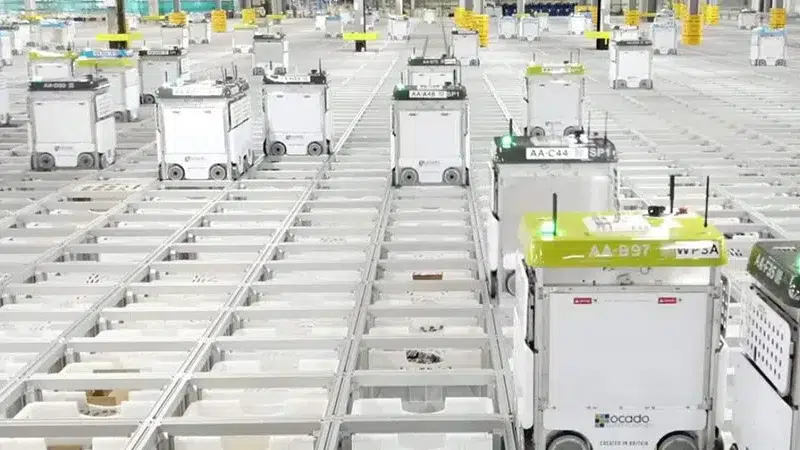
The facility will run on Ocado's Re technology stack, including its 600 Series robots, On-Grid Robotic Pick arms, and a fully automated freezer, the same architecture Ocado has spent years refining through its own retail business before spinning it out as a standalone technology offering to other grocers. Ocado's chief executive, Tim Steiner, tied this deal directly to the company's recent partnership with Asda, framing both as evidence of a broader pickup in demand for Ocado's fulfillment technology specifically, separate from Ocado's own retail operations.
That framing matters because it marks a real shift in what Ocado is: a company that started as an online grocer is now explicitly selling itself as the infrastructure layer underneath other grocers' online operations, competing less with the retailers buying its technology and more with in-house automation efforts and other robotics vendors. For a grocery CTO, that reframes the Ocado relationship from a potential future retail competitor to a potential infrastructure supplier, which is a materially different risk and partnership calculus than the one grocers were making about Ocado five years ago.
The build-versus-buy math at warehouse scale
Grocery automation at this scale has historically been a build decision for the largest players, Amazon and Walmart chief among them, and a buy decision through vendors like Ocado, Symbotic, or AutoStore for everyone else. This deal reinforces that a fast-growing, high-volume online grocer with enough scale to fill a facility to half its design capacity from launch is still choosing to buy the fulfillment technology rather than build it internally, even with years of lead time to plan a custom build.
That is a meaningful data point for any retailer assuming that scale alone eventually justifies an in-house automation program. The company behind this deal clearly has the online volume to justify serious capital investment in fulfillment, and it still chose a vendor relationship over building its own robotics stack from scratch. The honest read for most grocery CTOs weighing the same decision is that the build case only clears the bar at a scale most retailers, even large ones, have not actually reached, and the vendor route remains the economically rational default well past the point many assume it stops being one.
What this means for the supply chain roadmap
The practical takeaway is to separate two questions that this story tends to collapse into one: who the mystery retailer is, which is mostly trivia, and what their decision reveals about the economics of grocery automation, which is the part worth acting on. A three-year lead time between contract and go-live means any retailer seriously considering a similar facility needs to be modeling its 2028 or 2029 fulfillment capacity needs today, not when current capacity constraints start showing up in delivery slot availability.
It is also worth noting what this deal implies about Ocado's own trajectory: a technology vendor that can sign large, multi-year infrastructure deals with retailers that compete directly with each other is building a position closer to a utility than a retailer, and utilities tend to accumulate pricing power over time as switching costs rise. Grocers evaluating Ocado or any comparable fulfillment technology vendor should negotiate the long-term economics now, while the market still has more than one credible vendor to choose from, rather than after lock-in sets in.