Microsoft Puts Its Own Model Inside Copilot
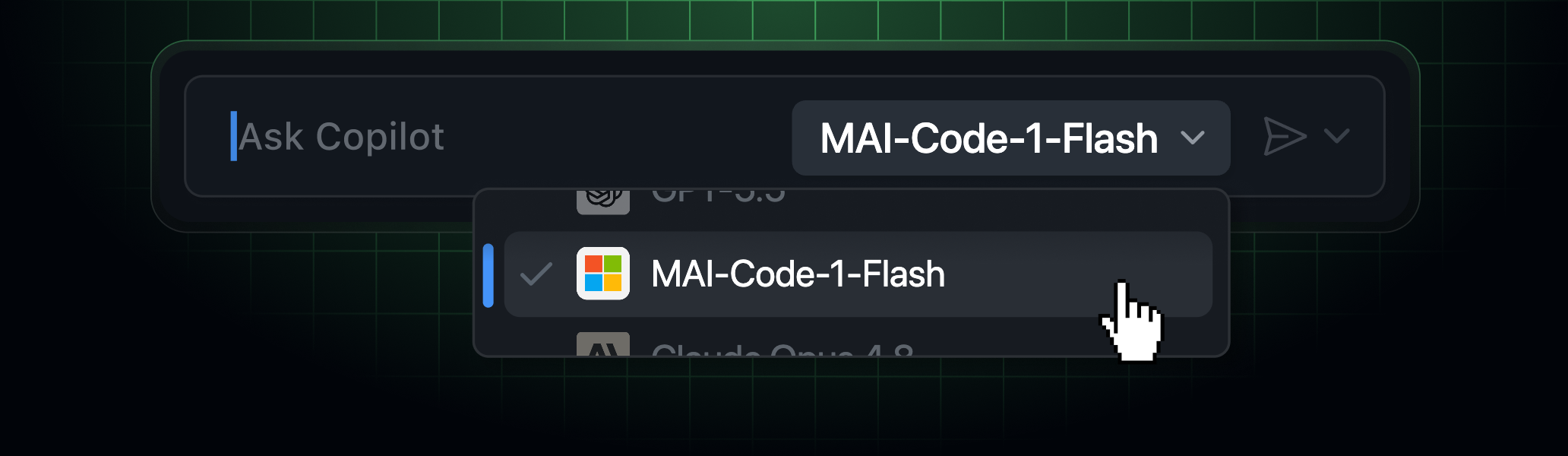
Microsoft has made MAI-Code-1-Flash generally available for GitHub Copilot Business and Copilot Enterprise, the company announced on June 26. The model is Microsoft AI's own in-house coding model, purpose-built for code and optimized specifically for Copilot. For an organization that built Copilot's early success on a partnership with OpenAI, shipping a first-party coding model into the product's paid enterprise tiers is a strategically loaded move. It is the clearest signal yet that Microsoft intends to control more of the model layer underneath its flagship developer product rather than depend entirely on external providers.
The Flash naming convention telegraphs the model's positioning. This is not a frontier model competing on raw reasoning power. It is a speed-optimized model designed for fast, low-latency responses suited to high-volume, iterative agentic coding workflows where speed and efficiency matter most. That is a deliberate and increasingly common product choice: as agentic coding generates many rapid model calls in a tight loop, latency and cost per call start to matter more than peak intelligence on any single response. A fast, cheap, capable-enough model can outperform a slower, smarter one in that setting.
Built for the Agentic Loop
The emphasis on high-volume, iterative agentic workflows reflects how AI coding has actually evolved. The early Copilot experience was a single developer accepting inline suggestions one at a time. The agentic experience is fundamentally different: an agent makes a rapid sequence of model calls as it reads code, plans changes, edits files, runs checks and iterates. In that loop, a model that responds in a fraction of the time, even if marginally less capable on any individual call, can dramatically improve the overall experience and economics. The cumulative latency of many slow calls is what makes an agent feel sluggish.
This is why a purpose-built coding model optimized for speed is more than a cost-saving exercise. It is tuned for the specific shape of agentic work, where throughput and responsiveness compound across hundreds of interactions in a session. Microsoft positioning MAI-Code-1-Flash precisely for this use case suggests the company has studied how its enterprise customers actually run Copilot at scale and built a model to match the dominant pattern. The model does not need to win benchmarks. It needs to keep an agent moving quickly through real coding tasks, which is a different and arguably harder optimization target.
Administrative Control by Design
The rollout includes a meaningful governance detail: administrators must enable the MAI-Code-1-Flash policy in Copilot settings before users can access it. That gate is deliberate and reflects how enterprise AI features need to be delivered. Rather than automatically switching every developer to a new model, Microsoft puts the decision in the hands of administrators who can evaluate the model, decide whether it fits their needs, and control its rollout. For organizations with strict requirements around which models touch their code, that administrative control is not a nicety. It is a prerequisite for adoption.
The model is billed at provider list pricing under usage-based billing, which fits the broader industry shift toward consumption-based pricing for AI features. That pricing model has real implications for engineering budgets, because costs scale directly with usage, and agentic workflows can generate a lot of usage. A fast, efficient model like MAI-Code-1-Flash is attractive partly because its lower cost per call helps keep those consumption-based bills manageable. As organizations grapple with the token-rationing pressures that have emerged across enterprise AI, having an efficient first-party option for high-volume coding work is a genuine advantage.
The First-Party Model Strategy
MAI-Code-1-Flash represents Microsoft AI's continued push to use its own first-party models inside Copilot rather than relying solely on third-party models. This is one of the most consequential strategic threads in enterprise AI right now. Microsoft built Copilot's reputation substantially on OpenAI's models, but it has been steadily developing its own model capabilities under the Microsoft AI banner. Shipping a first-party coding model into Copilot's enterprise tiers reduces dependence on any single external provider and gives Microsoft more control over cost, performance and the product roadmap.
The diversification logic is sound. Relying entirely on one external model provider concentrates strategic risk: pricing leverage sits with the provider, the roadmap is partly outside your control, and any disruption to that relationship threatens your flagship product. By building and deploying its own models, Microsoft hedges that risk and captures more of the value its product generates. The move also fits a wider 2026 pattern in which the largest technology companies are bringing more of the AI stack in-house, from custom inference chips to purpose-built models, rather than renting every layer from someone else.
What Engineering Leaders Should Weigh
For engineering leaders whose organizations use Copilot Business or Enterprise, MAI-Code-1-Flash is worth a deliberate evaluation rather than an automatic embrace. The right questions are practical: does its speed and cost profile suit your team's agentic workflows, how does its code quality compare to the other models available in Copilot, and where does it make sense to route work to a fast model versus a more capable one. The administrative policy gate gives you control over that rollout, so you can pilot the model with a subset of teams before deciding whether to enable it broadly.
The strategic context matters too. The availability of multiple models within Copilot, including first-party options from Microsoft and third-party models, gives organizations meaningful flexibility to match the model to the task. The smart approach is not to standardize on one model for everything but to route different kinds of work to different models based on their speed, cost and capability. A fast model like MAI-Code-1-Flash for high-volume iterative work, a more capable model for complex reasoning tasks. As the model layer underneath Copilot grows richer, the teams that benefit most will be the ones who treat model selection as an active engineering decision rather than a vendor default.
A Glimpse of Where Coding Models Are Headed
The arrival of a speed-optimized, purpose-built coding model from a major provider is a useful marker of where the AI coding market is maturing. The first phase was about proving that AI could write useful code at all. The current phase is about optimization: building models tuned for specific workflows, balancing speed against capability, and managing the cost of running AI at scale across thousands of developers. MAI-Code-1-Flash is squarely a product of this second phase, designed not to dazzle but to keep agentic coding fast and affordable.
We expect more models like this, specialized by task and optimized for the particular demands of agentic, high-volume work rather than chasing general capability. The trend toward purpose-built and efficiency-optimized models is good for enterprise buyers, because it gives them options that fit their actual usage patterns and budgets rather than forcing every workload onto a single expensive frontier model. For Microsoft, owning a model purpose-built for the dominant Copilot workflow is both a margin play and a control play. For its customers, the immediate question is simpler: try it, measure it, and route work to it where the speed and cost make sense.