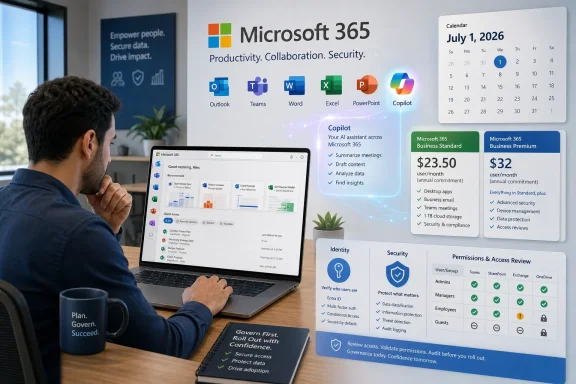
What Changed on July 1
Microsoft has made two new SKUs permanent for small and midsize businesses: Microsoft 365 Business Standard with Copilot at 23.50 dollars per user per month, and Business Premium with Copilot at 32 dollars per user per month, both on annual billing for organizations of one to 300 seats. What had been promotional or transitional pricing is now a fixed part of the catalog, and the message to the market is that AI is no longer an experiment bolted onto the productivity suite but a standard ingredient of it.
The change looks modest on a price sheet and enormous in its implications. By collapsing the base plan and the Copilot add-on into a single bundled tier, Microsoft narrows the gap between the AI enabled product and the plain one, and it does so at the exact segment of the market that has been slowest to adopt: the small business that lacks a dedicated software evaluation team. For millions of companies, the calculus of whether to buy AI just changed from an active decision into a default that arrives with the next renewal.
The End of the Add On
Until now, Copilot for small businesses lived as a separate line item, most recently priced around 21 dollars per user per month layered on top of a qualifying Microsoft 365 plan. That structure forced a distinct purchasing decision. A business owner had to look at the base subscription they already paid for, weigh an additional and roughly proportional charge for AI, and consciously choose to spend it. Every add-on is a checkpoint, and every checkpoint is a chance to say no.
Bundling erases the checkpoint. When Copilot is simply part of Business Standard, there is no separate box to tick and no incremental invoice to defend to a skeptical partner or accountant. As the reporting around the change put it, folding AI into standard tiers reduces the moment of hesitation that came with buying Copilot on its own. Microsoft has learned the oldest lesson in packaged software: the surest way to drive adoption of a feature is to stop asking customers to decide about it, and start including it.
Why Bundling Beats Persuasion
For two years the industry's central AI question has been about return on investment, with buyers demanding proof that a Copilot seat pays for itself before they commit. Bundling sidesteps that debate rather than winning it. When AI is part of the plan a company already needs for email, documents and security, the marginal cost of the intelligence approaches zero in the buyer's mind, and the burden of proof quietly disappears. The feature no longer has to justify a separate price, because it no longer carries one.
This is a defter strategy than discounting. A price cut invites customers to wait for the next cut; a bundle changes the unit of decision entirely. It also reshapes the sales motion for Microsoft's partners, who now spend less energy persuading customers to add AI and more energy guiding upgrades within a familiar tier structure. Renewals become the moment of adoption, and the conversation shifts from whether to buy Copilot to which plan to standardize on. That is a far easier conversation, and a far stickier outcome.
The Pressure This Puts on Every Other Vendor
The competitive consequence lands on independent software vendors. Once tens of millions of small businesses receive capable AI assistance as part of a subscription they already hold, every standalone AI tool must clear a higher bar to justify its own line item. The bundled Copilot becomes the price anchor against which buyers measure everything else, and any vendor charging separately for generative features now has to prove margin positive outcomes rather than mere novelty. Good enough and already paid for is a formidable competitor.
That does not spell doom for specialists, but it does narrow their room. The vendors that survive will be the ones offering depth Microsoft's horizontal assistant cannot match: domain specific workflows, proprietary data, regulated verticals and integrations that a general purpose Copilot will not reach. The undifferentiated middle, the products whose main pitch was simply adding AI to a familiar task, is where the squeeze will be hardest. Bundling by a platform owner has always reshaped the software economy, and this round is no different.
What SME Buyers Should Weigh
For SME technology buyers, cheaper embedded AI is a genuine gift, but it is not free of obligations. Copilot reaching into a company's email, files and chat is only as safe as the permissions and data governance underneath it. An assistant that can summarize any document the user can open will faithfully surface whatever an overbroad share or a misconfigured site exposes. The businesses that benefit most will be the ones that treat this rollout as a prompt to tidy access controls, not as a reason to ignore them.
The second consideration is adoption. Bundling guarantees that AI arrives on every desk; it does not guarantee that anyone uses it well, and we have seen repeatedly that unused seats are the most expensive kind. The value in 23.50 dollars per user per month is realized only through training, clear use cases and light governance that steers employees toward productive patterns. SME leaders should budget attention, not just dollars, and decide deliberately which tier to standardize on rather than letting a default choose for them.
The Price of Everyday AI
Step back and this is a quiet but consequential moment in the commoditization of workplace AI. When the dominant productivity platform folds a frontier assistant into its standard small business plan, it sets an expectation that ripples across the market: AI is not a premium indulgence but a baseline feature, like spellcheck or a spam filter before it. The number that matters is not 23.50 dollars but the signal it sends, that intelligent assistance is now part of the cost of doing business rather than an upgrade to be earned.
For business technology executives, the strategic response is to stop asking whether to adopt AI and start asking how to govern and exploit the AI they will now receive by default. The competitive edge no longer comes from having the tools, because soon nearly everyone will. It comes from the discipline around them: clean data, sensible permissions, trained people and a clear view of which workflows genuinely improve. Microsoft has set the price floor for everyday AI. What each company builds on top of that floor is now the only thing that differentiates it.


