The data ownership argument that separates this from Instacart
Cooklist founder Daniel Vitiello framed the company's competitive positioning in explicitly ownership-focused terms: retailers own all their data with Cooklist, and have complete control of how everything works, a direct contrast against third-party grocery platforms like Instacart, where the platform itself, not the grocer, accumulates the customer shopping behavior data generated through the service. For grocers increasingly aware that customer purchase behavior data is itself a strategic asset, that distinction is a substantive competitive differentiator rather than a marketing detail.
That data ownership pitch matters more in grocery than in most other retail categories, given how much grocers already depend on loyalty program and purchase history data to run their own margin-critical activities: private label development, promotional targeting, and increasingly, retail media advertising sold back to CPG brands. A third-party platform that intermediates the AI shopping relationship and retains the resulting behavioral data would, over time, erode a grocer's ability to monetize that data independently.
How the conversational cart-builder actually works
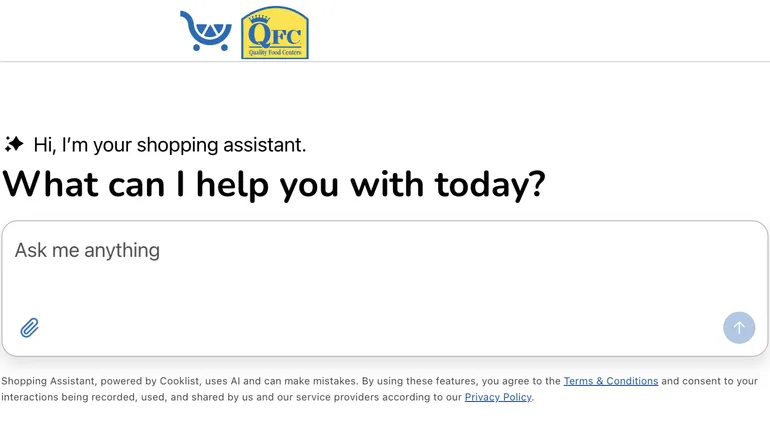
The mechanics are straightforward: customers describe what they need in conversational language rather than typing discrete search terms, and Cooklist's AI automatically builds a shopping cart from that description, inferring specific products from the broader context the customer provides. The company's own usage data shows customers average roughly 50 characters of context per chat interaction, five times the roughly 10 characters typical of a traditional search query, giving the underlying AI meaningfully richer signal about actual intent than keyword search has ever captured.
That character-count gap is a useful proxy for why conversational commerce interfaces are proving effective in grocery specifically. A shopper who types cheap dinner ideas for four people this week for under 30 dollars is giving the system constraint information, budget, serving size, timeframe, that a traditional search box structurally cannot capture in a single query, and Cooklist's cart-building logic is built to parse exactly that kind of compound intent.
The scale and the store-versus-online split
Cooklist's technology now runs across more than 700 U.S. grocery stores, anchored by Wegmans and Kroger as primary launch partners, with Kroger's deployment spanning multiple regional banners including Fred Meyer, Ralphs, Baker's, Dillons, QFC, and Smith's. The company has roughly 700 additional stores planned across ten more regional and national chains, a expansion pipeline that would roughly double the platform's current footprint if it executes on schedule.
One of the more counterintuitive findings from current usage is that approximately half of assistant users complete their actual purchase in a physical store rather than online, despite starting their shopping journey through a conversational digital interface. That pattern argues against treating conversational AI shopping purely as an ecommerce feature, and suggests grocers should think about these assistants as a cross-channel discovery and planning tool that ultimately drives in-store visits nearly as often as online checkout.
A third of queries are not about shopping at all
Roughly one-third of all queries directed at Cooklist's assistant are customer support related rather than product discovery or cart building, a proportion large enough that grocers deploying this technology should budget for its customer service function as seriously as its shopping function. That support volume likely reflects how naturally a conversational interface invites the full range of customer questions a shopper might have, not just product search, once the interaction model shifts away from a narrow search box toward open conversation.
For grocers evaluating this technology, that support-query volume is a planning consideration worth factoring into deployment scope from the outset. An assistant architected purely around shopping cart construction, without adequate handling for the substantial share of genuinely support-oriented queries customers will direct at it regardless of the tool's intended purpose, risks producing a visibly incomplete customer experience once real usage volume arrives.
Integration speed as a competitive factor
Cooklist's integration timeline of approximately six weeks per retailer is fast relative to typical enterprise retail technology deployments, and that speed is likely a meaningful factor in how quickly the platform has expanded to its current 700-plus store footprint. A six-week integration timeline lowers the internal approval bar considerably for a grocery chain deciding whether to pilot the technology, since the organizational cost of a failed pilot stays contained if the technical commitment required to test it is genuinely that short.
For grocery and broader retail technology leaders evaluating conversational AI shopping assistants generally, Cooklist's growth trajectory offers a template worth studying: a fast, low-commitment integration path paired with an explicit data ownership pitch appears to be resonating with grocers wary of ceding customer relationship control to a third-party platform, a combination competing vendors in the space will likely need to match to compete for the same retailer pipeline.