Klaviyo Turns Two Agents Loose on the Same Data
On June 30, Klaviyo pushed its marketing agent Composer into public beta and shipped major upgrades to its Customer Agent, staking out a position in the increasingly crowded contest to automate the work of consumer brands. The two agents are built into Klaviyo's customer relationship platform and, crucially, run off the same real-time customer profile. That shared foundation is the company's core argument against a market full of standalone AI point tools. "Businesses aren't struggling because they lack AI tools, they're struggling because most AI can't act on the context that matters," said Jamie Domenici, Klaviyo's chief marketing officer, in a line that doubles as a swipe at every bolt-on chatbot competing for the same budget.
The scale behind the claim is real. Klaviyo says the agents draw on 14 years of accumulated context and patterns from nearly 200,000 brands, and the company counts more than 196,000 paying customers and over 350 integrations across its platform. That data gravity is Klaviyo's moat, and the agent launch is an attempt to convert it into automation that competitors without the underlying customer record cannot easily match. For a company that built its business on owning first-party consumer data for ecommerce brands, agents are the logical next act: the same data, now put to work by software that can decide and execute rather than merely report.
Composer Wants to Replace the Campaign Grind
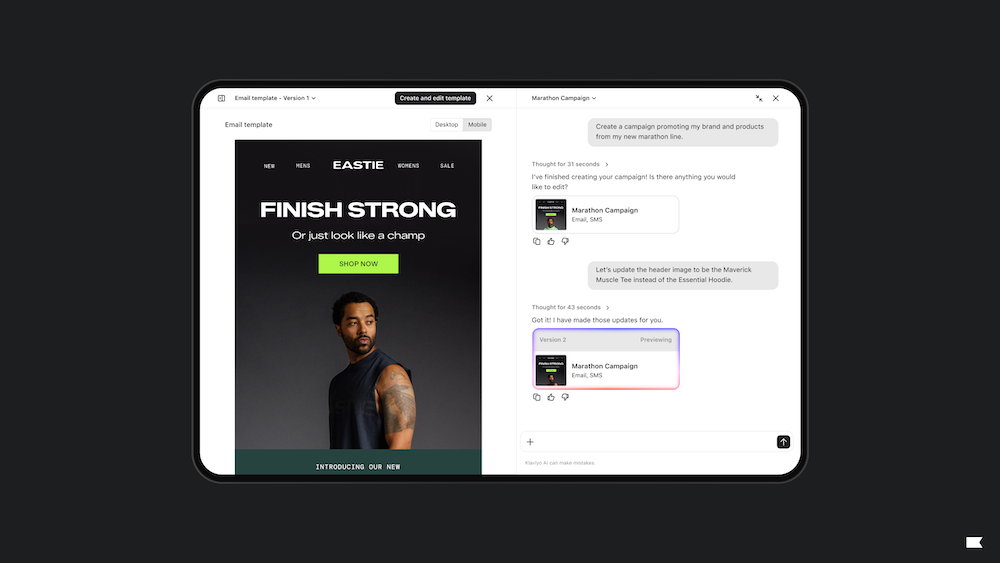
Composer targets the least glamorous and most time-consuming part of a marketer's job, the mechanical assembly of campaigns. Rather than starting from a blank canvas, a marketer describes the outcome they want in plain language, and Composer builds the audience, the copy, the channel mix, and the timing, grounded in the brand's own data and past performance, ready for review in minutes. The promise is to compress hours of setup into a short approval, and to do it without the marketer stitching together segments and flows by hand. It is automation aimed squarely at the operational overhead that keeps lean ecommerce teams from testing more ideas.
The agent also audits what is already running, which may be the more valuable feature. "Composer's Flow Audit tool surfaced collision issues across our 113-flow library," said Katherine Cabe, senior director of retention marketing at AS Beauty, one of the early testers alongside SPANX and Dermalogica. Anyone who has managed a sprawling library of automated flows knows how quickly they collide, overlap, and quietly cannibalize each other, and how rarely anyone has time to untangle them. An agent that continuously inspects that machinery for conflicts is doing work most teams simply never get to, and that unglamorous housekeeping may prove stickier than the headline campaign generation.
The Customer Agent That Acts Instead of Explains
The Customer Agent handles the other side of the relationship, service, and Klaviyo's pitch is that it acts rather than explains. Because it sits on the same customer record, it already knows a shopper's order history, loyalty status, and purchase behavior when a conversation starts, and it comes with pre-built skills for order tracking, returns, recommendations, and loyalty. Instead of describing a return policy, it processes the return; instead of explaining loyalty points, it applies them. It operates across web chat, email, SMS, and WhatsApp, and supports multiple languages, so brands are meant to be live from day one rather than after a long training project.
The distinction between explaining and doing is where most service chatbots have failed, and it is where the shared data model earns its keep. A support agent that can only answer questions offloads the easy tickets and escalates everything real; one that can complete an action inside the same conversation actually removes work. Klaviyo is betting that grounding the service agent in the full commerce record, rather than a separate helpdesk silo, is what makes autonomous resolution safe enough to trust. That is a meaningful claim, and it is the kind that will be judged in production by resolution rates and error rates rather than in a demo.
The Flywheel Is the Whole Pitch
The strategic heart of the announcement is not either agent alone but the loop between them. Both work off the same profile, and every action one takes enriches the data the other uses. When the Customer Agent resolves a conversation, it writes preferences, product interests, and intent signals back to the customer record, and Composer then uses that to build smarter campaigns. When Composer launches a campaign, the resulting engagement informs how the Customer Agent personalizes the next interaction. Klaviyo describes this as a flywheel, and the word is apt: marketing and service stop being separate functions and start compounding each other's intelligence.
"The next era of consumer experiences will be defined by companies that can combine AI with deep customer understanding to move faster, personalize better, and turn customer insights into growth," Domenici said, and the flywheel is the concrete expression of that thesis. We think it is also Klaviyo's strongest defense against disaggregation. A brand could assemble a marketing agent from one vendor and a service agent from another, but it cannot easily recreate the shared, real-time customer record that makes the two reinforce each other. That integration is the argument for consolidating on a platform rather than buying best-of-breed agents that never learn from one another.
What It Means for Consumer Brands
For consumer brands, the Klaviyo launch sharpens a decision that is coming for everyone: whether to standardize on a platform that owns the customer record or to stitch together specialized agents around it. The case for consolidation is the flywheel, the shared context, and the promise of agents that are live from day one. The case against it is concentration risk and the discomfort of handing more of the customer relationship, and more autonomous action, to a single vendor. Neither answer is obviously right, but the launch makes clear that the platforms holding first-party data intend to use agents to deepen their grip on it.
The prudent posture is to pilot the agents on bounded, measurable tasks and watch the numbers before ceding real autonomy. Composer's flow auditing and the Customer Agent's handling of routine returns and order questions are exactly the kind of contained, high-volume work where an error is cheap and a win is easy to quantify. Public beta means these agents are ready to be tested, not blindly trusted, and the brands that benefit will be the ones that instrument them tightly. Klaviyo has made a coherent bet that data plus agents beats standalone AI. For its customers, the question is how much of the customer relationship they are comfortable letting that bet automate.

-3.png)