Eric Berger at Ars Technica reported Tuesday that Impulse Space has closed a $500 million Series D, pushing the Redondo Beach company's lifetime funding above $1 billion only five years after Tom Mueller founded it. Mueller, the original lead propulsion engineer at SpaceX whose Merlin and Draco work made Falcon and Dragon possible, has built Impulse around two product lines: the small Mira spacecraft and the newly announced Helios kick stage. The capital will support hiring against 200 open positions on top of an existing 500 person headcount, and accelerate vehicle and service development. The round arrives at the moment in space mobility moved from PowerPoint to a defensible commercial category.
Mira's three flights make the propulsion credible
Three Mira missions have flown since the first launch in 2023, all using a propulsion system that runs on nitrous oxide and ethane. The non toxic propellant combination simplifies ground handling compared with hydrazine and reduces the regulatory overhead at integration facilities. For commercial smallsat operators that have been priced out of dedicated launches and stuck on rideshare drop off orbits, Mira offers a way to actually reach the orbit a payload was designed for. That capability sounds mundane until you ask how many commercial smallsats over the last five years failed to meet mission objectives because they ended up in the wrong inclination or altitude. Flight heritage on a novel propellant chemistry is also why Mueller can raise this much capital this quickly: investors are pricing demonstrated hardware, not slideware.
Helios rewrites the geostationary delivery math
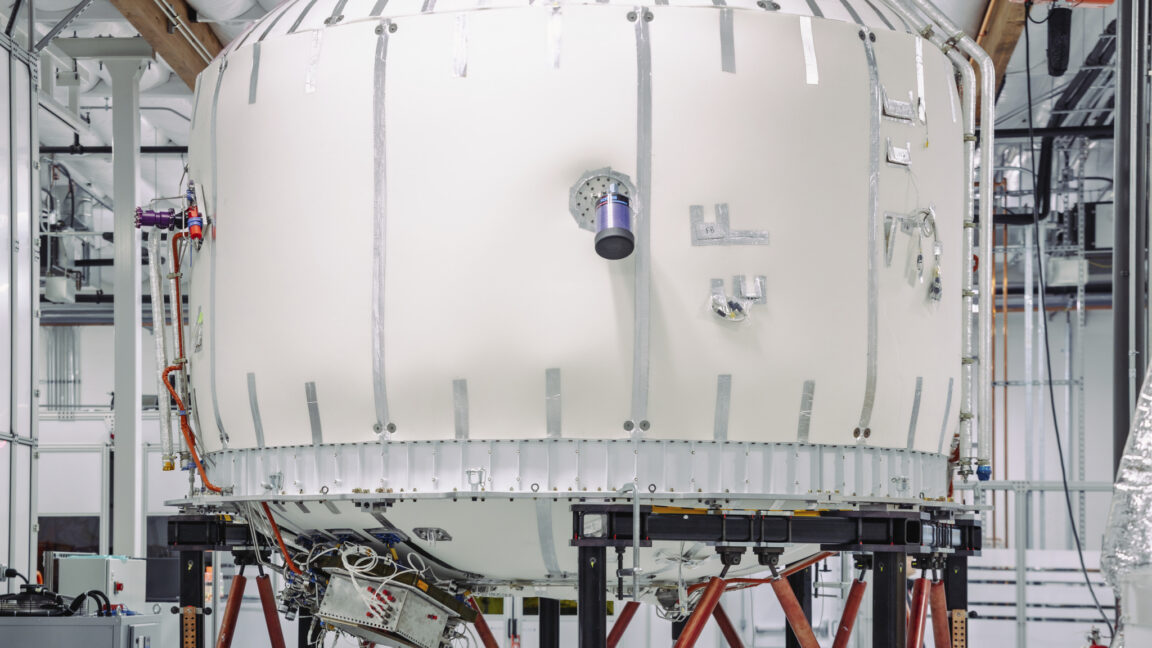
Helios is the more interesting product, because it changes the economics of geostationary delivery. The kick stage flies on top of a two stage Falcon 9 and pushes payloads directly to geostationary orbit, eliminating the months of slow electric propulsion spiraling that today's commercial geostationary satellites use to climb from transfer orbit. The debut mission, branded Caravan, is scheduled for next year and is fully booked. The next available slot has already slipped to 2028. That backlog tells us two things. Commercial demand for direct to geostationary delivery is real and willing to pay a premium for time on orbit. And Impulse is now supply constrained, which is the position every space hardware company wants to occupy. Backlog discipline also gives Mueller's team pricing power on the second and third Helios manifests, which is where unit economics for a kick stage business actually compound.
The lunar payload curve bends by a factor of ten
The long term thesis lives on the Moon. Impulse is developing its own lander, which would ride atop Helios on a Falcon 9. President and COO Eric Romo told Berger that the combined stack could deliver one to two tons to the lunar surface, against the 100 to 200 kilograms that Firefly's Blue Ghost class landers carry today. "You're not quite 10x-ing a reduction in the cost of mass to the Moon, but it's in that ballpark, and that's where we think the sweet spot is," Romo said. The target customer is Phase 2 of NASA's Moon Base plan, which begins delivering larger rovers and habitation infrastructure starting in 2029. That timing aligns with Impulse's stated development cadence, and it lines up with when NASA will be writing real procurement checks for cargo class lunar delivery.
Space Force is the unspoken anchor customer
The market context matters more than the funding number. The US Space Force has become increasingly explicit about wanting commercial satellite mobility, driven by Russian and Chinese spacecraft maneuvering near US assets in geostationary orbit. That demand is not yet visible on Impulse's public manifest, but it is the anchor customer pattern that justifies a $500 million round at this stage of company life. Sovereign defense demand also explains why the propellant choice matters: nitrous oxide and ethane infrastructure is dual use friendly and may shape where ground support facilities cluster around west coast launch corridors and Cape Canaveral integration bays over the next 24 months.
Where we would place the bet
For our customer base, the operator angle is narrower than for terrestrial robotics or autonomy stories, but it is sharper for anyone running a sovereign or defense adjacent practice. First, the rise of contracted orbital mobility means satellite procurement specifications can now assume in orbit relocation as a service. We would rewrite the resilience and end of life sections of any constellation RFP we are advising on this quarter to include a maneuvering services line item, priced at roughly $5 to $15 million per relocation based on current Mira contract chatter. Second, the lunar payload curve. A ten times improvement in delivered mass per Falcon 9 changes what kinds of payloads, including communications relays, ISRU hardware, and eventually data center components, become commercially viable for a 2029 to 2031 window. We would start scoping lunar surface deployment in any client's five year space roadmap rather than treating it as a 2035 problem. Third, vendor selection. For clients evaluating in space transportation partners before the end of this fiscal year, we would shortlist Impulse alongside Rocket Lab's in space division and Astranis, with the bet placed on whichever team has flown Helios class hardware by Q4 2026.
The 2029 milestone that will settle the thesis
The risk is execution. Impulse has flown three Mira missions but has not yet flown Helios, has not yet built its lander, and is dependent on Falcon 9 availability at the moment SpaceX is pivoting capacity toward Starship. A Helios slip into late 2027 would not be fatal, but it would compress the lunar timeline against NASA Phase 2 milestones beginning in 2029 and let competitors close the lead. For now, the round buys Mueller's team enough runway to execute, and the propulsion side of the bet is credible on hardware alone. Watch the Caravan launch next year; that is when the thesis stops being a fundraising story and starts being a delivery story, and it is when our advisory recommendations on in space mobility procurement will harden from optional to baseline.