The numbers
Iceland, the UK frozen-food grocery chain, says retail losses and shrink fell 80 percent across part of its store estate after deploying an AI-based monitoring system built by vendor SAI. The reduction is concentrated in Iceland's worst-performing 100 stores, which the company says had been responsible for roughly a third of its total shrink figure before the rollout. Iceland had previously estimated theft costs the business about 20 million pounds a year, a number large enough to justify a dedicated vendor engagement rather than an internal fix.
An 80 percent reduction in a targeted cohort of underperforming stores is a materially different claim than an 80 percent reduction chain-wide, and the distinction matters for anyone trying to model the investment case. Iceland deliberately started where the problem was worst, which is a sound way to prove a technology's value quickly, but also means the headline figure should not be read as a guaranteed outcome for stores that were already performing closer to the chain average, where the easy wins driving most of that 80 percent simply are not available in the same volume.
What the system actually watches for
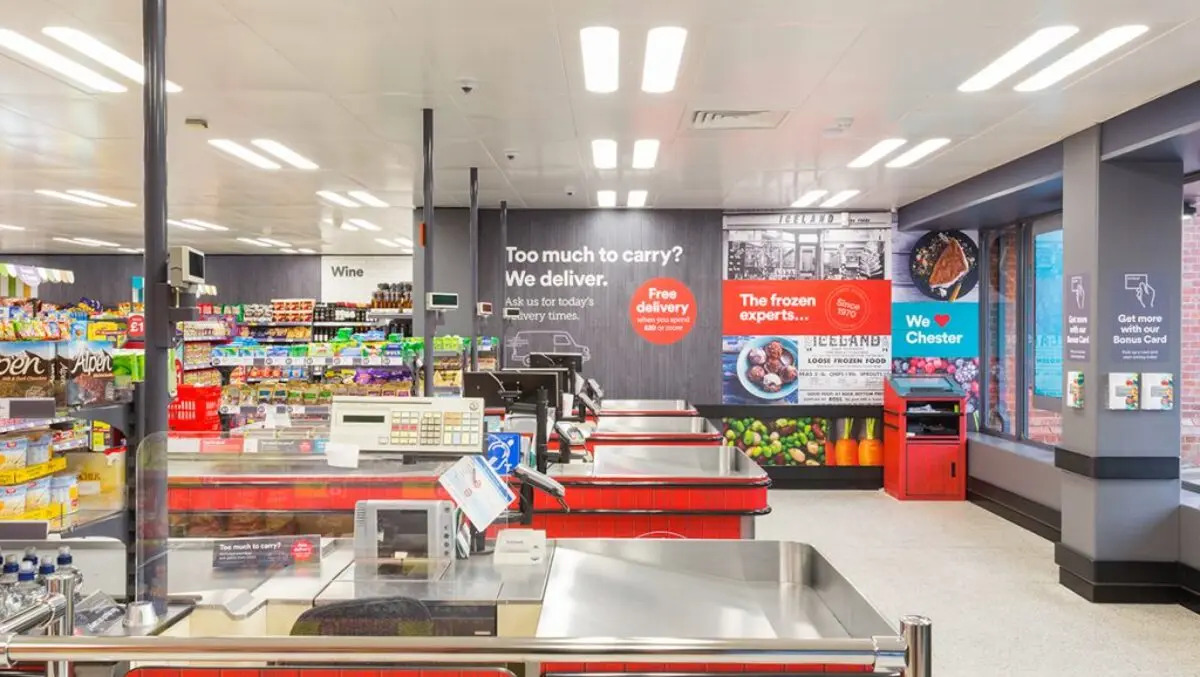
The SAI system works with Iceland's existing camera hardware rather than requiring new cameras, extending coverage to self-service checkouts, assisted checkouts, store aisles, and entrances. It is built to flag a specific set of behaviors: missed scans at self-checkout, partial payments, walkouts without payment, concealment of items, in-store consumption of products before purchase, and theft directly from shelves. That list covers both the checkout-adjacent theft that loss-prevention teams spend most of their attention on and the less-monitored shelf and aisle activity that often goes uncaptured by older rules-based systems.
Once the system flags and confirms suspicious activity, it sends an alert with accompanying images and footage directly to handheld devices carried by store staff. That routing choice, pushing confirmed incidents to a handheld rather than a back-office monitor, is a meaningful operational detail. It shortens the distance between detection and intervention from minutes spent walking to a security office to seconds spent glancing at a device already in an employee's hand, and it puts the supporting footage directly in front of the staff member who has to decide whether and how to act.
Solving the alert fatigue problem
Andy Edwards, Iceland's head of loss prevention and corporate audit, described the requirement that shaped the deployment: 'We needed a solution that could work alongside us, rather than behind us.' That framing points directly at the chronic failure mode of camera-based loss-prevention systems, which is alert volume so high that staff start ignoring notifications altogether. Iceland's results suggest the SAI system addressed that problem directly rather than just adding more detection on top of an already noisy system.
The specific numbers back that up. False alerts fell by 50 percent, and staff responded to 90 percent of confirmed crime alerts, a response rate that is close to unachievable with a high false-positive rate feeding the same handheld devices. Som Sinha, SAI's CEO and founder, put the company's framing this way: 'Iceland shares our belief that AI should make stores smarter, safer and easier to run.' The 90 percent response figure is the actual evidence for that claim, carrying far more weight than the sentiment behind it, because it shows staff still trusting the system enough to act on what it tells them.
Why reusing existing cameras was the right call
The decision to build on Iceland's existing camera infrastructure rather than specifying new hardware deserves more attention than it typically gets in loss-prevention vendor pitches. A hardware refresh across more than a hundred stores, let alone a full estate, means procurement cycles, installation scheduling, and store-level disruption that can stretch a rollout from months into years. Layering AI processing onto cameras already installed and already generating footage collapses that timeline substantially, which is likely why Iceland could stand up results in its worst 100 stores quickly enough to report them.
This is a build-versus-replace decision every retailer evaluating loss-prevention AI will face, and Iceland's case argues clearly for the lower-disruption path when the existing camera estate has adequate coverage and resolution. The tradeoff is that an AI overlay is bounded by what the underlying cameras can actually capture, so the approach works best as a retrofit for stores with reasonably modern camera systems already in place, rather than as a substitute for fixing genuinely inadequate physical coverage in stores where the cameras themselves are the actual bottleneck.
The decision for other grocers sizing a loss-prevention investment
For retail technology leaders sizing a similar investment, Iceland's numbers offer two separate things worth borrowing independently: evidence that an AI overlay on existing hardware can produce a real shrink reduction, and evidence that solving alert fatigue is at least as important as solving detection accuracy. A system that detects more theft but also generates more noise does not necessarily improve staff response, and Iceland's 90 percent response rate is only meaningful because the false-alert rate came down at the same time detection accuracy went up.
The honest caveat is that Iceland targeted its worst-performing stores first, so the 80 percent figure represents the easiest wins in the estate, not an average expected outcome across a full chain-wide rollout. Any retailer modeling a similar deployment should build a phased business case around that same logic, proving value in the highest-shrink locations before committing capital to a full rollout, rather than assuming the headline number scales linearly across stores that start from a very different baseline and a much smaller pool of avoidable losses to recover.