A consolidation wave with a specific trigger
IBM's acquisition of Confluent in March 2026, followed by IBM retiring its own competing Kafka products, is the anchor event reshaping the streaming data vendor landscape heading into the back half of the year. Confluent founder Jay Kreps stepping back from leadership in August 2026 adds a symbolic close to that transition: the company that built its identity around commercializing Kafka, the technology Kreps helped create at LinkedIn, is now fully absorbed into a much larger, more diversified enterprise software portfolio.
Beyond the IBM-Confluent deal, the report documents a broader wave of consolidation: CoreWeave absorbed Bufstream into its AI platform, Redis acquired Decodable, and WarpStream now operates under IBM ownership as well. A category this consolidated within a single year signals the streaming data market has moved past its independent-vendor growth phase into a period where scale and platform integration matter more than standalone technical differentiation.
Why the old deployment matrix stopped making sense
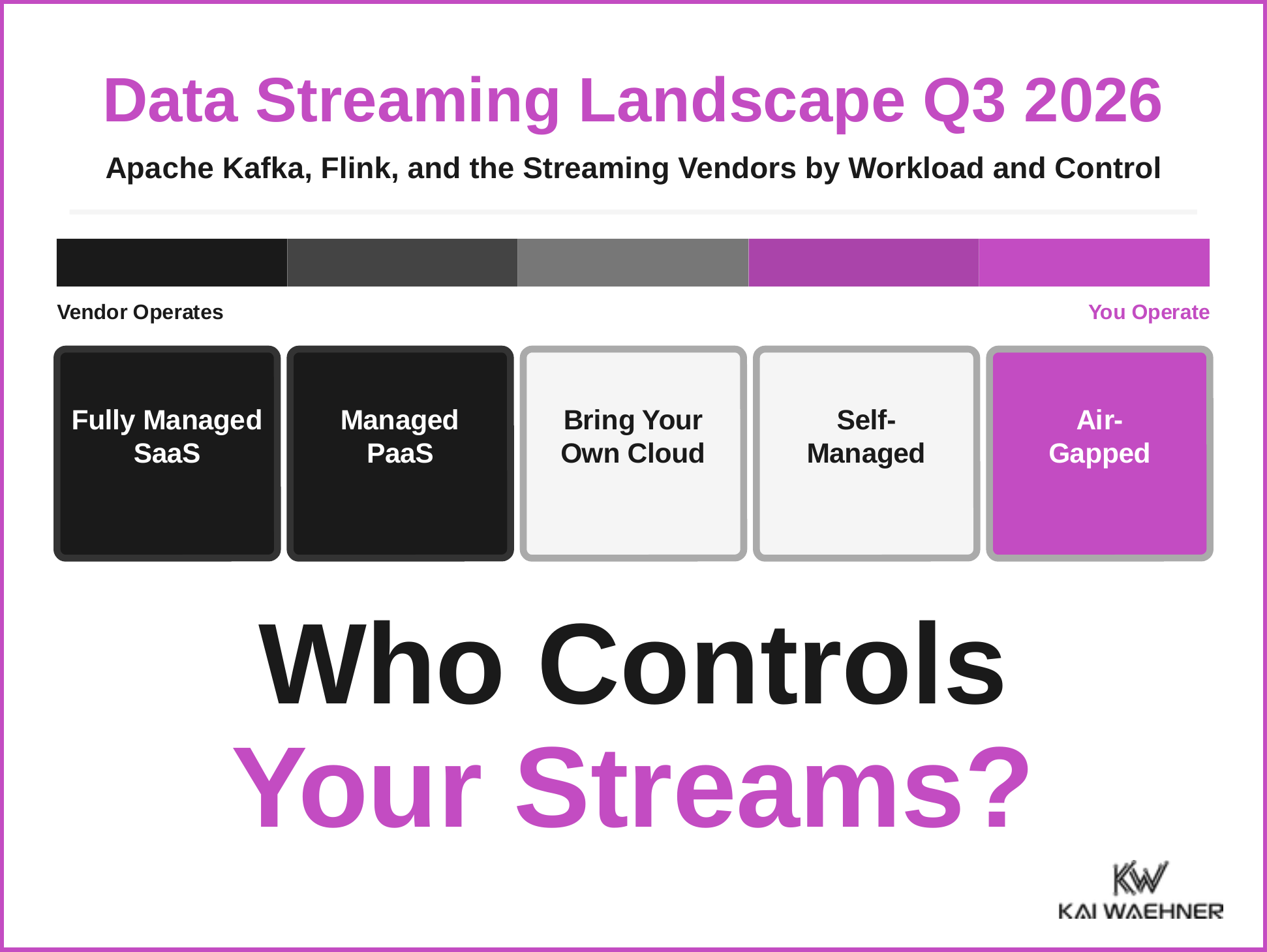
The report's authors made a structural change to how they map the vendor landscape, moving from a simple deployment-model matrix to a two-axis model plotting workload focus, operational versus analytical, against operating model, ranging from fully managed to air-gapped self-managed. That change reflects a real shift in the underlying market: the same underlying product increasingly ships across multiple deployment models simultaneously, making a single deployment-category label less useful for buyers trying to compare options.
The report states the reasoning directly: 'Sovereignty stopped being a footnote. It is now a structural dimension of the buying decision.' Self-managed and private deployment options are recovering market share specifically driven by jurisdiction and control requirements, not primarily by cost considerations, reversing what had been a multi-year trend toward fully managed cloud services as the default assumption for new streaming infrastructure deployments.
The incident that made sovereignty concrete
The report cites a specific, consequential event as the reason this shift moved from theoretical to urgent for enterprise buyers: in June 2026, the US government suspended foreign nationals' access to Anthropic's most capable AI models. The report's framing is blunt: 'A leading vendor was switched off by a government its customers had not chosen,' a description that reframes vendor dependency risk in terms enterprise infrastructure buyers had not previously had to weigh seriously for cloud-based AI and data services.
That single incident functions as a proof point for every enterprise data architect who has ever raised sovereignty concerns and been told the risk was theoretical. A government action cutting off access to a critical vendor's most capable service tier, regardless of the customer relationship or contract terms in place, is precisely the scenario sovereignty-focused deployment architectures are designed to guard against, and its occurrence has visibly accelerated enterprise interest in self-managed and jurisdiction-controlled alternatives.
Streaming and the lakehouse are merging at the boundary
A separate trend documented in the report: multiple vendors now offer direct conversion of Kafka streaming topics into lakehouse tables, including Confluent Tableflow, StreamNative Ursa, Snowflake Datastream, Databricks Zerobus and the open source Fluss project. That convergence collapses what had been a meaningful architectural boundary between real-time streaming infrastructure and the batch-oriented lakehouse storage layer, letting data flow from live streams into analytical storage without a separate, manually maintained ETL pipeline connecting the two.
For data engineering teams, that convergence reduces a specific category of architectural complexity that has historically required maintaining separate streaming and lakehouse systems with custom integration code bridging them. As more vendors ship this conversion capability natively, the practical effect is fewer moving parts and less custom glue code required to get streaming data into a form analytical tools and AI models can query directly.
Kafka the protocol outlives any single vendor
Despite the sharp vendor consolidation, Apache Kafka itself remains the de facto standard used by more than 150,000 organizations, and all four major hyperscalers, Amazon, Azure, Google and Oracle, now sell managed Kafka services alongside their own proprietary alternatives. That combination, vendor consolidation at the company level alongside protocol standardization at the technical level, is a pattern worth separating clearly: the specific companies selling Kafka infrastructure are consolidating rapidly, but the underlying protocol's dominance is, if anything, becoming more entrenched as hyperscalers standardize around it.
For enterprise buyers, that distinction matters directly for exit strategy planning. Protocol standardization on Kafka provides genuine switching flexibility between vendors offering Kafka-compatible services, but the report's own five-question selection framework explicitly flags that switching costs run deeper than protocol compatibility alone, including jurisdiction, economics at actual throughput and retention levels, and the practical operational capability required to self-operate if a chosen vendor relationship needs to end.
The five questions worth asking before the next vendor selection
The report's own framework for platform selection distills to five questions: how the workload classifies as operational versus analytical, what control requirements apply from regulatory or continuity needs, what jurisdiction governs both the vendor and its parent company, what the real object-storage economics look like at actual throughput and retention, and what the genuine exit strategy looks like beyond protocol compatibility alone.
For CIOs and data architects building or refreshing streaming infrastructure strategy heading into 2027, that five-question framework is a more durable planning tool than any single vendor comparison, precisely because it centers the sovereignty and control questions this consolidation wave has made unavoidable, rather than treating them as a secondary consideration behind raw performance and cost benchmarks alone.