Solving a scale problem spreadsheets were never built for
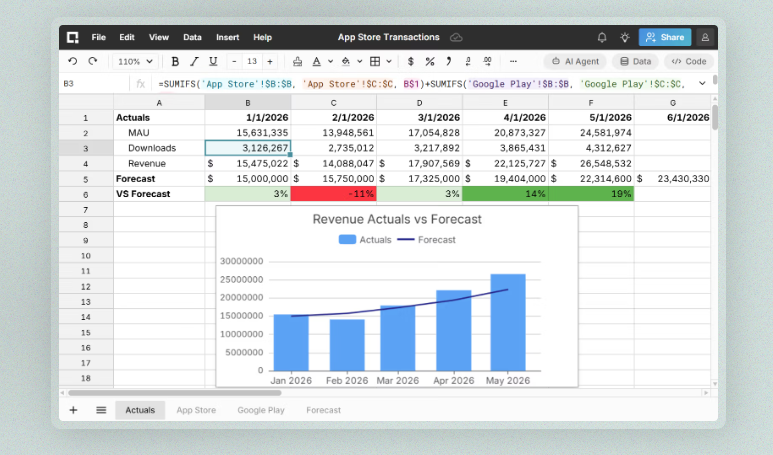
Row Zero built its product around a specific, well-understood pain point: Excel caps out at roughly 1 million rows and Google Sheets at 10 million, limits that force any analyst working with genuinely large datasets to drop into a database tool, a notebook, or a BI platform the moment their data outgrows spreadsheet software. Row Zero's answer was to rebuild the spreadsheet interface itself around a dataset ceiling of up to 1 billion rows, two to three orders of magnitude beyond what the incumbents support.
The mechanism behind that scale is straightforward but effective: each spreadsheet runs on its own dedicated Amazon EC2 instance rather than sharing compute in a multi-tenant backend, giving users the responsiveness of filtering, reorganizing and visualizing large datasets without the lag that typically accompanies spreadsheet tools stretched well past their intended scale. The product also includes native Python support and built-in AI capabilities, plus connectors directly into cloud data platforms including Databricks itself.
Why Databricks wants a spreadsheet interface at all
Databricks co-founder Patrick Wendell framed the rationale plainly: 'Incorporating a seamless spreadsheet experience is a must-have' as finance, operations and go-to-market teams adopt Genie, the company's AI assistant. That statement reflects a specific, well-documented adoption problem for AI data tools generally: business users outside core data engineering teams are far more comfortable working in a spreadsheet interface than in a notebook, a SQL editor, or a chat-based query tool, no matter how capable the underlying AI is.
By acquiring rather than building spreadsheet functionality from scratch, Databricks gets a mature, purpose-built interface layer immediately rather than spending engineering cycles replicating years of Row Zero's spreadsheet-specific optimization work. For a company competing directly with Snowflake and Microsoft Fabric for the same enterprise data platform budget, shipping a credible spreadsheet-native AI interface quickly matters more than building an equivalent capability with technical purity from the ground up.
The governance layer that makes this an enterprise play
Databricks plans to support the integrated spreadsheet experience with Genie Ontology, Unity Catalog and Unity Gateway, the company's existing tools for business term interpretation and governance compliance. That detail is what separates this from a simple feature bolt-on: rather than treating spreadsheets as an ungoverned escape hatch where data leaves the platform's compliance boundary, Databricks is positioning Row Zero's technology to operate inside the same governance perimeter as every other Genie interaction.
For enterprise data teams, that governance integration is the more consequential detail than the raw scale numbers. Spreadsheets have historically been where governed data goes to become ungoverned, copied into a local file, emailed around, and disconnected from lineage tracking the moment it leaves a managed platform. A spreadsheet interface that stays inside Unity Catalog's governance boundary addresses a genuine, long-standing data management gap rather than simply adding a new tool to the sprawl.
A capital-efficient outcome in a crowded space
Row Zero raised just 13 million dollars in outside funding prior to acquisition, from local venture funds and an unusually credible individual investor: Wes McKinney, the creator of the pandas library that underlies much of the modern Python data analysis ecosystem. McKinney's involvement as an investor, not just an advisor, signals a level of technical validation from someone with direct expertise in exactly the data manipulation problem Row Zero was solving.
That a company this capital-light reached an acquisition by a platform vendor as significant as Databricks, reportedly at its 190 billion dollar valuation scale, suggests the acquisition price reflected strategic fit and product maturity more than a bidding war driven by prior large funding rounds. It is a useful data point for founders building narrow, well-executed tools in adjacent categories: deep expertise in a specific technical problem can matter more to an eventual acquirer than total capital raised.
What standalone continuity signals
Databricks confirmed Row Zero will continue operating as a standalone product even as its technology gets integrated into Genie, a decision that preserves the existing customer base and revenue Row Zero built independently while Databricks works on the deeper platform integration in parallel. That dual-track approach, standalone product plus platform integration, is a common pattern for acquisitions where the acquirer wants to avoid disrupting an established customer relationship while the harder integration engineering work proceeds.
For Row Zero's existing customers, that continuity commitment matters directly: an acquisition that immediately sunset the standalone product would force an abrupt migration, while parallel operation gives existing users time to evaluate whether the Databricks-integrated version meets their needs before any transition becomes necessary.
What this signals about the AI data tooling market
Databricks describing itself as actively scouting for more startups to acquire, according to reporting around this deal, suggests Row Zero is one data point in a broader acquisition strategy rather than an isolated purchase. As the major data platform vendors, Databricks, Snowflake and Microsoft among them, race to build comprehensive AI-native interfaces spanning notebooks, chat, spreadsheets and BI dashboards, acquiring focused point solutions with proven product-market fit is emerging as the faster path compared to building each interface natively.
For enterprise data leaders, this consolidation trend is worth watching closely when evaluating point-solution vendors for procurement: a startup with strong technical execution and a narrow, well-solved problem is an increasingly plausible acquisition target for the major platforms, which has real implications for vendor lock-in risk, roadmap continuity and support commitments when building a multi-year data platform strategy around smaller, specialized tools.