The optimism at Groceryshop had a catch
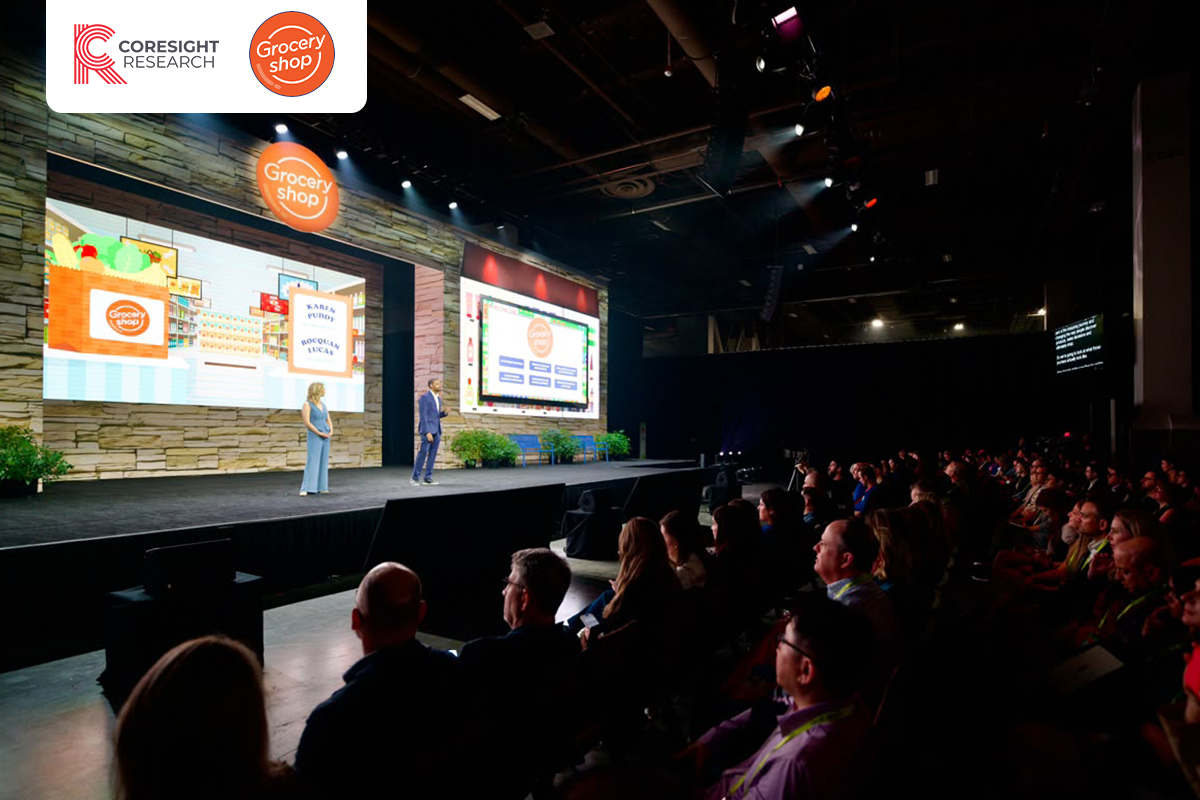
Groceryshop 2026 ran September 22 to 24 in Las Vegas, and the mood on stage was bullish bordering on evangelical. Instacart CEO Chris Rogers told the room that AI is going to transform grocery more than any other technology shift to date. FMI research presented at the event found more than two-thirds of food retailers now use AI in some form, up from 47% just a year earlier. That is a genuine inflection, not a rounding error, and it means most of this audience's grocery and CPG peers have already moved past the pilot stage and into some form of production deployment, whether that is demand forecasting, conversational search, or basket personalization.
The executives who have actually shipped agentic features, though, spent less time celebrating and more time confessing. Kroger's EVP and chief digital officer Yael Cosset laid out the tension directly on stage: investor and competitive pressure is pushing retailers to move fast on AI, but speed without governance is how organizations inject risk and inaccuracy into the investment itself. That caution is notable because Cosset runs one of the more AI-forward grocery operations in the country, with proprietary and third-party frontier models already embedded across forecasting and personalization, and is still telling an audience of peers to slow down on the parts of the stack that aren't ready.
The bottleneck is data, not models
The clearest articulation of the actual constraint came from PwC US global retail leader Kelly Pedersen, who described the core problem as garbage in, invisible out. The failure mode with agentic shopping is invisibility: when an AI agent can't parse a product's attributes, ingredients, or availability cleanly, it doesn't guess or approximate, it skips the product entirely. That reads to a retailer as lost demand with no error message attached, which makes the problem far harder to diagnose than a conventional site outage or a broken search index would be.
Coresight Research's coverage of the event underscored the same point from the consumer side: 83% of shoppers abandon carts due to uncertainty about specific items, a number that plausibly gets worse, not better, once an AI intermediary is making the first pass at product selection on the shopper's behalf. Schnuck Markets' own shopping assistant reportedly required extensive data preparation work on nutrition and promotional fields before it could ship at all, and that preparation work, more than the assistant's conversational interface, was the actual multi-month project the team delivered.
Consumers want help, not autonomy
Coresight's Groceryshop data adds a second constraint on top of the data problem: consumer trust has a hard ceiling that no amount of model improvement currently moves. 74% of consumers say they are willing to delegate tasks to an AI shopping agent, such as comparing prices or narrowing a category down to a shortlist. Only 9% will let that same agent complete a purchase without their direct involvement. That eight-to-one gap between assistance and autonomy should shape where retailers spend their next engineering quarter far more than any model benchmark will.
Rohlik Group's director of strategy and growth, Petr Lizner, offered the sharpest data point on why reliability beats novelty in this category: the European online grocer's 95% perfect order rate is what drives its 90 net promoter score, not any AI-powered feature layered on top. Instacart's own positioning reinforced the same lesson from the retailer side of the marketplace. Rogers noted that 100% of Instacart's volume still comes from physical stores, framing the company explicitly as a technology layer sitting on top of retailer inventory rather than a replacement for the retailer relationship.
The CPG side of the table is watching the same gap
It is worth noting that the data readiness problem sits on both sides of the retailer-supplier relationship, not just inside the retailer's own systems. CPG brands feeding product content into a retailer's catalog are frequently the source of the incomplete attributes that Pedersen described, since nutrition panels, ingredient lists, and promotional terms often arrive from suppliers in inconsistent formats that predate any AI initiative. A retailer can rebuild its own PIM infrastructure and still inherit bad inputs from a supplier that has not made the same investment.
That interdependency is part of why several vendors used Groceryshop to pitch shared infrastructure rather than retailer-only tools, on the logic that data quality is a supply chain problem, not a single company's technology debt. Whether retailers adopt shared data standards with CPG partners or fix their own catalogs unilaterally, the underlying diagnosis from this week's event is consistent: the constraint on agentic shopping sits upstream of the agent itself, in the product content pipeline most retailers treat as a merchandising afterthought.
What this means for the AI roadmap
For a CIO weighing where to put agentic commerce investment in 2027 planning, Groceryshop 2026 is a useful reality check against vendor pitch decks promising rapid autonomous deployment. The retailers presenting real, shipped results, Kroger, Instacart, Albert Heijn, and CVS among them, all led with data infrastructure and governance work that predates any customer-facing agent feature. None of them described full autonomy as the near-term goal. All of them described narrowing the gap between what the AI recommends and what the shelf, warehouse, and fulfillment system can actually deliver on time.
The practical implication is sequencing. Budget for a data quality and catalog remediation workstream before budgeting for the agent-facing feature itself, since an agent built on incomplete product data will underperform a well-tuned conventional search bar and erode trust faster than it builds it. Design the agent's authority level around the 9% autonomy ceiling consumers currently accept, not around what the underlying model is technically capable of doing unsupervised. Retailers that get this sequencing backwards will spend 2027 debugging what looks like a trust problem but is actually an unresolved data problem underneath it.