The number that crossed 7 trillion
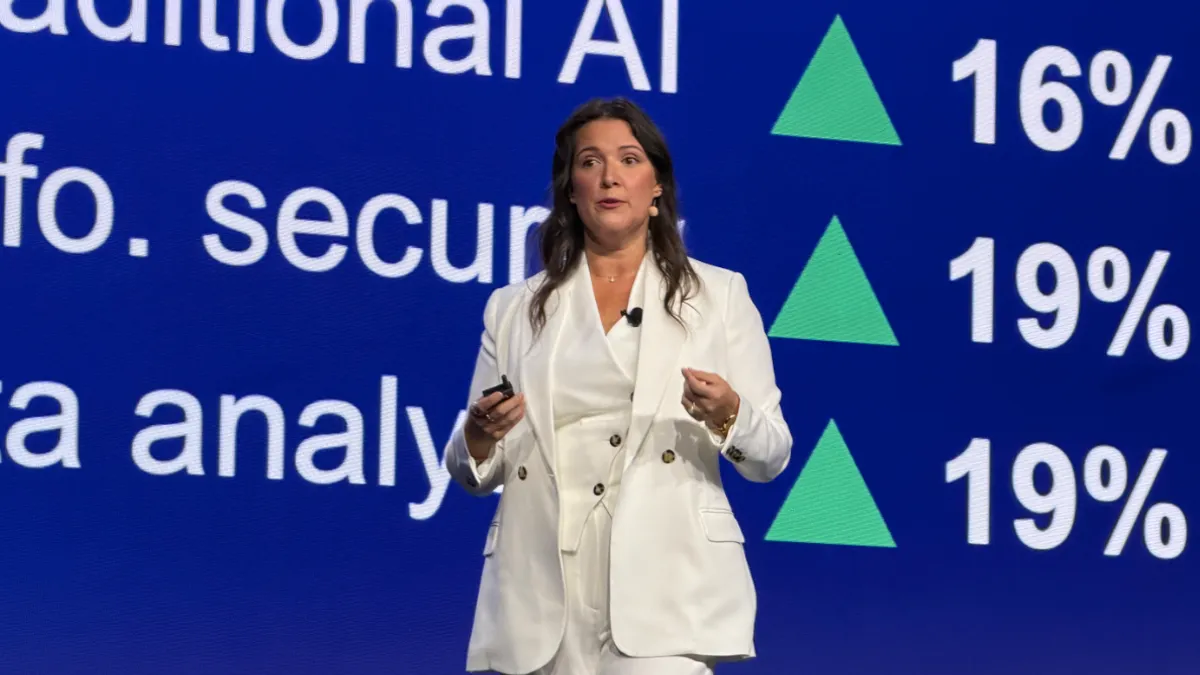
Gartner's latest forecast, presented at its IT Symposium/Xpo in Orlando, puts worldwide IT spending at 7.35 trillion dollars in 2027, a 15 percent jump from 2026 and the first time the market has cleared 7 trillion dollars. The firm frames the growth almost entirely around artificial intelligence: AI infrastructure and AI software are expected to drive the next trillion dollars of spending on their own, ahead of traditional categories like devices, communications services, or data center construction that used to anchor these annual forecasts. For enterprise buyers, that single data point reframes the entire planning conversation around AI rather than treating it as one line item among many.
That framing matters for how CIOs should read the headline number. A 15 percent jump sounds like a broad expansion across every category of technology spending, and in past years a number like this would have signaled general budget loosening across hardware, software, and services alike. Gartner's own commentary makes clear this cycle is different: it is a concentrated bet on AI buildout specifically, concentrated enough that we would treat the forecast as a signal about where the money is flowing rather than a general mandate to assume every procurement conversation just got easier.
Memflation arrives
The more immediate problem for CIOs is memory pricing. Gartner distinguished VP analyst John-David Lovelock says memory prices have more than doubled over the past year, driven primarily by data center demand pulling supply away from traditional device markets, and he has coined the term memflation to describe the surge. He expects it to persist through 2027 and likely into 2030, which makes this a multi-year planning problem rather than a single bad quarter CIOs can simply wait out.
Lovelock's warning to CIOs is blunt and worth quoting directly: as much as CIOs are worried about the cost of AI today, it is not going to be this low again. He also notes an odd wrinkle in the usual supply and demand logic: right now the market actually has more memory capacity than demand, a condition that would normally ease prices but has not. Everything with a memory chip or a computer chip in it, from PCs to phones to on-premises servers, is going up in price, and Lovelock is clear that there is no negotiating around it.
What this does to a 2027 budget
For a CIO building next year's plan, memflation turns a familiar cost line into something closer to an energy bill: volatile, largely outside your control, and capable of eating margin that was earmarked for new initiatives rather than infrastructure replacement. Hardware refresh cycles, laptop fleets, and on-premises AI infrastructure all carry memory-dependent pricing, and that pricing is now moving independently of whatever discount your account team negotiated last quarter or promised would hold through the next renewal cycle.
The practical response is to treat memory and compute pricing as a variable input in every AI business case, rather than the fixed assumption most multi-year models still bake in by default. Build a price-sensitivity range into any multi-year AI infrastructure commitment, and push procurement to lock in pricing or hedge exposure wherever contract terms allow. A business case that only survives at today's memory prices is a wager on prices holding steady, dressed up as a financial plan, and boards should be told the difference plainly before they approve it.
The governance predictions riding alongside the forecast
Gartner paired the spending number with a set of longer-range predictions from Gartner Fellow Daryl Plummer that point toward where accountability for AI is headed over the rest of the decade. By 2030, the firm expects 80 percent of Global 500 companies to formally designate their CIO as the evidence custodian responsible for proving AI accountability to boards, regulators, or courts when something goes wrong, which turns documentation and audit trails into a core CIO deliverable rather than a compliance afterthought handled by someone else.
Two nearer-term predictions reinforce the same direction and give CIOs a rough timeline to plan against. By 2029, Gartner expects 60 percent of organizations deploying AI to establish a function that maps AI's total cost to the value it actually delivers, and by 2028, 60 percent of Global 500 companies are expected to embed AI FinOps controls directly at the point of inference rather than reconciling costs after the fact. Together, these predictions describe accountability and cost discipline becoming formal job functions with named owners, budgets, and reporting lines, rather than ad hoc exercises assembled after an incident forces the question.
Reading the optimism against the friction
It is worth holding two things in mind at once here, because the forecast genuinely supports both. Gartner's headline number describes real, large-scale investment in AI infrastructure and software, the kind that will reshape vendor roadmaps and procurement priorities well into 2027 and beyond. At the same time, the input costs underneath that investment, chiefly memory and compute, are rising faster than most enterprise budget models were originally built to absorb, which means the forecast's optimism and its cost pressure are describing the same underlying boom from two different angles.
That tension is the real takeaway for enterprise technology leaders building next year's plan. The spending growth is best read as evidence that the inputs to AI projects, from memory to compute to the governance tooling Gartner expects boards to eventually require, are becoming more expensive at exactly the moment demand for them is accelerating fastest. A CIO who reads the 7.35 trillion dollar headline as a sign that funding just got easier has missed the half of the story that will actually show up in next year's hardware invoices.
The roadmap call for CIOs
Two things belong on every CIO's 2027 planning checklist after this forecast. First, model memory and compute pricing as a genuine variable in every AI infrastructure business case rather than a constant carried over from last year's template, and revisit any existing contract that quietly assumed today's pricing would hold for its full term. Second, start building the evidence trail Gartner says boards will eventually require, audit logs, cost-to-value mapping, and documented decision rights, well before the first regulator or activist board member asks for it as a compliance requirement rather than a competitive differentiator.
CIOs who treat memflation and the evidence custodian prediction as two sides of the same planning problem, cost discipline and accountability arriving together, will be better positioned than those who treat the 7.35 trillion dollar headline as simply good news for IT budgets. The money behind this forecast is real, the vendors chasing it are real, and the bill that comes with both the memory surge and the governance expectations attached to it is just as real. Planning for one without the other is planning for half the forecast.