A Series B with a strategic investor attached
Fleek, a London company building the plumbing of the global secondhand clothing trade, announced on July 8 that it raised 25 million dollars in Series B funding. Burda Principal Investments led the round, and the investor list carries a clear strategic signal. eBay joined alongside FJ Labs and H14, with existing backers Andreessen Horowitz, HV Capital, and Y Combinator returning. The round brings Fleek's total funding to 45 million dollars and will fund development of what the company calls an AI-native marketplace, expanded engineering, and growth of its global buyer and supplier network. Burda's history as an early Vinted backer adds weight to the thesis that used fashion is a durable, scalable category.
The eBay participation is the detail commerce leaders should notice. eBay has spent years rebuilding its business around resale and authentication, and its willingness to put capital into a wholesale marketplace tells us the incumbents see value upstream of the consumer app. Most attention in recommerce has gone to the shopper-facing platforms where people sell a single jacket. Fleek operates a layer below that, connecting the wholesalers and graders who move secondhand clothing in bulk to the boutiques and resellers who sell it on. An incumbent investing there is buying a window into the supply chain that feeds the resale market it competes in.
Fleek Sort and the grading bottleneck
The technology at the center of the round is Fleek Sort, a custom vision-language model trained on millions of secondhand marketplace transactions gathered across Fleek's network over the past four years. Secondhand inventory is uniquely hard to digitize, because every item is one of a kind, unlabeled by any standard catalog, and variable in condition. A grader has to identify the garment, judge its quality, categorize it, and price it, and that work has stayed stubbornly manual. Fleek Sort automates the identification, grading, and merchandising steps from photographs and video, and it keeps learning from the real transaction outcomes that follow each listing.
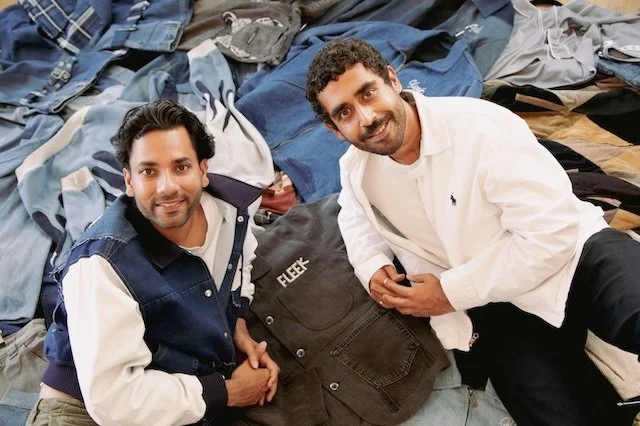
Chief executive Abhi Arora argues the underlying system is broken, saying most people have no idea what happens to a piece of clothing after they part with it. Chief technology officer Sanket Agarwal describes Fleek Sort as the world's first AI trained specifically to understand secondhand inventory. We take those claims with the usual caution, and the problem they target is real and expensive. Grading is the bottleneck that keeps used fashion slow, inconsistent, and hard to scale. An AI that reliably grades a garment from a photo compresses labor, standardizes quality, and makes cross-border trade in secondhand goods far more liquid than the manual process allows today.
A working marketplace under the AI
The model matters because it sits on top of a marketplace that already moves volume. Fleek connects more than 2,000 verified wholesale suppliers and graders with over 50,000 retailers, resellers, and boutiques across more than 100 countries. Its sorting hubs operate in Pakistan, India, and Dubai, the places where much of the world's used clothing is actually processed, with pilots launching in the United Kingdom, Europe, and the United States. That geography is telling. Fleek built its data advantage where the physical work happens, then trained a model on the transactions flowing through those hubs. The marketplace generates the data, and the data sharpens the marketplace.
This structure is the part worth studying for anyone building a vertical marketplace. Fleek runs both a marketplace and the AI grading tool on top of it, so every trade improves the model and every model improvement makes the marketplace more efficient. Founded in 2021 by Arora and Agarwal, the company has spent four years accumulating a transaction dataset that a new entrant cannot simply buy. That flywheel between marketplace liquidity and proprietary data is the real asset the Series B funds, and it explains why sophisticated investors treated a wholesale used-clothing platform as a technology bet worth backing at scale.
Why secondhand demands its own infrastructure
Secondhand fashion breaks the assumptions that mainstream retail systems are built on. Conventional commerce infrastructure expects SKUs, standardized catalogs, and repeatable inventory, and none of that exists when every item is unique and previously owned. A retailer that tries to run used goods through tools designed for new merchandise ends up drowning in manual work, because nothing about the garment matches a known product record. Fleek's wager is that recommerce needs purpose-built infrastructure, from grading models that read condition to a marketplace that speaks the language of wholesale lots. The category is large enough now to justify that dedicated stack.
The unit economics explain the urgency. Manual grading caps how fast a supplier can process bales of used clothing, and inconsistent grading erodes trust between buyers and sellers who never see the goods in person. Automating and standardizing that step lifts throughput and reduces the disputes that slow cross-border trade. For commerce leaders watching the resale boom, the lesson is that scale in secondhand comes from solving the operational problems behind the storefront. Fleek is betting that whoever owns the grading and matching layer captures the value as the category grows, and its investors are placing the same bet with real money.
The competitive and strategic context
Fleek is emerging as consolidation reshapes the resale market. eBay recently agreed to acquire Depop, Vinted continues to expand across Europe, and ThredUp has leaned harder on automation to make consignment pay. Most of these names compete for the consumer who wants to buy or sell a single item. Fleek occupies the wholesale tier that supplies many of them, which is a quieter position and a defensible one. By selling infrastructure and liquidity to the thousands of small resellers who populate the consumer platforms, Fleek can grow alongside the entire category as adoption spreads across regions.
eBay's investment reads as a hedge and a listening post. If wholesale recommerce infrastructure becomes essential, eBay wants a stake in the company building it, and it gains visibility into the supply that feeds resale demand. For other retailers and marketplaces, the signal is that the secondhand supply chain is professionalizing quickly, with AI as the tool that finally makes bulk used inventory tractable. We would watch whether Fleek's grading standard starts to function as a shared reference across the industry, because a trusted, machine-generated grade could become the common language that lets used clothing trade as smoothly as new goods.
What commerce leaders should take away
For retail and commerce leaders, Fleek is a case study in where AI creates durable value in a marketplace. The durable advantage comes from pairing a model with a proprietary transaction dataset and a marketplace that keeps refreshing it. A clever model alone diffuses as competitors catch up. A leader evaluating an AI investment should ask whether it compounds, whether each use makes the next one better, and whether the data behind it is hard for a rival to replicate. Fleek Sort scores well on all three, which is why the round attracted both financial and strategic capital and why eBay chose to join the cap table.
The broader takeaway is that recommerce has graduated from a sustainability talking point to a supply chain that rewards serious infrastructure investment. Retailers with resale ambitions should decide whether to build grading and inventory capabilities in house or partner with a specialist that already has the data and the hubs. Given the four-year head start Fleek has on its dataset, most players will find partnering faster and cheaper than building from zero. The company just raised the capital to press that advantage, and with eBay watching from the cap table, the race to own the machinery of secondhand fashion has begun in earnest.