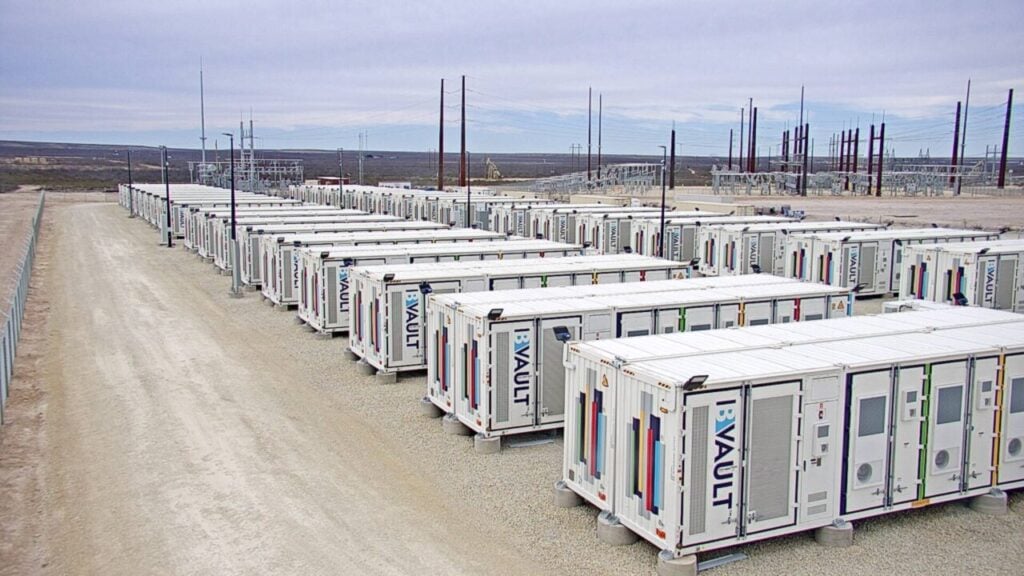
The deal itself
Energy Vault announced on August 7 what it called the largest single contract in its history: a 1.25 gigawatt integrated power infrastructure deployment for an undisclosed hyperscaler AI data center customer in Texas, delivered alongside an unnamed power generation EPC contractor and Caterpillar as the generator set supplier. The company expects initial deployments to begin within four to twelve months and projects 500 to 600 million dollars in revenue from the contract across the second half of 2026 and into 2027.
The system is not a simple generator farm. Energy Vault is supplying battery energy storage systems, grid forming power conversion systems, and AI infrastructure control software designed to manage generation, storage, power conversion, and electrical distribution as what the company describes as a single unified power plant. CEO Robert Piconi framed the shift in customer expectations plainly: buyers are no longer procuring individual technologies, they require integrated power infrastructure capable of delivering reliable, always on electricity at unprecedented speed and scale.
Why off grid is the operative word
The deal's defining feature is its independence from the traditional utility interconnection process, which matters more here than the raw gigawatt figure. Grid interconnection queues in high demand regions routinely stretch past five years, and transformer lead times for the equipment utilities need to expand capacity now average well over two years industry wide. For a hyperscaler racing to bring GPU capacity online against a competitor's timeline, a multi year wait for a grid connection functions as a disqualifying constraint on the entire project, regardless of how attractive the site is on every other dimension.
Off grid and behind the meter power, generation and storage built and controlled by the data center operator's own infrastructure partner rather than the local utility, sidesteps that queue entirely. It trades a slower, cheaper, grid connected model for a faster, more expensive, self contained one. That is a rational trade when the alternative is watching a five year interconnection timeline eat the entire useful life of a GPU generation before the facility even opens.
This is a different animal than Amazon's gas plant
Off grid power for data centers has been a recurring theme all year, but the delivery model here is worth distinguishing from the largest single site power projects making headlines. A hyperscaler building its own multi gigawatt gas plant is a capital intensive, single customer, single site bet that only the largest balance sheets can make. Energy Vault's model looks more like power infrastructure delivered as a managed service, where a third party developer designs, finances, and operates the integrated system on the customer's behalf, and the hyperscaler pays for delivered, reliable power rather than owning the generation asset outright. That structural difference is what makes the model portable to buyers who are not Amazon or Meta.
That distinction matters for the broader market because it lowers the bar for who can access gigawatt scale off grid power. Not every AI infrastructure buyer has the capital or the appetite to become a power plant operator directly. A managed integrated power model, priced and delivered by a specialist, is a more replicable pattern for the tier of enterprise and mid sized colocation buyers who need reliable capacity fast but cannot underwrite a captive power plant themselves.
The catch enterprise buyers should ask about
Off grid capacity solves the interconnection timeline problem, but it does not eliminate the underlying constraints, it relocates them. Generator sets at this scale still require fuel supply contracts, emissions permitting, and in many jurisdictions the same kind of local pushback that has already stalled dozens of grid connected data center proposals this year over air quality and noise concerns. A facility that skips the utility queue can still run into a county air permit fight that takes just as long to resolve.
Enterprises evaluating capacity from providers using this model should ask directly what fuel supply contracts back the generation, what emissions permitting has already cleared versus what remains pending, and what happens to committed capacity if a permit challenge delays commissioning. The four to twelve month deployment timeline in this deal assumes those pieces are in hand. Buyers signing capacity agreements built on similar models elsewhere should not assume the same timeline holds without asking the same questions directly of their own provider.
What this means for the next twelve months
Expect more deals structured this way. The combination of persistent grid interconnection delays, transformer scarcity, and continued hyperscaler urgency to bring GPU capacity online makes integrated, largely off grid power delivery an increasingly standard feature of new data center procurement rather than an exception. Energy Vault is one of several providers, alongside gas turbine and battery specialists, competing to become the default answer to how a data center gets power without a multi year utility wait.
For CTOs and infrastructure leaders evaluating where their next capacity commitment comes from, the interconnection timeline of the underlying power source is now as material a due diligence question as the compute pricing itself. A colocation or cloud provider sitting behind a five year grid queue is offering a materially different risk profile than one sitting behind a contracted, permitted, off grid power plant, even if the sticker price per rack looks similar today. Ask any provider quoting new capacity for a delivery date past twelve months out to show, in writing, exactly how that power gets to the facility, and treat a vague answer on that single point as disqualifying as a vague answer on uptime or security certifications would already be.