Scale arrives in one announcement, not one store at a time
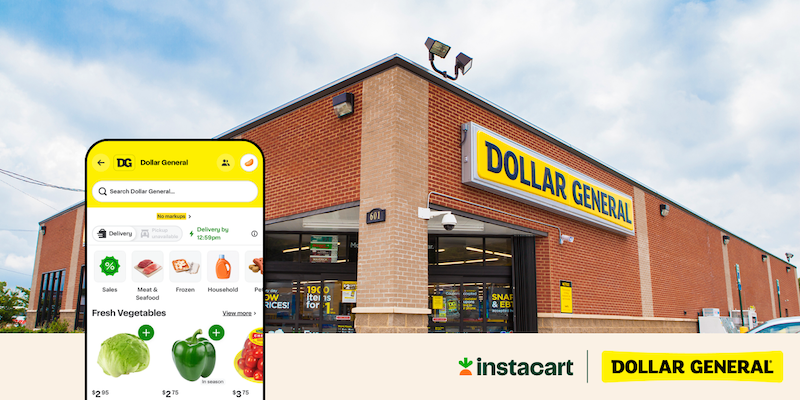
Dollar General and its pOpshelf banner went live on Instacart Marketplace on November 11, putting same-day delivery in front of customers across roughly 20,000 stores in 48 states in a single coordinated move rather than a phased market-by-market rollout. Ryan Hamburger, Instacart's Chief Commercial Officer, described Dollar General as a trusted part of communities across the country and called it one of the largest store footprints to join the platform to date. Tony Rogers, Dollar General's Senior Vice President and Chief Marketing Officer, said the retailer keeps expanding the ways customers can shop with it, positioning the Instacart launch as one more option for getting everyday essentials on a schedule that suits the shopper rather than the store.
The scale of the launch is the real story here, more than the delivery capability itself. Most retail delivery rollouts arrive market by market or region by region, with coverage maps that fill in gradually over several quarters as operational kinks get worked out in each new area. Dollar General skipped that cautious sequencing entirely and activated its full national footprint at once, a move that only works technically and operationally because the stores, inventory systems, and store-level processes were already standardized closely enough across nearly 20,000 locations to plug into Instacart's infrastructure without a staged, market-by-market integration effort.
The build-versus-buy call discount retail keeps making
Dollar General did not build a delivery fleet, a dispatch system, or a consumer-facing delivery application for this launch. It rented demand generation and last-mile execution from Instacart's existing network instead, the same calculation grocers and convenience chains have been making for several years running, as the capital cost of building proprietary logistics has stayed stubbornly high relative to delivery's actual share of total sales across most retail categories. That calculation gets easier to make every year that delivery volume stays a minority of overall transactions.
For a chain whose economics depend on thin margins and high store density, that calculation becomes close to obvious once the alternative is spelled out. The capital that would otherwise go toward a dedicated delivery stack, fleet vehicles, routing software, and a consumer app, gets spent on the store network itself, where Dollar General's returns are better understood and easier to forecast. The tradeoff retailers accept in return is a dependence on a platform partner that also serves every competing banner in the same categories, which caps how much delivery can become a genuine point of differentiation rather than simply becoming table stakes shared across the entire sector.
Why density is the actual asset here
Twenty thousand stores spread across 48 states amounts to a logistics asset that most retailers simply do not have available to them, regardless of how much capital they might be willing to spend trying to replicate it. It means a shopper in a rural town is nearly as likely to have a nearby Dollar General as a shopper in a dense mid-sized city, which gives Instacart's delivery radius options that denser, urban-concentrated retailers cannot match and gives Dollar General a genuinely defensible reason to sit on the platform beyond simple convenience for its existing customer base.
That geographic density also reshapes the unit economics underlying the partnership in ways that matter for margin. Shorter average delivery distances translate into lower cost per order for Instacart's shopper network, which in turn makes the overall economics work in lower-margin categories like household basics and small-format grocery, categories that would strain a delivery model built around fewer, larger, more widely spaced stores where every trip covers more ground for the same order value.
What this signals about the next wave of marketplace delivery
Dollar General's move lands alongside continued growth in AI-assisted and marketplace-driven shopping more broadly this holiday season, with players across retail reporting rising AI-referred site traffic and faster adoption of third-party fulfillment layers as 2026's Cyber Week approaches. The common thread running through nearly all of these moves is retailers choosing to plug directly into existing demand and logistics infrastructure that someone else has already built, rather than spending years and significant capital trying to construct a comparable network from the ground up on their own timeline.
For technology leaders evaluating similar partnership moves inside their own organizations, the Dollar General launch is a useful data point on exactly how fast a marketplace integration can scale once the underlying store and inventory systems are standardized well enough to support it. The real constraint in a rollout like this was never technical complexity sitting on Instacart's side of the integration. It was whether Dollar General's own point-of-sale and inventory systems were consistent enough across thousands of individual locations to onboard in a single national motion instead of the many smaller regional waves most retailers still require.
The limits of the strategy worth watching
Marketplace delivery is primarily a distribution solution, and it comes with a margin cost worth naming plainly. Every order routed through Instacart carries a take rate that a fully proprietary delivery operation would avoid, and that cost structure gets harder to justify internally once delivery volume grows from a small slice of total sales into a genuinely meaningful share of revenue. Retailers that lean entirely on third-party marketplaces also give up a degree of direct customer relationship and the first-party purchase data that would otherwise come with owning that interaction end to end.
Dollar General is betting that store density and existing brand trust matter more right now than owning that customer relationship directly, particularly in categories where the product itself drives loyalty far more than the delivery experience around it ever could. Whether that bet continues to hold as AI-assisted shopping agents increasingly decide on a customer's behalf where an order actually gets placed is the open question every discount retailer building its strategy around a marketplace platform will eventually need to answer with more than a convenience argument.