The Deal: Buying Distribution, Selling Verification
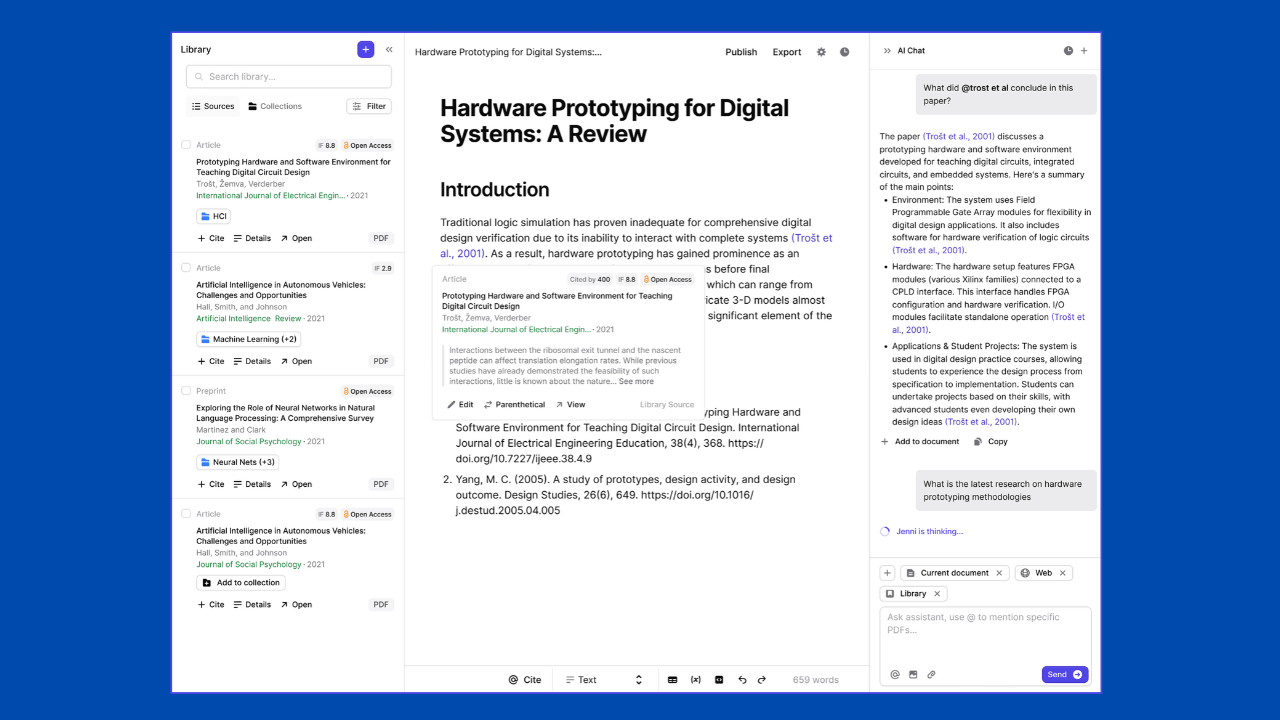
On November 3, Digital Science announced it had acquired Jenni AI, an AI-native academic writing platform used by more than 8 million students and researchers across 189 countries. Digital Science, a UK-based company that supplies data, software and infrastructure to researchers, universities, publishers and funders, is attaching Jenni to Dimensions, its database of 171 million publications, rather than folding the product into an existing offering. The goal is that every source Jenni suggests can eventually be checked against a real paper rather than generated from a pattern.
CEO Stephen Leicht framed the logic directly: researchers already use AI as a matter of routine, and the gap worth paying for is a citation that has been checked against the actual paper, something a general-purpose chatbot cannot reliably offer. That is a narrow, specific bet. The contest here is about source verification rather than writing fluency, and Digital Science is spending its acquisition budget on exactly the failure mode that has embarrassed researchers, students and more than a few expert witnesses over the past two years.
The Problem Digital Science Is Actually Solving
Generative AI's habit of fabricating plausible-sounding references, titles, authors and journals that do not exist, has moved from an annoyance to a liability for institutions. Retractions, plagiarism investigations and disciplinary cases tied to fabricated citations have made research integrity officers and library technology leads far more cautious about which AI writing tools they recommend or license. A tool that cannot guarantee its citations are real carries institutional risk well beyond the inconvenience it causes the student or researcher who used it.
Jenni AI's workspace already let users upload papers, import reference libraries and refine citations manually. The acquisition upgrades that into an automated check against Dimensions' 171 million publications over the coming months, starting with full-text search. For a research office trying to reduce fabricated-citation incidents, that is a concrete, auditable improvement over trusting a general chatbot's output, and it gives institutional buyers a specific feature to evaluate instead of a vague promise of accuracy.
Why Jenni Keeps Its Name and Pricing
Jenni AI will continue as a standalone product under its own name, with its existing team, pricing and subscription plans unchanged. CEO David Park said the company was built on the belief that the future is written with AI rather than by AI, a positioning the acquisition does not disturb. That continuity is deliberate: Digital Science is buying an 8-million-user distribution base and a product people already trust, and disrupting the brand or pricing would risk losing exactly the user relationships that made the acquisition worth doing.
For institutional buyers already running Jenni AI licenses, that continuity removes a common post-acquisition headache: renegotiating contracts, retraining users on a rebranded interface, or discovering that pricing jumped once a larger company took over. It is a low-friction path to improved verification features, which matters for procurement teams that already have Jenni built into research workflows and have no appetite for a migration project layered on top of a feature upgrade.
What This Means for University Research IT Leaders
Research computing and library technology leaders evaluating AI writing tools now have a template for the next generation of procurement questions. The relevant question is no longer whether the tool writes well. It is whether the vendor can verify its own output against a database it controls, and how large and current that database actually is. Jenni AI's answer, 171 million publications through Dimensions, sets a benchmark that competing tools without an underlying research database will struggle to match credibly.
That shifts the build-versus-buy calculus for institutions that considered building in-house citation-checking layers on top of existing AI writing deployments. A vendor-owned, continuously updated research database is a genuinely difficult asset to replicate internally, which strengthens the case for licensing a vendor that already has one rather than bolting verification onto a general-purpose AI tool. Institutions renewing AI writing licenses this budget cycle should ask every vendor on their shortlist the same question Digital Science just answered publicly.
A Consolidation Pattern Worth Tracking
Jenni AI joins Overleaf, ReadCube and Papers AI in Digital Science's portfolio, continuing a run of acquisitions that steadily narrows the number of independent research-AI vendors left standing. For CIOs and procurement leads, consolidation of this kind cuts both ways. It can mean better-integrated tooling and more stable long-term vendor relationships, but it also concentrates risk: a single company now controls citation management, collaborative writing, reference management and AI-assisted drafting across a large share of the research workflow.
Institutions that have spread their research-tooling licenses across several of these now-related products should revisit their vendor risk assessments, since what looked like a diversified toolkit two years ago may now sit under one corporate roof with one outage, one pricing decision and one security posture. That is a reason to update the risk register, not to avoid the consolidated vendor outright. A procurement team that signed separate contracts for Overleaf, ReadCube and Jenni AI as independent point solutions should now treat them as a single vendor relationship for renewal negotiations, incident response planning and business continuity purposes, even though each product still carries its own name and interface.
The Build vs Buy Question for Competing Vendors
Competing AI writing and research tools now face a credibility gap that a model upgrade alone cannot close. Any vendor without a comparable verified-source database behind its product is effectively asking institutions to trust a fabrication rate it cannot independently check. Expect smaller AI writing startups to pursue data partnerships, licensing deals with publishers, or acquisition offers of their own over the next few quarters, because the alternative is competing on a feature, citation accuracy, that Digital Science can now claim to have solved structurally rather than promised aspirationally.
For enterprise and institutional buyers, that competitive pressure is useful leverage. Vendors under pressure to match Jenni AI's verification claim will be more willing to negotiate proof-of-accuracy commitments, audit rights and service-level guarantees into contracts than they were twelve months ago. Procurement teams renewing AI writing tool licenses this cycle should use that pressure now, before the next wave of consolidation removes the negotiating leverage entirely. The window to extract those concessions stays open only as long as multiple independent vendors are still competing for the same institutional budgets, and that window narrows with every acquisition like this one.