The round that changed the category
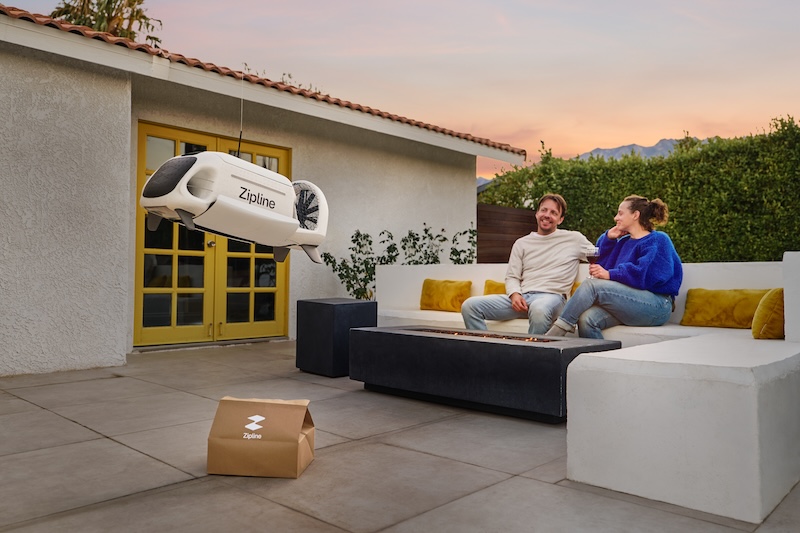
Zipline raised 1.5 billion dollars at a 21.5 billion dollar post-money valuation, with Paradigm, WCM Investment Management, and Layer Global leading the round. Valor Equity Partners, Fidelity Management and Research, Uber, Tiger Global, J.P. Morgan, ARK Invest, and Salesforce Ventures all participated. That is not a typical growth round for a logistics startup. It is the kind of syndicate that shows up when institutional capital has decided a technology has moved from speculative to load-bearing for the businesses that depend on it.
Matt Huang of Paradigm called Zipline one of the largest autonomous robotics companies in the world. Alan Tu of WCM framed it as a generational improvement in the user experience of e-commerce and food delivery. Anton Levy of Layer Global pointed to Uber and Walmart as evidence the model is becoming a mainstream part of everyday life. None of that language is about proving the concept. It is about financing capacity at scale, which is the signal CTOs and supply chain leaders should read most closely.
What Walmart and Uber actually committed to
Walmart and Zipline agreed to a new national, multi-year contract that adds 300 additional delivery sites, with room for further expansion. That is a meaningfully different commitment than the store-by-store trials most retailers ran with drone delivery through 2024 and 2025. A multi-year, multi-site agreement means Walmart's logistics and real estate planning now treats drone capacity as a fixed input, not a variable one, and that it expects the economics to hold at scale rather than only in favorable test markets.
Uber's stated target, one million Zipline deliveries a day by 2029, is the clearer tell for enterprise planners. That number only makes sense if Uber believes drone delivery can be scheduled, insured, and routed with the same operational discipline as its driver network. For any retailer or quick-commerce operator watching from the sidelines, the question is no longer whether drones can handle last-mile delivery reliably. It is whether building that reliability in-house still makes sense once a vendor has raised this much capital to do it for you.
The build versus buy calculus just moved
Before this round, a retail CTO evaluating drone delivery was weighing a genuine build option: hire aerospace and robotics talent, navigate FAA certification independently, and own the fleet. That option was always expensive and slow, but it was at least plausible when the vendor landscape was fragmented and under-capitalized. A 21.5 billion dollar valuation, backed by payments, cloud, and logistics incumbents, changes the comparison. Zipline now has the balance sheet to out-invest almost any retailer's internal drone program, and the Walmart and Uber deals give it reference customers that de-risk the vendor choice for everyone who follows.
That does not mean buy is automatically correct. It means the bar for building in-house has risen sharply, and any retailer still running an internal drone pilot needs a credible answer for why its unit economics will beat a vendor operating at Zipline's scale within two or three years. For most mid-size and regional retailers, the realistic path is now a commercial agreement with a capitalized platform vendor, structured so that exclusivity, data ownership, and service-level penalties protect the retailer if the vendor's priorities shift toward larger partners like Walmart.
Governance and risk questions this round does not answer
Raising capital does not resolve airspace regulation, noise ordinances, or liability allocation when a drone damages property or injures someone, and none of those risks disappear because the investor list is strong. Retail leaders negotiating drone delivery contracts should treat FAA waiver status, insurance coverage, and incident response obligations as contract terms, not vendor marketing claims, and should require evidence of operational safety record at the scale the contract implies, not just at pilot scale.
There is also a concentration risk worth naming directly. If Walmart and Uber are the anchor customers absorbing most of Zipline's near-term capacity, smaller retail partners need contractual protection against being deprioritized during peak periods, equipment shortages, or software rollouts tuned for the largest accounts. A vendor flush with capital still allocates scarce engineering and fleet capacity somewhere first, and contract language should specify what the retailer is guaranteed rather than what it hopes to get.
Cost structure and the capex to opex shift
The financial argument for buying drone delivery capacity rather than building it is straightforward once capital intensity is this high. A single autonomous aircraft certification program, fleet maintenance operation, and airspace compliance team represents fixed capex that only pays off at volumes most individual retailers cannot reach alone. Converting that into a per-delivery operating cost, paid to a vendor spreading the same fixed costs across Walmart, Uber, and others, is a better match for how most retail finance organizations want logistics costs to behave: variable, scalable, and tied to actual delivery volume.
The catch is contract duration. Multi-year commitments of the kind Walmart just signed lock in pricing assumptions for years in a market where drone delivery costs are still falling as fleets scale. Retail finance teams should negotiate repricing triggers tied to published cost curves or competitor benchmarks, not fixed multi-year rates that look attractive today but age poorly as the category matures and more capitalized entrants compete for the same routes.
What to watch through 2027
Expect Amazon, DoorDash, and regional grocery chains to either expand existing drone programs or announce new vendor agreements within the next two quarters, now that Zipline's raise has set a valuation benchmark and de-risked the category for later movers. Watch specifically for whether any competitor matches the multi-year, multi-site structure of the Walmart deal, since that structure, not the funding headline, is what actually changes a retailer's logistics planning. A second signal worth tracking is whether Zipline's manufacturing expansion, funded directly by this round, translates into shorter lead times for new retail partners, which would be the clearest evidence that capital is converting into delivered capacity rather than sitting on the balance sheet.
The more durable question for retail technology leaders is whether drone delivery becomes a commoditized utility, priced and contracted like cloud compute, or stays concentrated among two or three capitalized vendors with pricing power. That outcome will depend less on the technology, which is increasingly proven, and more on how many retailers follow Walmart's lead into long-term commitments versus holding out for a more competitive, utility-like market to form. CTOs weighing that choice should treat the next two Zipline customer announcements as the real test of whether this valuation was earned by demand or by momentum investing.