Putting a number on agentic readiness
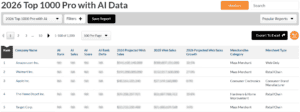
Digital Commerce 360 and ReFiBuy launched the AI Commerce Rankings on July 15, and the timing tells us where retail attention has moved. As shoppers increasingly start purchases inside ChatGPT, Gemini, Perplexity, and other assistants, retailers need a way to know whether those agents can actually find, read, and recommend their products. The new rankings answer that by scoring companies in the Top 1000 database, a resource Digital Commerce 360 has maintained for more than 25 years. The benchmark updates quarterly, which turns a fuzzy strategic worry into a recurring metric that a merchandising or ecommerce leader can put on a dashboard and watch over time.
Brian Warmoth, editor in chief at Digital Commerce 360, put the rationale plainly, saying that as AI-driven shopping becomes a more meaningful part of product discovery, retailers need new ways to understand how they are positioned. Jon Love, the research data manager, added that the rankings help leaders evaluate readiness for the next major shift in consumer behavior. We think the framing matters as much as the data. For two years, agentic commerce has lived in the language of prediction and hype. A quarterly score built on a trusted retail index moves the conversation toward measurement, and measurement is what unlocks budget and accountability inside large organizations.
The four signals under the score
The methodology rests on four signals, and each maps to a concrete question a retail leader should already be asking. The first is bot friendliness, which measures whether AI agents can reach and parse a retailer's catalog data at all. The second is AI source traffic, the share of a site's visits arriving from AI-powered discovery surfaces. The third is diversity of AI sources, which rewards retailers who draw traffic from several engines. The fourth is 90-day momentum, the trajectory of that AI traffic over the most recent quarter. Together they describe both the current state and the direction of a retailer's presence in agent-driven shopping.
We appreciate that the framework separates access from outcomes. Bot friendliness is a plumbing question about whether feeds, structured data, and permissions let an agent see your products. AI source traffic and its diversity measure whether that access is translating into real visits. Momentum catches the retailers moving fast enough to matter. A leader can read a low bot-friendliness score as a fixable engineering task and a weak momentum score as a signal that competitors are pulling ahead. The four dimensions give a management team distinct levers to pull, which beats a single opaque grade that hides where the work needs to happen.
Agentic Commerce Optimization becomes a discipline
ReFiBuy contributed the methodology and the scoring, and it coined the term Agentic Commerce Optimization to describe the practice. The name deliberately echoes search engine optimization, and the parallel is instructive. A generation of retailers built teams, budgets, and vendor relationships around ranking well in Google results. Agentic Commerce Optimization argues that a similar discipline is forming around ranking well inside AI assistants that read catalogs, compare options, and hand shoppers a recommendation. If agents become a primary route to discovery, then structuring product data for machines to consume becomes as important as the storefront humans see.
We would caution leaders against treating this as a rebranded SEO project handed to the same team with the same tactics. Agents read differently from crawlers. They call feeds, query structured data, and increasingly transact through protocols that carry pricing, availability, and loyalty terms. Winning here means clean product data, machine-readable inventory, and participation in the emerging commerce protocols. The AI Commerce Rankings give this work a scoreboard, and a scoreboard tends to concentrate effort. Retailers that stand up a dedicated capability now will compound their advantage as agent traffic grows, while those who wait will find the gap harder to close each quarter.
Bot friendliness is the plumbing that decides everything
Of the four signals, bot friendliness deserves the most immediate attention, because it gates the other three. If an agent cannot access a retailer's catalog, no amount of brand strength or marketing spend will surface those products inside an assistant. Many retailers still block bots aggressively, throttle automated traffic, and hide inventory behind interfaces built for human browsers. Those defenses made sense when scrapers were a threat and offered no upside. In an agentic world, the same defenses lock a retailer out of a fast-growing channel and hand the sale to a competitor whose data flows freely to the assistant doing the shopping.
The fix is largely technical and squarely within a retailer's control. Exposing structured product feeds, keeping prices and availability accurate in machine-readable form, and setting permissions that welcome legitimate shopping agents all move the bot-friendliness score upward. We see this as low-regret work, because clean, accessible product data pays off across search, marketplaces, and internal AI projects at the same time. A retailer that treats its catalog as an API positions itself for whatever assistant wins share next. The rankings simply make the cost of neglecting that plumbing visible, and visibility is what forces the conversation into planning meetings.
What the rankings reveal about the readiness gap
A benchmark like this earns its value by exposing distance between leaders and laggards. Industry data already suggests that a small group of retailers captures the bulk of AI-driven traffic while most sites barely register. By scoring the entire Top 1000 on the same four signals every quarter, the rankings turn that intuition into a ranked list a board can read at a glance. A retailer that discovers it sits in the bottom half on bot friendliness learns that its problem sits in access, and access is an engineering fix. A retailer with strong access and weak momentum learns that rivals are converting agent traffic faster.
We expect the quarterly cadence to matter more than any single snapshot. Agentic commerce is moving quickly, with new protocols, new assistants, and shifting consumer habits arriving almost monthly. A one-time audit ages fast. A recurring score lets a leadership team see whether its investments are moving the needle and whether competitors are pulling away. That is the difference between a research report and a management tool. The AI Commerce Rankings aim to be the latter, and if retailers start citing their position the way they once cited search rankings, the benchmark will have reshaped how the industry allocates attention and budget.
Turning the score into decisions
For a retail leader, the practical move is to treat the ranking as a working diagnostic and assign each signal an owner. Bot friendliness belongs to engineering and data teams who control feeds and permissions. AI source traffic and diversity belong to the digital and merchandising leaders who shape how products are represented and priced for agents. Momentum belongs to the executive who has to answer whether the company is keeping pace. A quarterly number that no one owns changes nothing. A quarterly number tied to specific teams and targets drives the work that closes the readiness gap.
The deeper lesson is that agentic commerce is becoming measurable, and measurable channels attract investment and discipline. Retailers spent a decade learning to compete for a spot on the first page of search results. The same competitive logic is arriving for the recommendation an AI agent hands a shopper, and the companies that instrument themselves first will set the pace. We would push every commerce leader to establish a baseline now, whether through this ranking or their own analytics, because the shift toward AI-mediated shopping rewards the retailers that prepare early. A score you can track is the first step toward a channel you can win.