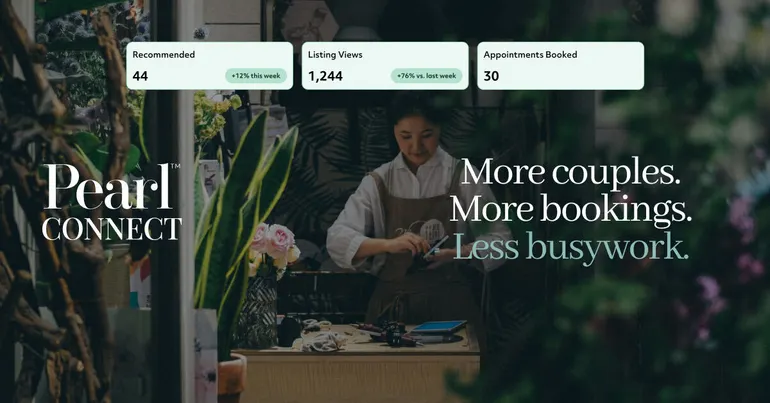
What Pearl Connect actually is
David's Bridal launched Pearl Connect, an AI-powered marketplace that lets wedding vendors market themselves, communicate with and ultimately book services for engaged couples directly through the platform. The matching engine runs on data couples already share inside Pearl Planner, David's Bridal's existing wedding planning tool: wedding date, venue, style preferences, budget range and overall vision for the day. Instead of vendors buying generic lead lists or paying for broad-match search advertising that reaches mostly uninterested browsers, they get connections pre-filtered against a couple's genuine, stated plans and timeline.
Elina Vilk, David's Bridal's president and chief business officer, described the underlying intent plainly: 'The vendor doesn't have to spend the first several exchanges figuring out whether the opportunity is a fit.' That sentence captures the entire value proposition in compressed form. The product sells qualification rather than raw contact volume, and it does so using data the company already owns internally rather than data it has to purchase, license or scrape from somewhere else entirely.
The flywheel framing is the real product decision
Vilk called the two-product structure a 'wedding planning flywheel': couples plan and share intent through Pearl Planner, vendors gain useful context around that intent through Pearl Connect, and both sides get a simpler, faster path to a real connection and measurable business growth. That framing matters more than any individual feature on the list, because it describes a retailer that decided its own planning tool was never just a retention feature, it was always a data asset with a genuine second buyer sitting on the other side of a potential marketplace.
That is a genuinely different business model decision than most retailers make with their own first-party intent data, which typically stays locked entirely inside personalization and marketing systems and is never offered externally as a standalone product to anyone outside the company. David's Bridal instead built the infrastructure to sell structured access to that intent directly to the vendors who want it most, at a price point they are apparently willing and able to pay on a recurring basis.
The pricing tells you how confident they are in the data
Pearl Connect offers a free entry tier alongside paid packages priced at 49 dollars and 119 dollars per month. Charging vendors a recurring subscription for ongoing access to matched leads, rather than a one-time fee or a simple per-lead charge, reflects a bet that the ongoing quality of the intent data justifies a standing relationship rather than a purely transactional one. It follows the same pricing logic behind any recurring B2B data or lead-generation product, and it signals real confidence that match quality stays durable enough to retain paying subscribers month after month.
That confidence is not incidental or accidental. Pearl Planner originally launched in 2025 and added an AI-driven budgeting feature this past spring, meaning the underlying data set feeding into Pearl Connect has been growing structurally richer, not simply larger in raw volume, right up through this launch. A vendor paying 119 dollars a month is implicitly betting that a couple who has entered a full AI-assisted budget into the platform represents a meaningfully higher-intent lead than one who filled out a generic inquiry form on a wedding directory site.
Why this matters beyond wedding retail
Strip away the wedding-specific vocabulary and this becomes a reusable template worth studying closely. Any retailer or platform running a genuine first-party intent-capture tool, a gift registry, a design consultation flow, a financing pre-qualification tool, a room planner, is sitting on the same raw material David's Bridal just turned into a genuine second revenue line. The barrier is rarely the underlying data itself, it is usually the organizational willingness to build and operate a full two-sided marketplace product on top of a business that has historically only ever sold to one side of that relationship.
That willingness is the part genuinely worth studying closely here. It requires treating a customer engagement tool as a data platform in its own right, complete with its own go-to-market plan, its own pricing tiers and its own success metrics kept separate from the core retail business, which amounts to an organizational change far more than a purely technical one. Most retailers already have the underlying data sitting in their systems. Very few have made the deliberate decision to build a genuine second business around it.
The risk this model has to manage
Selling access to customer intent data to a third party, even structured and vendor-facing rather than sold directly to advertisers, raises the same trust questions every marketplace built on first-party data eventually has to confront honestly. Couples entering their budget and venue details into Pearl Planner need to clearly understand that this information is what powers vendor outreach through Pearl Connect, and the retailer needs consent and disclosure practices robust enough to hold up as the marketplace continues scaling well past its initial vendor base.
Handled well, this represents a genuine value exchange: couples get better-matched vendor outreach instead of cold, generic solicitation, and vendors pay specifically for qualification instead of raw volume they have to sort through themselves. Handled poorly, it becomes exactly the kind of data-monetization decision that quietly erodes the trust the original planning tool was built to earn in the first place. The companies that get this right will stay explicit with customers about the exchange rather than letting it surface later as an unwelcome surprise.