What Databricks actually shipped
On November 11, Databricks announced a set of agentic AI tools built to continuously analyze and organize the data scattered across a business, rather than sitting idle until someone opens a chat window and types a question. The centerpiece is an updated version of Genie, its assistant for business data, which now runs in the background, follows what an employee is working on through the day, and surfaces suggestions tied to that activity instead of waiting to be asked. Databricks is positioning this as the natural next step after years of selling the lakehouse as the place enterprise data lives, now extending that platform into something that actively watches the data on a user's behalf.
Alongside Genie, Databricks introduced an ontology feature that scans an organization's data, including management reporting lines and projects that cross departments, so a user can find information or run an analysis without knowing which team or system owns the underlying tables. That is the more interesting half of the announcement for a data leader, because it is Databricks extending its existing Unity Catalog governance layer into an organizational map rather than simply bolting a chatbot onto existing dashboards. If it works as described, it turns years of accumulated metadata into a navigable structure instead of a pile of tags.
The CEO as the product's best reference customer
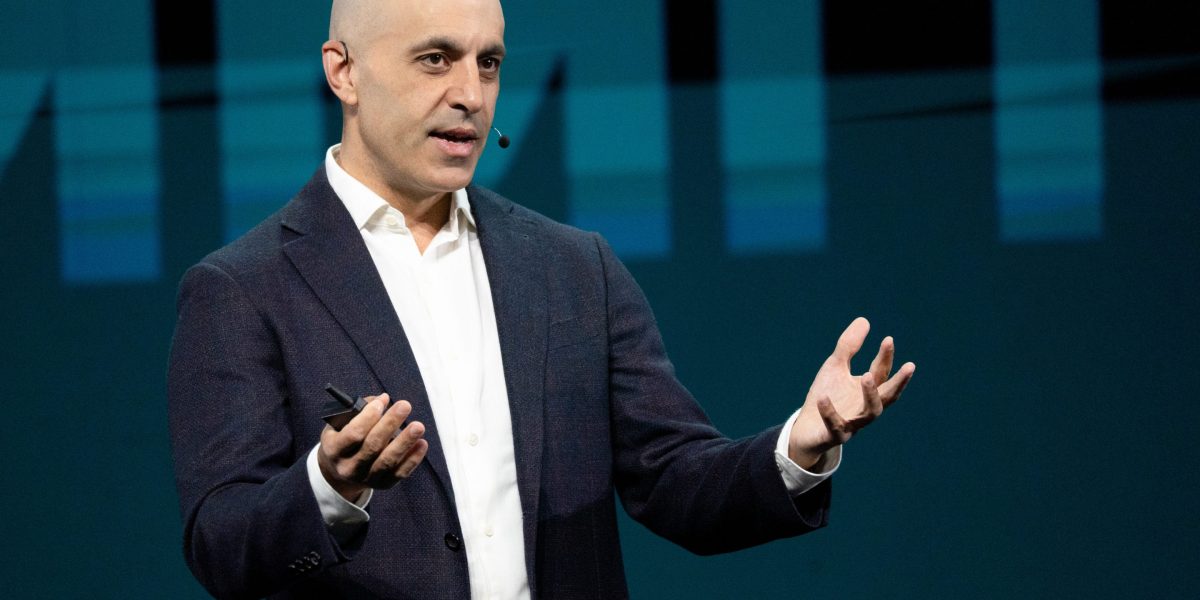
Ghodsi did the selling himself, and he did it in personal terms rather than technical ones. He said the agents are "running in the background all the time, so it's always on," that he personally uses the tools "every hour of the day," and that they have made him a "10x better CEO" than he was a year ago. He went further, predicting that "lots of companies, both big and small, will use this," framing the launch as inevitable rather than merely available.
Buyers should treat that framing for exactly what it is: a founder's personal testimonial, delivered with the confidence of someone who controls the roadmap, rather than a measured outcome independently verified by a third party. There is no published study behind the 10x figure, no breakdown of which specific tasks improved or by how much, and no public account of how the ontology feature behaves once the underlying metadata is incomplete or inconsistent, which is the normal condition at most large enterprises rather than the exception. A CTO evaluating this should ask Databricks for a reference customer outside the executive suite before repeating the number internally to a budget committee.
Why this landed when it did
The timing was not an accident. Databricks announced its tools one day after Anthropic shipped its own office productivity push, including a spreadsheet application that competes directly with Excel and Google Sheets and a feature that lets Claude join video calls directly. Two well-funded AI vendors moved into the same territory, knowledge-worker productivity, within roughly 24 hours of each other, which suggests both companies had been tracking the other's roadmap closely enough to want the news cycle rather than cede it.
That convergence says something about where the industry currently believes the next wave of AI spending will go. Software engineering already has a comparatively clear return on AI investment: faster code, fewer bugs, measurable cycle time that a finance team can model. Office and knowledge work does not yet have that clarity, and that gap is exactly why both companies are leaning on narrative and executive anecdote, Ghodsi's personal productivity story among them, rather than third-party benchmarks to make their case to buyers who have not yet seen comparable proof.
What is still missing from the pitch
Databricks has not published pricing for the new Genie capabilities, details on how permissions propagate through the ontology graph as it crosses department boundaries, or any customer data showing time saved or errors avoided at meaningful scale. For a feature explicitly designed to run unattended and surface information across departmental lines, those are not minor omissions a CTO can wave away during a pilot conversation. An always-on agent with access to reporting lines and cross-team projects is also an always-on surface for data leakage if role-based access is not enforced correctly from the first day it is turned on inside a real organization.
Databricks remains privately held and well capitalized, having raised 5 billion dollars at a 190 billion dollar valuation in August, so it has the balance sheet to iterate on this feature for years without needing to prove unit economics quickly the way a smaller vendor would. That is useful context for CTOs deciding whether to pilot now or wait for the second release: the product will keep changing under the hood, and an early commitment buys influence over where the roadmap goes next more than it buys a finished, fully governed tool ready for unsupervised enterprise use.
The decision in front of the reader
If your organization already runs on Unity Catalog and Databricks for its lakehouse, the ontology feature is worth a scoped pilot specifically designed to test how it behaves against your real metadata quality, not a vendor-curated demo environment built to show the feature at its best. The value proposition, one assistant that understands org structure well enough to answer cross-functional questions correctly, is genuinely useful if it performs as described, and genuinely risky if it hallucinates reporting relationships or data ownership with the same unwavering confidence it shows in Databricks's own marketing materials.
If you are not already a Databricks customer, this announcement alone is not yet a reason to become one. Wait for independent accounts of accuracy and permission handling from teams with messy, real-world metadata, and watch closely whether Anthropic, Microsoft, or Google ship a comparable ontology layer on top of their own data platforms within the next two quarters. Agentic office assistants are becoming table stakes faster than the governance tooling needed to run them safely is maturing, and that widening gap is where the real due diligence has to happen before any budget gets committed.