From experiment to production platform
At its Data and AI Summit, Databricks made the case that enterprise AI has crossed a threshold. Agent Bricks, the company's agent platform, has now seen more than 100,000 agents built on it, collectively processing over 1 quadrillion tokens annually. Those are production scale numbers, not pilot numbers, and they frame the announcement's central argument. The question for enterprises is no longer whether they can build an agent that works in a demo. It is whether they can build, deploy, govern, and operate fleets of agents reliably and economically at scale. Databricks is positioning Agent Bricks as the platform for exactly that transition.
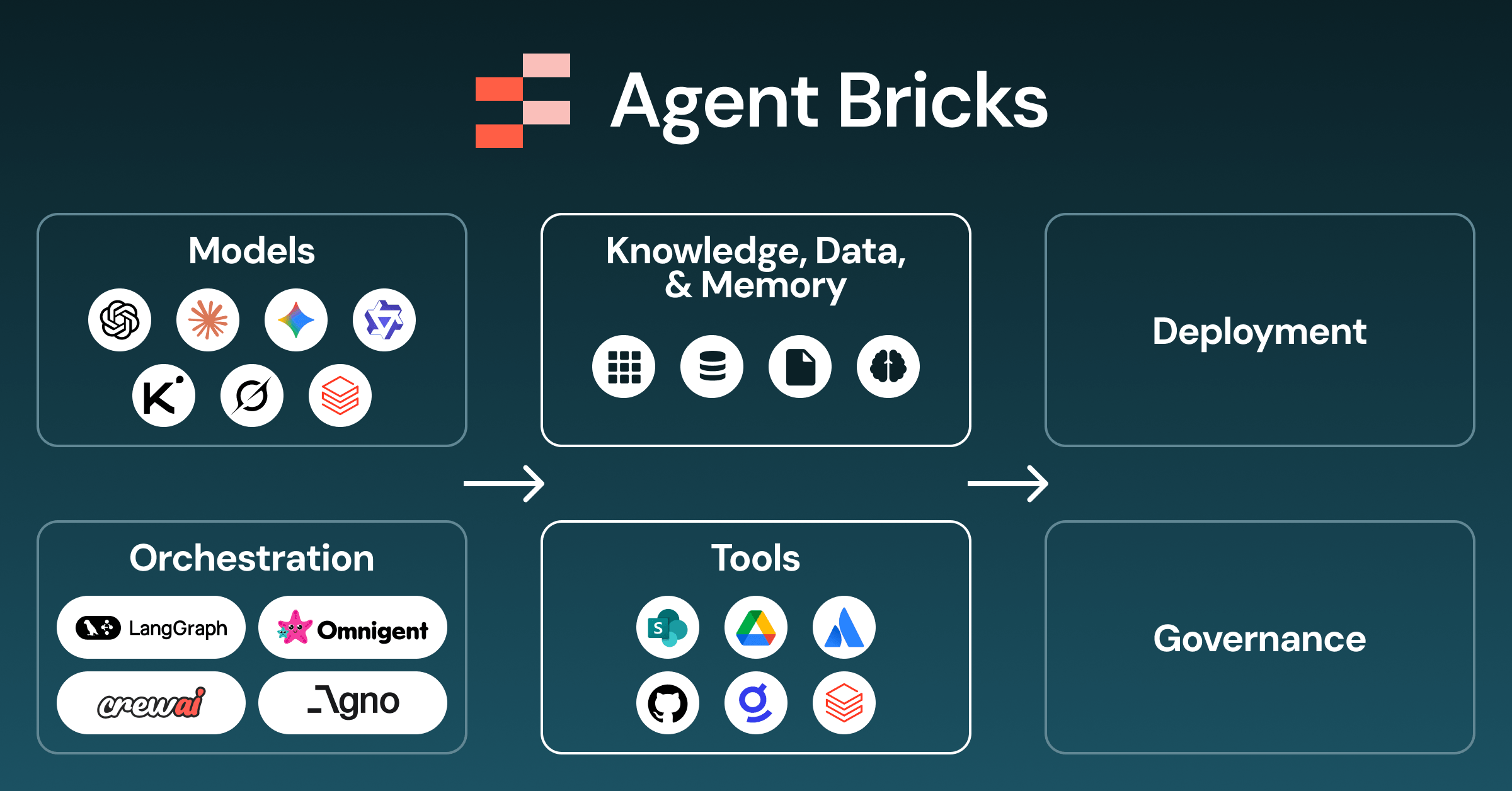
The expanded Agent Bricks organizes its pitch around three pillars, choice, context, and control. Choice means support for a wide range of models. Context means giving agents access to enterprise data and tools. Control means governance and observability over what the agents do. Taken together, the framing is a deliberate signal that Databricks understands the production problem. Building one agent is an exercise. Running hundreds of them against live business data, with auditability and cost discipline, is an infrastructure challenge, and that is the territory Databricks is staking out as the index and analytics era of its business gives way to an agentic one.
Model choice as a strategic stance
The choice pillar is the most strategically pointed. Agent Bricks supports frontier proprietary models from OpenAI, Anthropic, Google's Gemini, and the open models Qwen and Kimi, and Databricks announced a new partnership with SpaceX to integrate the Grok models as well. Crucially, it also works with a range of agent harnesses, including LangGraph, CrewAI, the Claude Code SDK, and OpenAI's agent SDKs. The message to enterprises is that they should not have to bet their AI strategy on a single model provider, and that the platform layer, not the model, is where they should anchor.
This is a meaningful position in a market where the major model providers are each trying to become the default enterprise platform. By making provider switching a feature rather than a migration, Databricks is appealing directly to the anxiety technology leaders feel about lock in. Edmunds vice president of technology Gregory Rokita articulated the appeal precisely. Databricks gives us a secure, governed foundation to run multiple models and switch providers as our needs evolve, all while keeping costs in check, he said. That sentence captures the entire value proposition. The model is a commodity input. The platform that lets you choose freely among them is the durable asset.
Unity AI Gateway and the governance problem
The control pillar is anchored by Unity AI Gateway, which Databricks positions as a unified governance and runtime layer spanning both Databricks hosted and externally hosted AI assets, including models, agents, MCP services, and skills. Its capabilities target the concerns that keep enterprise AI initiatives stuck in pilot. It provides unified visibility into AI spend with cost attribution down to the user, team, tool, and use case, and it can enforce hard spend caps that automatically stop requests once a budget is exceeded. For organizations watching AI costs spiral unpredictably, that financial control is not a nicety but a prerequisite for scaling.
Beyond cost, the gateway extends Unity Catalog governance with contextual service policies that apply runtime controls based on the user, agent, model, or the contents of a request and response. It captures end to end agent traces and integrates with security tooling for investigations. The gateway also ships managed connectors for common enterprise systems including Google Drive, Jira, Confluence, Slack, GitHub, and SharePoint, addressing the context pillar by giving agents governed access to the data they need. Udemy principal engineer Nathan Sullins described the result bluntly. All foundation model traffic routes through AI Gateway, giving us unified governance from production agents to PII detection pipelines, he said.
Why governance is the real product
There is a pattern worth naming here, and it extends well beyond Databricks. The marketing energy in AI has centered on model capabilities, the benchmark scores and the impressive demos. But the actual obstacle to enterprise adoption has shifted to the unglamorous work of governance, cost control, and operational reliability. An enterprise cannot deploy autonomous agents against sensitive data without knowing what they are permitted to do, monitoring what they actually do, and controlling what they cost. The capability has largely arrived. The control has not, and that gap is where platforms now compete.
By making Unity AI Gateway central to its announcement, Databricks is implicitly conceding that the model layer is becoming commoditized and that the value is migrating to governance and operations. This is a smart read of where enterprises actually struggle. We have heard the same theme from technology leaders all year. They are not blocked by whether the AI works. They are blocked by whether they can deploy it responsibly, prove to auditors and regulators that it is controlled, and keep its costs from running away. The vendor that solves the governance problem, not the one with the highest benchmark, is the one enterprises will standardize on.
Real customers, real workloads
Databricks backed its claims with a roster of named customers running production agents, including AstraZeneca, 7-Eleven, Fox Corporation, and Block, with Merck and First American using its runtime for custom model training. These are large, sophisticated organizations across pharmaceuticals, retail, media, and financial services, and their presence lends credibility to the production scale framing. Enterprise technology buyers are rightly skeptical of platform claims, and reference customers operating at this scale are more persuasive than any benchmark. Databricks also highlighted efficiency gains, such as a custom trained data agent achieving competitive performance with leading proprietary models at significantly lower cost.
That cost efficiency angle reinforces the broader strategy. If an enterprise can train a custom agent that matches frontier model performance on its specific task at a fraction of the cost, the calculus of AI deployment changes. The expensive frontier model becomes one option among many rather than a mandatory dependency, and the platform that enables that optimization captures the value. Databricks is betting that as agents move into production at scale, the organizations running them will care intensely about getting the right performance at the right cost, and will reward the platform that lets them tune that tradeoff freely.
The bet on the platform layer
Stepping back, the summit announcements amount to a coherent bet on where enterprise AI value will accrue. Databricks is wagering that models will continue to commoditize, that no single provider will dominate, and that enterprises will demand the freedom to mix and switch among them. In that world, the durable, defensible business is the platform that sits above the models, handling data access, governance, cost, and operations consistently regardless of which model is underneath. It is the same logic that made data platforms valuable in the previous era, applied to the agentic one.
For technology executives, the practical takeaway is to evaluate AI infrastructure decisions through the lens of governance and flexibility rather than model selection alone. The model you choose today may not be the one you use in a year, and an architecture that locks you to a single provider is a liability in a market moving this fast. Whether Databricks specifically wins this layer remains to be seen, with the major cloud and model providers all competing for the same ground. But its diagnosis of the problem, that control and choice matter more than raw capability, is one we expect the market to validate.