Ten Days That Reframed the Buildout
The story of cloud infrastructure in 2026 has been one of unprecedented capital: hyperscalers and neoclouds racing to commit hundreds of billions of dollars to gigawatt-scale campuses. Over the past two weeks, a quieter story has started to set the terms. On June 4, both houses of the New York State Legislature passed the Responsible Data Center Development Act, a measure that would impose a one-year freeze on permits for data centers drawing more than 20 megawatts. Four days later, Seattle's City Council voted 9-0 to pause large-scale AI data centers for a year. On June 12, the Pacific Northwest utility Avista shelved negotiations with a developer seeking up to 500 megawatts near Spokane.
We read these as a single trend rather than three coincidences. The buildout has reached the point where individual projects are large enough to reshape a county's power and water profile overnight, and local institutions are responding with the bluntest tool they have: a moratorium. For executives planning capacity, the lesson is that the binding constraint is no longer only chips or transformers. It is consent. The places that were supposed to absorb the next wave of compute are starting to say no, or at least not yet.
New York Tries to Go First
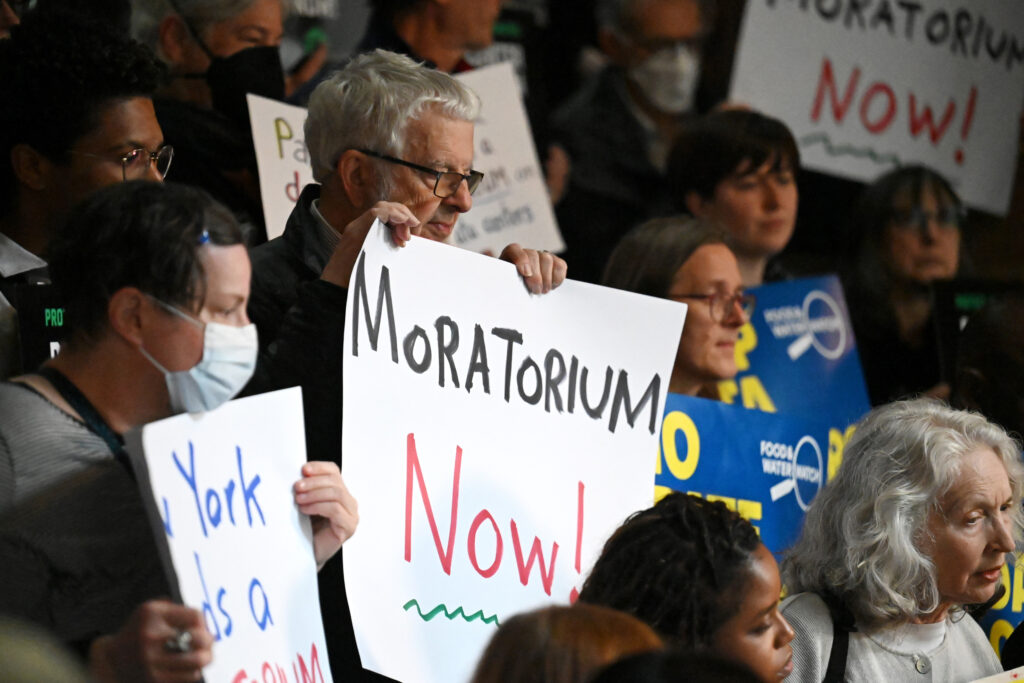
New York's bill, S10642/A11560, cleared the Senate 44-16 and the Assembly 102-39 in the final hours of the session. If Governor Kathy Hochul signs it, New York becomes the first state in the nation to enact a statewide data center freeze. Beyond the twelve-month pause, the act requires local public hearings before construction, a statewide environmental impact report within eighteen months, and renewable-energy and emissions-disclosure conditions. State Senator Kristen Gonzalez, the sponsor, framed it plainly: "We need to make sure we have appropriate infrastructure and processes in place to protect communities from rising utility bills."
The industry pushed back hard. Khara Boender of the Data Center Coalition warned that "a statewide moratorium would discourage investment and send a signal that the state is closed for business." Hochul has not taken a position and has previously suggested siting should be left to municipalities, which is precisely what is now happening across the country. The political tell is that this passed in a state desperate for tax base and tech jobs. When New York is willing to risk the "closed for business" label, the local mood has shifted further than the capex headlines suggest.
Seattle Says the Quiet Part Out Loud
Seattle's unanimous vote is striking precisely because Seattle is a tech town. The council approved both an ordinance enacting the moratorium and a resolution to study data center impacts. Council member Alexis Mercedes Rinck cast it in moral terms: "We have a moral imperative to put the health of our people and our planet above the profit margins of tech companies." That is not the language of a community negotiating incentives. It is the language of a community that has decided the trade is bad on its face.
Advocates were blunter still. Ben Jones of 350 Seattle observed that "people see data centers as the bridge to AI, and people are not happy with AI," linking infrastructure opposition to a broader souring on the technology itself. That linkage should worry cloud providers more than any single permit denial. If a data center becomes a physical proxy for diffuse anxiety about AI, then the usual playbook of jobs numbers and tax revenue stops working, because the objection is no longer really about jobs or taxes.
A Utility Blinks in Spokane
The Avista case is the most instructive because the brakes were pulled by the utility, not a legislature. Avista had signed a nonbinding memorandum with an unnamed developer drawing 125 megawatts starting in 2029, scaling to 500 megawatts by 2032. That ceiling exceeds half the power used by every residential and business customer in Spokane County combined. President and CEO Heather Rosentrater said the company heard "the questions and concerns from our customers, community members and local leaders," while senior vice president Jason Thackston admitted, "we did not expect the volume of feedback that we received."
Spokane's City Council is weighing its own one-year moratorium, and Mayor Lisa Brown has insisted that "protecting our water resources, ensuring drinking water quality, must include the City of Spokane." Councilman Paul Dillon captured the dynamic: "There's so many more questions than answers." When a load-serving utility voluntarily pauses a deal of this size to seek "broader policy and community alignment," it signals that the social license to interconnect is now something developers must earn explicitly, not assume.
Three Costs the Community Keeps Naming
Across all three fights, the objections rhyme: electricity rates, water for cooling, and grid capacity. The rate concern is concrete, with reports of bills near major data center hubs rising as much as 267 percent over five years, and data centers now consuming roughly 4 to 5 percent of US electricity. Water is the second flashpoint, sharpened in Spokane by fears of contamination and heat pollution. The third is timing: grid interconnection queues now stretch four to five years, so a single hyperscale load can crowd out everyone else's growth for the better part of a decade.
These are not fringe complaints. At least eleven states have active moratorium bills in 2026, and dozens of municipalities have moved ahead with local pauses, shifting the center of gravity toward city and county government. The Ratepayer Protection Pledge that big tech signed at the White House in March, promising to fund their own generation and infrastructure upgrades, was an attempt to defuse exactly this. The events of June suggest the pledge has not yet reached the council chambers where these decisions are actually made.
What It Means for Cloud Leaders
For CIOs and infrastructure executives, the practical takeaway is that siting risk has graduated into a board-level variable. A signed land option and a utility memorandum no longer guarantee a campus will be built on schedule, or at all. Capacity plans that assume frictionless interconnection in growth markets need a discount applied for political reversal, and multi-region strategies should treat a moratorium the way they treat a fault domain: something to design around, not wish away.
The deeper shift is that the cheapest, fastest places to build are now often the ones most likely to revolt, because they are the ones least equipped to absorb the load. The providers that succeed in the next two years will be the ones that show up early, fund their own power and water solutions credibly, and treat community alignment as part of the engineering problem rather than a public-relations cleanup. The compute will get built. Where, and on whose terms, is suddenly an open question.

/filters:no_upscale()/news/2026/06/forge-billing-usage-platform/en/resources/1Screenshot%202026-05-30%20at%208.05.53%20PM-1780198156897.png)