What shipped
D2L's Brightspace release for August 2026, version 20.26.08, went into production on August 6. The headline addition is Lumi Feedback, an automated grading capability that runs submissions through the Brightspace Platform Notification Service rather than requiring administrators to map a CSV file by hand. Lumi Tutor also picked up an enhanced Study Mode that now supports H5P interactive exercises and can run without an active Brightspace connection, which matters for students on unreliable campus networks or working offline between classes.
The release note frames Lumi Feedback as a purchasable add-on rather than something bundled free into every Brightspace seat, so the pricing model still separates AI features from the core license. The fact that automated grading now ships as a documented, general-availability feature inside a routine monthly release, rather than as a standalone pilot program requiring a special early-access agreement, tells buyers something important about where the LMS market has settled on AI functionality: it is becoming expected infrastructure that vendors ship on a normal release cadence, not a proof-of-concept program that gets announced with its own press cycle and a waitlist. That maturity shift changes how buyers should evaluate it in a renewal conversation.
Createspace targets a real enterprise problem
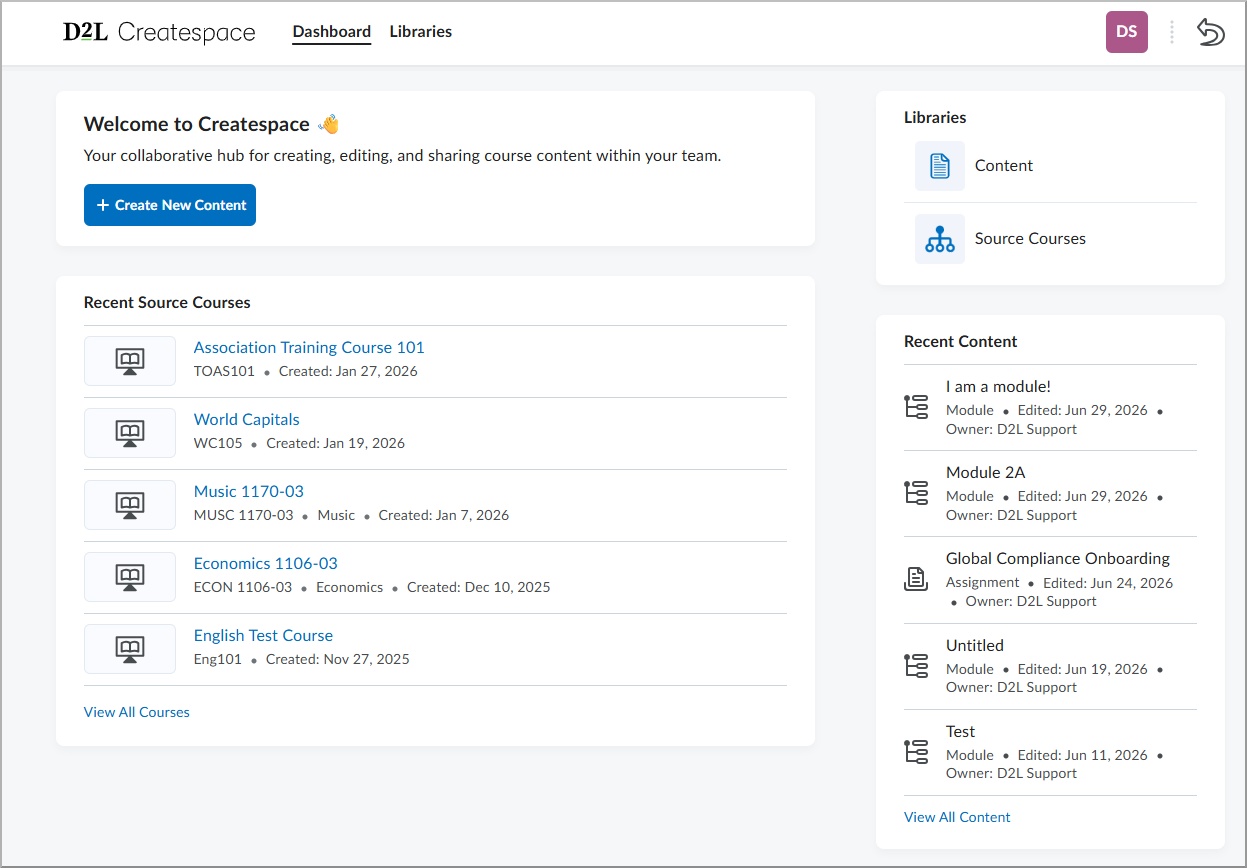
The more consequential addition for large deployments is Createspace, a centralized workspace built for instructional design teams. It gives content teams a single authoring environment, reusable content libraries, designated source courses for standardization, and folder-based collaboration, with deployment and syncing across every course that draws on a shared source. For any institution or corporate training org running dozens or hundreds of course sections off the same base curriculum, that solves a real operational headache: today, content drifts as individual instructors copy and modify their own versions with no central version control.
Createspace also adds outcome-alignment mapping directly into the authoring workflow, letting instructional designers tie learning outcomes to specific modules and submodules rather than bolting that mapping on after the fact through a separate compliance exercise. For institutions under accreditation pressure to demonstrate outcome tracking, or for corporate learning teams that have to prove training maps to competency frameworks, that is a meaningful reduction in manual reporting work, and it is the kind of feature enterprise buyers should weigh more heavily than any single AI tool. It also reduces the audit burden on instructional design staff heading into an accreditation site visit, since the mapping already exists inside the authoring tool rather than living in a separate spreadsheet someone has to maintain and reconcile by hand every semester.
The quieter API and workflow changes
A new Rubrics API lets external systems programmatically create, update, and delete rubrics, which opens the door for institutions to build automated grading workflows that span Brightspace and whatever assessment or proctoring tools sit alongside it. Combined with quiz-level question annotation tools that let learners flag and strike through answer choices during a test, the release leans toward giving instructors and administrators finer-grained control over the assessment experience rather than shipping flashy new AI chat features.
The Work To Do widget was also cleaned up so evaluation activities are hidden by default for multi-role users and completed modules drop out of the list automatically, a small change but one that reduces the noise administrators and TAs have to filter through daily. None of these individual changes will make a product demo slide. Taken together, they are exactly the kind of detail that determines whether a platform actually reduces the operational load a large institution carries at scale, across thousands of course sections and TAs, or simply adds another dashboard for already-stretched staff to check every morning.
Why this matters for buyers, not just users
The pattern across this release is instructive for anyone evaluating LMS platforms for a large deployment: D2L is investing more visible engineering effort in content operations and API extensibility than in headline-grabbing generative AI features. That is a defensible bet. Instructional design teams managing content sprawl across hundreds of course sections have a harder, more expensive problem than any individual instructor deciding whether to try an AI chatbot, and Createspace addresses that problem directly.
For CTOs and CIOs comparing Brightspace against Canvas, Blackboard Ultra, or Moodle-based alternatives, the right question is not whether the vendor has an AI grading feature: most now do, in some form. The better question is whether the platform gives instructional design and IT teams the version control, outcome mapping, and API surface to manage content at institutional scale without manual reconciliation. D2L's August release is a clearer answer to that question than to the AI feature-parity question.
The pricing question still unresolved
D2L has not published list pricing for Lumi Feedback or Createspace as standalone add-ons in the release documentation, which leaves procurement teams to negotiate case by case. That is consistent with how most LMS vendors are currently pricing AI features: as optional modules layered on top of a base contract, rather than included seat-for-seat. Buyers should expect that to shift over the next one to two renewal cycles as AI grading becomes a baseline expectation rather than a differentiator, which will put pressure on vendors to fold it into base pricing or lose deals to competitors who do.
In the meantime, institutions renewing Brightspace contracts this cycle have leverage to negotiate Lumi Feedback and Createspace access into the base agreement rather than paying incremental fees, especially given that competing platforms are shipping comparable automated grading capabilities on similar timelines. Vendor account teams will resist that framing initially, since AI add-ons carry meaningfully higher margins than the base license. The release cadence itself, monthly and incremental, gives buyers regular checkpoints to raise the issue again rather than waiting for a single annual contract cycle to make the case, and procurement teams should use that cadence deliberately rather than treating it as background noise.