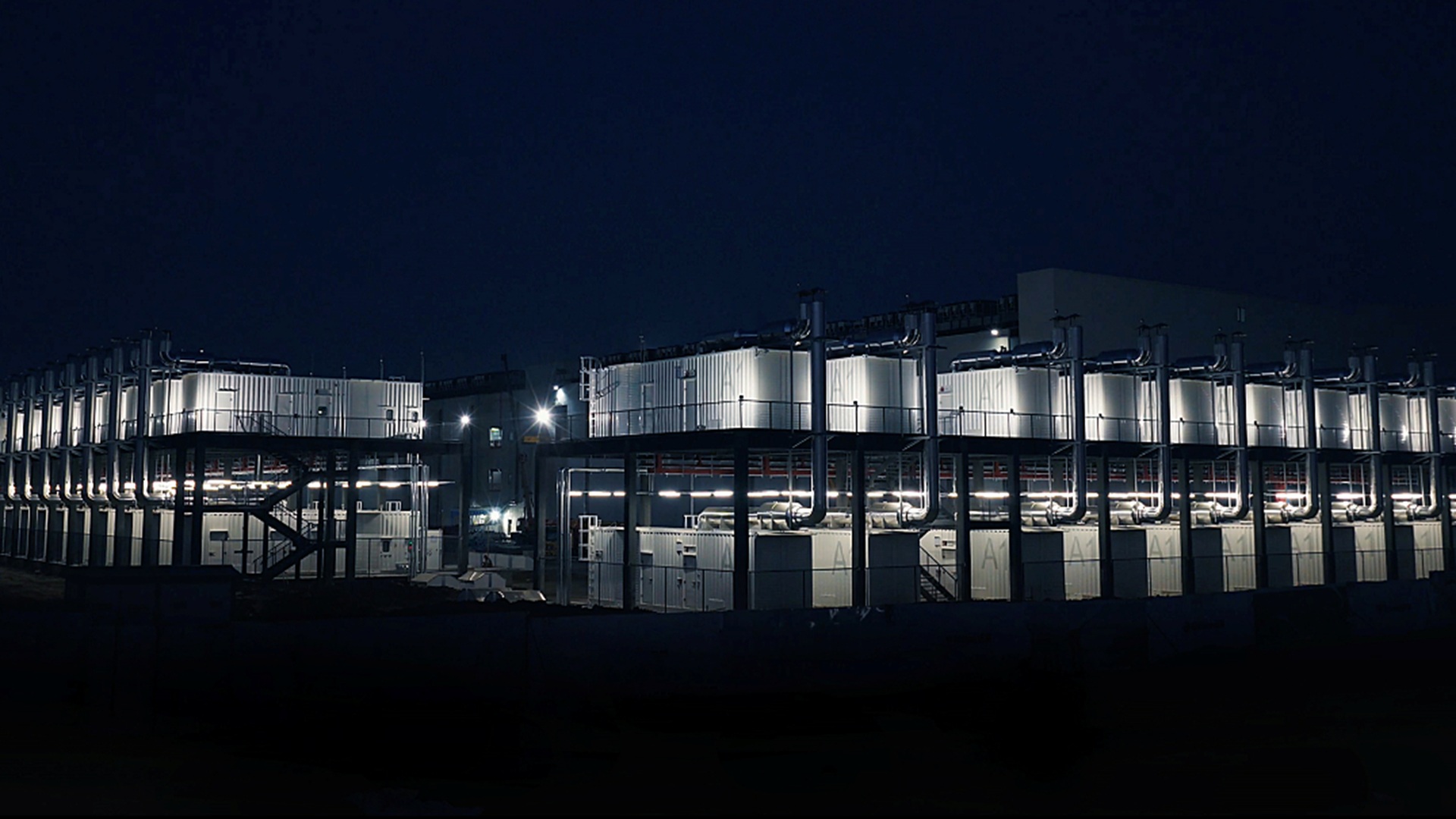
What Envision built
Envision Energy, the Chinese renewable energy and green technology company, commissioned its Galaxy Campus in Ulanqab, Inner Mongolia, on August 6. The facility is designed to eventually support up to 1 million AI accelerators and more than 2 gigawatts of capacity, delivering roughly 1 million PFLOPS of computing power across a 120,000 square meter building. Envision says the compute density per square meter runs about 10 times higher than conventional data centers, a claim tied directly to how tightly the facility integrates power and compute infrastructure rather than treating them as separate systems.
Ricky Zheng, general manager of Envision's AI data center unit, described the engineering challenge behind that density: "Supporting a million accelerators requires a purpose-built AI Power System that integrates renewable generation, dedicated transmission infrastructure, and large-scale energy storage to deliver stable, low-cost green power." That framing puts power system design, rather than server room layout or rack density alone, at the center of how the entire campus was engineered from the ground up, and it explains why the density gains came from rethinking the power supply chain rather than the compute hardware itself.
Power as the design constraint, not an afterthought
Most hyperscaler data centers are sited near existing grid capacity and then layer power purchase agreements on top to green the electricity mix after the fact. Envision's approach inverts that sequence. The company designed dedicated renewable generation, transmission, and storage into the Galaxy Campus from the start, using its own background as a renewable energy and battery storage developer rather than contracting that expertise out. Inner Mongolia's abundant wind and solar resources made the region a logical site for that strategy.
Zheng framed the broader thesis behind the project bluntly: "The next frontier of AI is infrastructure. As AI models become larger and more compute-intensive, the limiting factors are increasingly power availability, network performance and energy efficiency." That is the same conclusion Western hyperscalers and independent power producers like NRG have reached this year, arriving from a different starting point and a different regulatory environment, which suggests the power-first design pattern is becoming a global convergence point rather than a regional quirk.
Mission Gobi and the bigger bet
The Galaxy Campus is the first major milestone inside Envision's Mission Gobi program, unveiled at VivaTech in June 2026, which targets 5 gigawatts of green computing capacity built across desert and arid regions by 2030. The strategy treats sparsely populated, resource-poor land, exactly the terrain the Gobi region offers, as an advantage rather than a limitation, since abundant wind and solar exposure with minimal competing land use can support utility-scale renewable generation at a pace dense urban or coastal sites cannot match.
A 5 gigawatt target by 2030 would put Envision's AI infrastructure ambitions in the same range as the largest single-company data center commitments announced by US hyperscalers over the same period, built almost entirely on a renewable-first model rather than the natural gas and nuclear power deals dominating comparable announcements in North America. If the company hits even half of that figure on schedule, it would represent one of the largest concentrations of renewable-powered AI compute built anywhere in the world by the end of the decade, arriving well ahead of most Western competitors working through grid queues instead.
How this compares to the Western buildout
US and European hyperscalers have leaned heavily on natural gas, nuclear power agreements, and grid interconnection to meet AI power demand, running into exactly the queue congestion and community opposition now stalling projects in Texas and Maryland. Envision's Inner Mongolia campus sidesteps that entire category of friction by building dedicated generation and storage on-site in a region with far fewer competing land and grid claims, at the cost of choosing a location remote from major population centers and existing network backbones.
That tradeoff, remoteness in exchange for power availability, mirrors decisions Western operators are increasingly forced into as well, whether it is Meta running a Canadian site on gas turbines or Brookfield converting a former uranium enrichment site in Kentucky into a power-first campus. The key difference is that Envision's approach is renewable rather than fossil or nuclear, and it is happening at a pace that suggests China's domestic renewable manufacturing base, built over more than a decade of state-backed investment, gives it a genuine speed advantage in building power-integrated AI campuses at gigawatt scale.
What this means for global capacity planning
Enterprises benchmarking global AI compute capacity should treat China's power-integrated buildout as a parallel track worth monitoring closely, even where regulatory and geopolitical realities keep it out of reach for most Western enterprise workloads directly. The design pattern itself, a power system engineered alongside compute from day one rather than added after the fact, is transferable, and expect independent power producers and neoclouds in other markets to study Envision's approach closely as their own grid interconnection paths get more congested and expensive over the next several years.
The near-term implication is more about competitive dynamics than direct access for most enterprise buyers outside China. A 5 gigawatt renewable-first buildout by 2030 changes the global compute supply picture materially, and any roadmap assuming AI capacity growth is bottlenecked primarily by chip supply rather than power engineering needs to account for a major producer solving the power problem on a different, and potentially faster, track than the one most Western hyperscalers are currently running on.

