Coravel goes live with a customer already signed
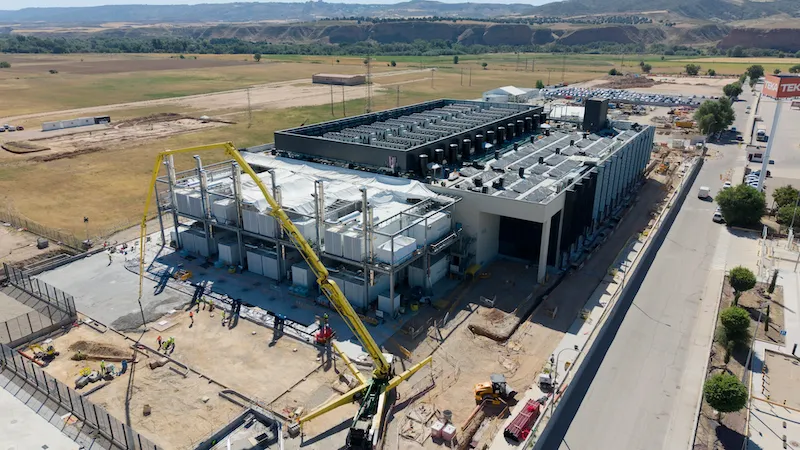
On July 14, ACS Group and Global Infrastructure Partners, the infrastructure arm BlackRock acquired in 2024, formally launched Coravel, the operating brand for a global data center platform the two first outlined in November 2025. The 50-50 joint venture did not arrive as a blueprint. Coravel opened with a signed hyperscaler customer covering roughly 140 megawatts of critical IT load across three purpose-built facilities at its Dallas-Fort Worth campus, plus rights to about 100 megawatts of future expansion across two additional buildings. Construction runs through 2028, with Turner, another ACS company, building the sites. For a launch announcement, having demand contracted before the brand exists is the headline.
Howard Boville, Coravel's chief executive, framed the pitch around delivery certainty. "Customers are increasingly seeking a single, accountable partner that can simplify delivery, reduce execution risk and provide certainty," he said. Juan Santamaria, chief executive of ACS Group, called the launch "an important milestone in ACS Group's strategy to build a leading global digital infrastructure platform." The message aimed at hyperscalers is coordination: one entity holding investment, development, construction and operations under a single accountable roof. That integrated posture is the product, and the Dallas-Fort Worth lease is the proof point Coravel wanted in hand on day one.
The pitch is one accountable partner, end to end
The data center supply chain has fractured into specialists: land bankers, power developers, general contractors, and colocation operators, each optimizing a slice. Hyperscalers stitching those slices together carry the integration risk, and in a market where a slipped substation or a delayed cooling delivery can push a campus past its GPU window, that risk now carries real cost. Coravel's argument is that folding capital, engineering, construction and operations into one balance sheet removes handoffs and compresses schedules. ACS brings the build muscle through Turner and its European engineering arms. GIP brings the capital depth and a long history of owning power and transport assets.
Whether that model actually delivers faster than a well-run colocation developer remains the open question. Turner and ACS have the construction resumes, and GIP has financed energy infrastructure at scale for two decades. The bet is that the coordination premium hyperscalers will pay for schedule certainty exceeds the margin a fragmented supply chain leaves on the table. Boville's leadership team was recruited from cloud, hyperscale and enterprise technology backgrounds, signaling that Coravel intends to speak its customers' operational language rather than a pure real estate one. Execution over the next 18 months at Dallas-Fort Worth will show whether the integrated story survives contact with a live build.
BlackRock reaches past the debt to own the operator
The more strategic signal sits on the capital side. Through GIP, BlackRock has spent two years assembling exposure to AI infrastructure, and Coravel moves it from financier to operating principal. Owning half of a platform that develops, builds and runs data centers gives BlackRock a claim on operating margin and long-term contracted cash flows, well beyond lending spreads. Those hyperscaler leases run for years and land with investment-grade tenants, exactly the duration and credit profile that institutional capital covets. Coravel becomes a vehicle to deploy that capital at scale while retaining operational control over how it gets built and monetized.
For the wider market, this is the pattern to watch. Private capital is no longer content to sit behind a developer as a passive lender. It wants the platform, the customer relationships and the recurring revenue. Coravel joins a lengthening list of investor-backed operating platforms competing for the same hyperscaler wallets that Digital Realty, Equinix and a wave of AI-specific developers already chase. The differentiator each claims is delivery certainty, and each will be measured on megawatts energized against schedule. Bruno Digital reads the launch as confirmation that AI data center supply is consolidating into a handful of deep-pocketed, vertically integrated names.
A 1.7 gigawatt pipeline across three continents
Coravel launches with a development portfolio of roughly 1.7 gigawatts, representing about 1.2 gigawatts of usable IT load, spread across Europe, the United States and Australia. That geographic spread matters for two reasons. First, it hedges against the power and permitting bottlenecks now defining where AI capacity can actually land, letting Coravel steer demand toward grids with headroom. Second, it positions the platform to serve hyperscaler and enterprise customers who need capacity inside specific jurisdictions for latency or data residency reasons. The 140 megawatts contracted in Dallas-Fort Worth is a down payment against that pipeline.
Converting a pipeline into energized halls is where these numbers usually meet reality. Gigawatts on a slide are cheap; interconnection queues, transformer lead times and local opposition are the constraints that decide delivery. Coravel has not disclosed the power arrangements behind its non-Dallas sites, and the gap between 1.7 gigawatts of pipeline and contracted, powered capacity is where the platform's credibility will be earned. For buyers evaluating Coravel against incumbents, the questions are concrete: which sites have secured power, on what timeline, and under what tariff. The launch answered the demand question for one campus and left the supply questions open for the rest.
The read for infrastructure buyers
For a CTO or head of infrastructure at a PE-backed SaaS or commerce business, Coravel will not sell you capacity directly. Its customers are the hyperscalers and large AI companies you already rent from. The relevance is second order and still material: platforms like this determine how quickly your cloud provider can add the GPU capacity you are waiting on, and at what cost. A more competitive, better-capitalized supply base for hyperscale shells should, over time, ease the capacity crunch that has kept GPU allocations rationed and priced at a premium.
The near-term takeaway is to treat AI capacity as a supply-constrained input and plan procurement accordingly. Track which operators your providers lean on, because delivery risk in the shell layer flows straight through to your instance availability. Coravel's integrated model, if it delivers, is a bet that consolidation and coordination will unclog that pipeline faster than a fragmented market could. Watch the Dallas-Fort Worth campus energize against its 2028 schedule as the first real data point. For now, Coravel is a well-funded new entrant with one signed customer and a lot to prove across three continents.