The mapping exercise came before the product
On November 9, BBC Bitesize published the results of a mapping exercise it ran with secondary school teachers to catalogue the work that surrounds lesson delivery rather than the lessons themselves. The exercise identified more than 140 distinct tasks spanning nine areas, including curriculum planning, assessment, safeguarding, student wellbeing, behaviour management and professional development. Rather than treating this as background research for a future roadmap, BBC Bitesize used the findings directly to decide what to build next, a sequencing choice that is unusual enough in edtech to be worth noting on its own.
Most learning-platform vendors start from a feature idea, a generative AI course builder or a new analytics dashboard, and then look for a workflow to attach it to. BBC Bitesize ran the process backwards: survey the actual task list first, then build the smallest tool that removes the most friction from it. The resulting product, a browser add-on and an improved search tool called Discover, is modest by design, and it is a useful discipline for any enterprise learning team under pressure to ship an AI feature before it has mapped the workflow that feature is meant to improve.
Nine categories of work no lesson plan covers
The nine areas BBC mapped read like a job description nobody writes down. Curriculum planning and assessment are the categories most learning platforms already target, but safeguarding, behaviour management and student wellbeing are the ones that consume disproportionate teacher time without a corresponding tool built for them. Participating teachers singled out homework tracking and assessment planning specifically as manual and time-consuming, tasks that sit at the intersection of several categories and therefore fall through the gaps of most single-purpose edtech products.
This is the part of the exercise with the clearest enterprise parallel. Any organisation measuring employee time spent on the job against time spent on the administrative scaffolding around the job, status updates, compliance documentation, cross-team coordination, will recognise the same shape. The scaffolding tasks are individually small, collectively enormous, and almost never show up in a role's formal description or in the metrics a learning platform is built to improve. Mapping them explicitly, as BBC did, is a prerequisite for building a tool that actually reduces the load rather than adding a 141st task to the list.
Shipping inside the tool teachers already use
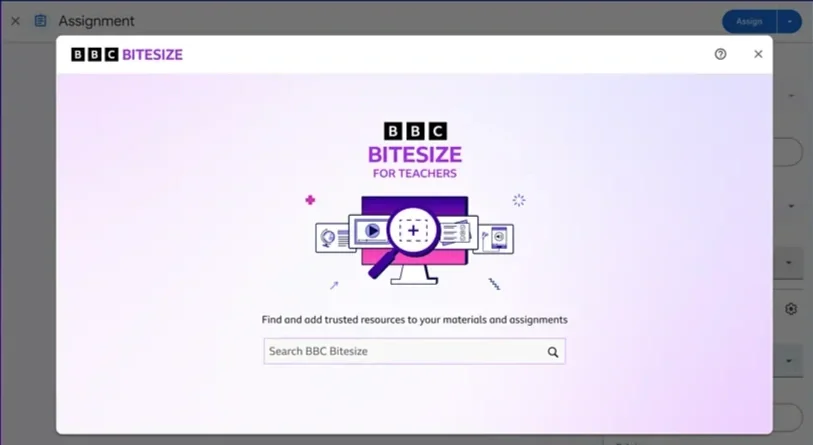
Instead of building a destination, BBC Bitesize built a Google Classroom add-on that lets teachers browse thousands of Bitesize resources, attach them to lessons and assignments, and share them with students without leaving Classroom. Search results are labelled 'For Teachers' or 'For Students' so the right content surfaces for the right audience inside a single interface. The rebrand accompanying the launch, BBC Teach becoming Bitesize for Teachers, with legacy resource URLs still resolving, signals a consolidation around one teacher-facing identity rather than a proliferation of separate portals.
Cerys Griffiths, Head of BBC Bitesize, framed the goal plainly: "We want to help teachers save time by bringing Bitesize into Google Classroom." That is a different ambition than building the best standalone resource library, and a more disciplined one. Every enterprise software buyer has sat through a vendor's pitch for yet another dashboard that promises to become where work happens. The harder and more durable move is embedding useful functionality inside the system of record the organisation has already standardised on.
The governance checkpoint enterprise buyers will recognize
The add-on is not simply available to any teacher who wants it. Schools' Google Workspace administrators need to approve it through the Google Workspace Marketplace before teachers can install it, the same procurement checkpoint that governs any third-party add-on inside a managed Workspace environment. That detail reframes the launch from a consumer-style product release into an enterprise software distribution problem, complete with an IT approval gate, a review cycle and the likelihood that some districts adopt it quickly while others sit in a backlog for months.
For enterprise technology leaders evaluating vendors who promise frictionless adoption, this is the reminder that any tool living inside Google Workspace or Microsoft 365 inherits that platform's governance model whether the vendor designed for it or not. A product strategy built around integrating with what an organisation already uses only delivers its promised speed if the organisation's own admin approval process is fast enough to match it, which is as much an internal IT capacity question as a vendor capability question.
Time saved is not the same as load removed
BBC's companion research, a survey of 500 teachers, found 77% rank saving time on lesson planning and preparation as a priority when choosing digital learning resources. That statistic alone would justify most vendors' marketing claims. Matt Green, the former teacher and creator who worked on the integration, reframed the burden as something broader than raw hours: the real cost, he said, is "the mental load of constantly keeping track of everything."
That distinction, between hours saved and load removed, is one most enterprise learning teams measure badly. A tool that shaves fifteen minutes off a single task but adds a new interface to check, a new login to remember or a new report to generate, can increase cognitive load even as it reduces logged time. Green's framing of the integration's goal, making existing tools work better together, without adding another job to the list, is a sharper design bar than most enterprise learning platforms set for themselves, and a useful one to borrow when evaluating a vendor's next feature release.
The lesson for enterprise learning tool design
None of this is really a K-12 story. It is a product discipline case study that happens to be set in a UK secondary school. Map the actual workflow before building, measure cognitive load rather than just logged hours, ship inside the system of record rather than building a new one, and expect the organisation's own IT governance to gate adoption speed regardless of how good the integration is. Those four lessons apply as cleanly to a corporate L&D platform choosing between a standalone LXP and a Microsoft Teams or Salesforce-embedded experience as they do to Bitesize and Google Classroom.
Enterprise learning leaders evaluating their 2027 platform roadmap should treat BBC's sequencing, research the real task list, build the narrowest tool that removes the most friction, embed it rather than add a destination, as a more reliable predictor of adoption than any vendor's feature count. The teachers BBC surveyed did not ask for more tools. They asked for less to keep track of, and that is the bar every enterprise learning platform claiming to reduce workload should be measured against.