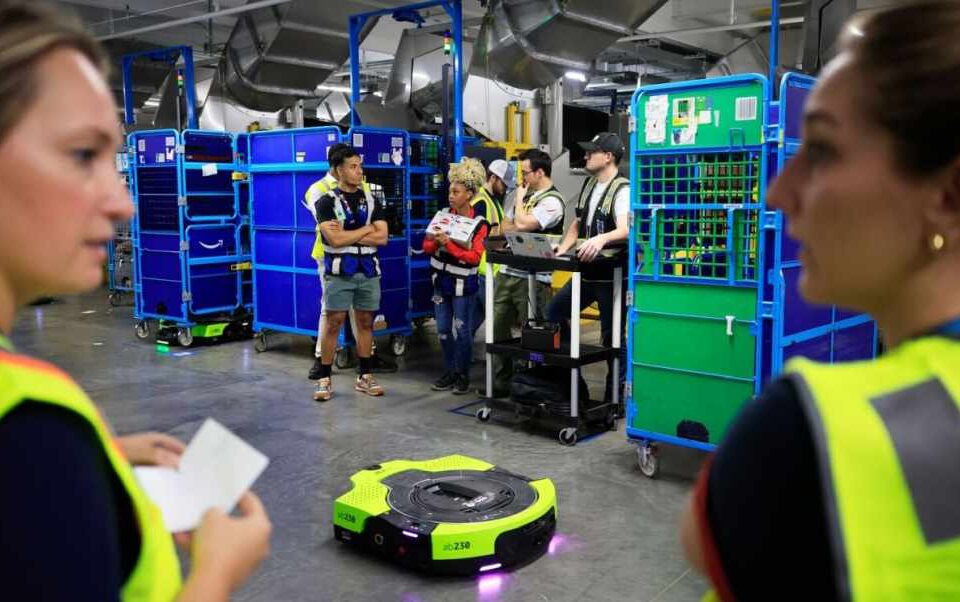
Amazon used its Delivering the Future event at the Dartford fulfillment center east of London on June 4 to unveil a next-generation Proteus autonomous warehouse robot that accepts conversational spoken commands, alongside a €10 billion ($11.6 billion) European expansion plan. The new Proteus drops the rigid predefined programming of the current generation in favor of natural-language interpretation similar to the large language model assistants that consumers already know. Scott Dresser, VP of Amazon Robotics, summarized the operating model: "You tell it what needs to be done. It figures out the priority, the route, the timing." Today's Proteus fleet runs at 25 U.S. facilities and primarily moves carts of up to roughly 400 kg in dock areas. The next-gen unit will navigate the full warehouse floor and reach European sites in the first half of 2027, according to Amazon's release covered by Tech Startups.
Voice-controlled Proteus and the dark DC timeline
The capability jump matters more than the voice interface headline. The current Proteus is essentially a smart pallet jack confined to dock zones; the next generation moves anywhere in the building and accepts task assignment in natural language from any associate carrying a handset. That changes the integration story for retrofits. Operators no longer need a full WMS rewrite and a dedicated robotics integrator to add fleet capacity; they can drop units onto an existing floor and let workers issue tasks the same way they would brief a temp. Amazon will not ship Proteus to third parties, but the reference architecture is now public, and Geek+, Locus Robotics, Exotec, and AutoStore will face direct customer pressure to match the voice-tasking primitive within 12 to 18 months.
STARK and Vulcan close the picking gap
Alongside Proteus, Amazon introduced STARK, a robotic tote-handling system first tested in Barcelona that will deploy across 15 European facilities by 2027, and Vulcan, a tactile-sensing picker designed for fragile and irregularly shaped SKUs. The three robots tackle different bottlenecks: Proteus handles bulk movement across the building, STARK handles container manipulation at packing stations, and Vulcan handles the final picking step that has stayed stubbornly human. With all three deployed at scale, Amazon is signaling that a fully automated general-merchandise fulfillment center is within a 24 month horizon for its largest European nodes. Vulcan is the most strategically significant of the three. Picking is the cost line that has resisted automation for two decades, and Amazon's published throughput data implies a 30% to 50% unit-pick cost reduction once Vulcan reaches mature deployment.
Where the €10 billion actually lands
The €10 billion goes into modernizing European fulfillment and opening more than 25 new same-day delivery sites in the UK and Germany in 2026 alone. Amazon Now, the ultra-fast delivery brand, extends to Manchester and Birmingham this year. Same-day grocery delivery is live in more than 2,300 U.S. cities plus parts of Tokyo, with active expansion plans for Japan and Britain. At the corporate level, Amazon's 2026 capex guidance now sits above $200 billion, more than 50% above 2025, with AI infrastructure and warehouse automation as the two largest line items. The grocery extension is the more shake up vector for continental Europe; Amazon has clearly resolved the perishables and basket-size unit economics enough to scale, and the German and French metros are the obvious next targets after the UK builds out.
Our read for European retail and 3PL CTOs
We think CTOs at European grocers, electronics chains, and contract logistics providers should treat the Dartford announcement as a procurement-timing forcing function, not a competitive curiosity. The buying window for AutoStore, Exotec, Geek+, Dexterity, and Symbotic systems has roughly 12 to 18 months before vendor backlogs lengthen and pricing firms. Carrefour, which has been incrementally automating its dark stores around Paris and Madrid, now has a defensible reason to bring a 2027 capex line forward into 2026. Schwarz Group, with Lidl and Kaufland operating some of the densest store networks in Europe, should accelerate the in-store micro-fulfillment pilots it ran in 2024 rather than waiting for a 2028 group-wide rollout. Otto Group, which runs its own DCs for general merchandise, is the clearest candidate to benchmark Vulcan-class tactile picking against its current Hermes pick lines.
On build versus buy, we lean buy for tote handling and bulk movement (the vendor field is mature) and selective build-with-partner for tactile picking, where IP is still concentrated at three or four suppliers and lock-in risk is real. Concretely, we would size automation commitments at 8% to 12% of 2026 logistics opex, target a 30% pick-cost reduction by end of 2027, and write break clauses into any multi-year vendor contract tied to Amazon's published Vulcan benchmarks. Waiting for the 2027 capital cycle means buying into a tighter market against a competitor that has already locked in capacity.
The closing window on automation parity
Amazon spent the last decade teaching the European retail sector that fulfillment cost is a strategic variable, not an operational one. Dartford is the moment the lesson gets a price tag attached. A €10 billion build-out backed by three new robotic primitives resets the cost basis of European retail logistics over the next 24 months, and the operators who delay their own automation commitments will not be competing on service in 2028; they will be competing on whether they can still afford to fulfill an order at all.