What Albertsons actually shipped
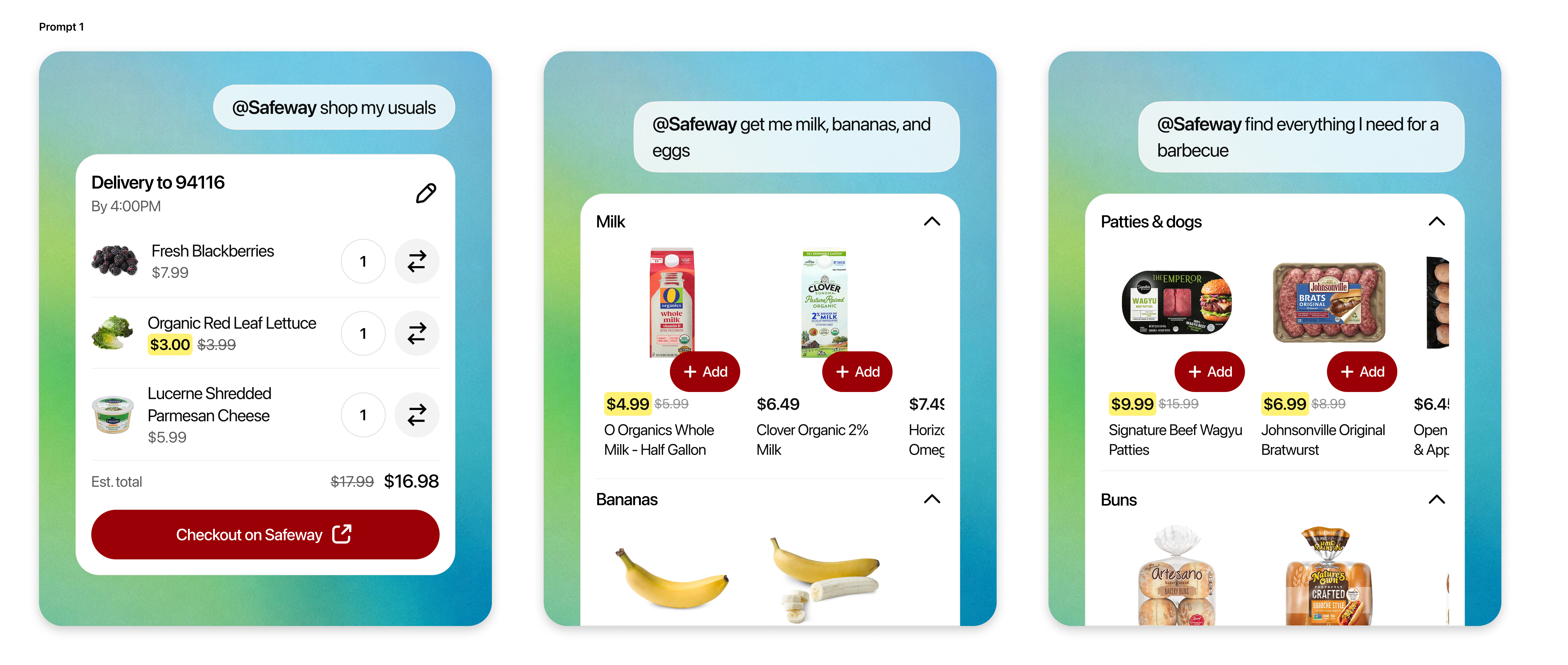
On August 5, Albertsons Companies announced a Safeway plugin inside ChatGPT. Shoppers can type @Safeway followed by a request like reorder my weekly shopping list or help me plan a quick pasta dinner for four, and the assistant returns relevant Safeway products pulled from real inventory and pricing. The shopper can adjust the selections inside the chat before being redirected to Safeway's own site or app to complete checkout, keeping the final purchase step under Albertsons' own control rather than OpenAI's.
Jill Pavlovich, Albertsons' senior vice president of digital customer experience, framed the move around meeting shoppers where they already are: research tells us that consumers are increasingly interested in using AI to help with grocery shopping, she said, adding that the plugin is meant to make grocery shopping as simple as having a conversation. The company has more than 2,240 stores and 1,708 in-store pharmacies across 22 banners in 35 states, giving the integration meaningful reach if adoption follows the company's own research.
Checkout stays home, and that is the interesting part
The design choice worth dwelling on is where the transaction actually completes. Rather than letting OpenAI's Instant Checkout process the payment inside ChatGPT, Albertsons routes the shopper back to Safeway's own platform to finish the purchase. That keeps the transaction data, the loyalty attribution, and the customer relationship inside Albertsons' systems rather than handing it to a third-party checkout flow, preserving the retailer's ability to tie the purchase back to a loyalty account and personalize the next visit accordingly.
That is a meaningfully different bet than the one Walmart made and then reversed. Walmart tested OpenAI's Instant Checkout for five months before pulling it in March 2026, citing accuracy problems, poor integration with internal systems, and conversion rates well below Walmart's own channels. Albertsons appears to have designed around exactly that failure mode from the start, using the AI platform for discovery and cart-building, where it adds genuine convenience, while keeping the transaction itself on infrastructure the retailer fully controls and can measure end to end.
The plugin is the third move in a sequence, and that matters
The ChatGPT plugin sits at the end of a deliberate build-up rather than standing alone as a single experiment. Albertsons launched an agentic shopping assistant across its own properties in December 2025, and in February 2026 it ran a pilot with OpenAI exploring conversational advertising formats inside AI platforms. The Safeway plugin follows as the third step in that sequence, giving the company a body of internal data and lessons to draw on before extending its reach onto a platform it does not control.
That sequencing is the part other grocery CIOs should pay attention to. Albertsons built its own AI shopping capability first, tested advertising and monetization mechanics second, and only then extended into a third-party AI platform. That order matters because it means the company had already worked out its data model, its recommendation logic, and its measurement approach before exposing any of it to an external chat interface it does not control.
The demand signal behind the timing
Albertsons has real data behind this bet. Dunnhumby's 2026 Consumer Trends Tracker, published in February, found that 15% of surveyed US consumers already report using AI tools like ChatGPT for grocery shopping, with building shopping lists and comparing prices as the leading use cases. That figure comes from a measured survey of actual consumer behavior, and it gives grocery CIOs a defensible reason to prioritize AI plugin work over other roadmap items competing for the same engineering time.
It also explains why grocers are moving in parallel rather than waiting to see who wins first. Kroger has its own AI shopping assistant built on Google's Gemini Enterprise, and Cooklist's agentic cart-builder now runs across Kroger banners and Wegmans stores. The category is converging on the same conclusion from different starting points: conversational AI is becoming a standard grocery shopping surface, and a fifteen percent adoption figure this early in the technology's life points to mainstream behavior rather than a niche curiosity.
The build vs buy question for grocery CIOs
Every grocer now faces a version of the same decision Albertsons just made public: build a proprietary AI shopping assistant, plug into an external platform like ChatGPT while keeping checkout in-house, or hand the whole flow to a third party like Instacart or OpenAI. Each path trades control for reach in a different ratio. Albertsons' hybrid approach, discovery through ChatGPT with checkout on owned infrastructure, is a reasonable answer for a retailer with the engineering capacity to maintain both a proprietary assistant and a third-party integration simultaneously.
Smaller grocery chains without that capacity face a harder call. Relying entirely on a platform like Instacart or a startup like Cooklist for agentic shopping capability is faster to ship but cedes more of the customer relationship. The Albertsons model is instructive precisely because it shows a mid-path is achievable: use external AI platforms as a discovery channel while insisting the checkout, the data, and the loyalty tie stay on infrastructure the retailer owns.
What to watch next
The real test for the Safeway plugin will be adoption and conversion over the coming quarters, well beyond the announcement itself. Albertsons has not published usage figures yet, and the company's own December 2025 assistant and February 2026 advertising pilot give it internal baselines to compare against. Grocery CIOs evaluating similar moves should ask their own AI product teams for the same discipline: instrument the plugin from day one so there is a real conversion number to point to in six months, backed by data rather than a press release alone.
The broader signal is that grocery retail has settled on a shape for this technology faster than general merchandise retail did. Where general retailers spent 2025 experimenting with full third-party checkout and then walking parts of it back, grocers appear to be converging directly on the hybrid model Albertsons just shipped. That is worth noting for any CTO deciding how much engineering time to spend building an in-house assistant versus wiring up presence inside the AI platforms shoppers already use.