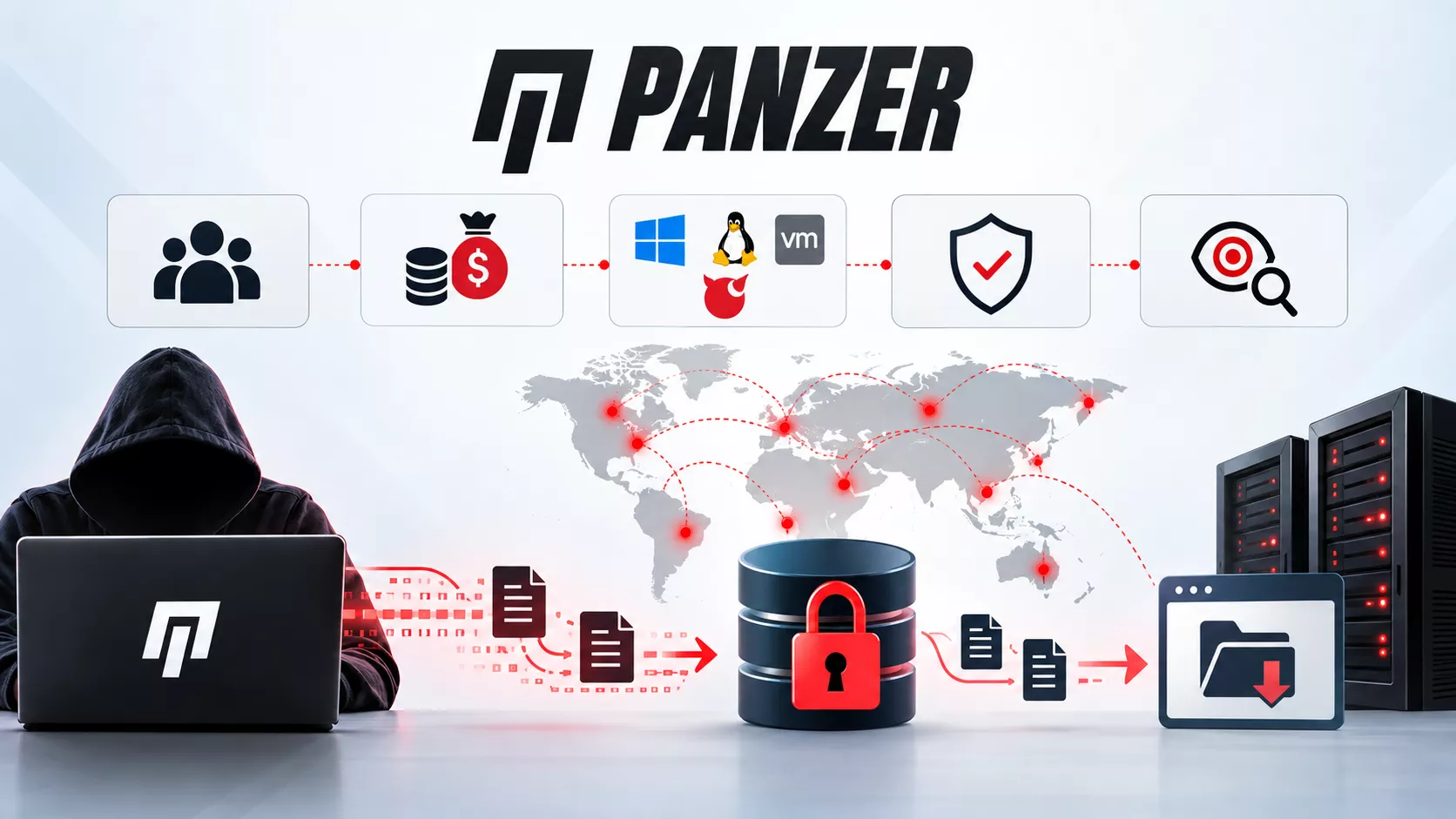
A new name enters the ransomware economy
Security researchers documented a new ransomware-as-a-service operation called Panzer on September 5, already credited with 16 confirmed victims spread across 11 countries in what appears to be its opening wave of activity. The geographic spread is unusually wide for a launch phase: three victims in Thailand, two each in Italy, Indonesia, and Serbia, and single confirmed incidents in South Korea, Spain, the Czech Republic, Germany, Nigeria, Switzerland, and Curaçao, a footprint that spans four continents within days of first being noticed.
The sector breakdown tells its own story about intent. Technology firms account for four of the 16 victims, manufacturing for three, with the remainder scattered across government, defense, agriculture, education, energy, and retail organizations. That distribution does not read like an opportunistic spray against whatever target happened to be easiest to hit. It reads like an operation deliberately testing its tooling against a varied set of environments before committing to scale further.
Double extortion with a franchise model
Panzer follows the now-standard double-extortion playbook: exfiltrate data first, encrypt systems second, and threaten public leak of the stolen files regardless of whether the victim ultimately pays for the decryption key. What sets it apart operationally is the affiliate infrastructure built up behind the encryption tooling itself. The group runs a semi-open recruitment process that screens prospective affiliates over Tox, the encrypted messaging protocol long favored by ransomware crews specifically for its resistance to law enforcement takedown efforts.
Accepted affiliates keep an 80 percent cut of every ransom payment, leaving only 20 percent for the platform operators themselves, an economics-first pitch clearly designed to pull experienced operators away from competing RaaS brands offering less generous splits. A dashboard reportedly tracks affiliate balances, available builds, support tickets, and leak-site publishing workflow in one interface, industrializing coordination work that used to require far more ad hoc communication between criminal collaborators.
Cross-platform builds mean virtualization is not a safe harbor
Panzer ships builds for Windows, Linux, VMware ESXi, and FreeBSD, an unusually broad platform matrix for a newly surfaced operation still in its first documented wave of victims. The ESXi build matters most for enterprise infrastructure teams specifically, because ransomware capable of natively encrypting hypervisor datastores can take down every virtual machine running on a compromised host in a single operation, turning one stolen credential into a full-site outage rather than a contained, single-server incident.
This mirrors a pattern the ransomware ecosystem has been consolidating around for roughly two years now. Groups that once focused narrowly on Windows domain environments have converged on ESXi support as a baseline expectation, because it multiplies blast radius achieved per successful intrusion at very little extra development cost to the group building the toolkit. Any organization still treating its virtualization layer as somehow outside the ransomware threat model is operating well behind where the attackers already are today, and likely lacks basic monitoring on the hypervisor management plane itself.
Retention over volume in the affiliate pipeline
One detail in the Panzer program stands out on close reading: affiliate accounts showing no activity within their first week get automatically deactivated from the platform. That is a retention-focused design choice rather than a growth-at-all-costs one, and it suggests the operators are optimizing deliberately for a smaller pool of consistently active affiliates instead of maximizing raw headcount, likely because active affiliates generate steadier ransom flow and produce lower operational noise per dollar the platform ultimately earns.
The tactics observed alongside the ransomware itself are unremarkable individually and well documented elsewhere: OS credential dumping, brute-force login attempts, internal network discovery, abuse of valid accounts, lateral movement through remote services, and disabling of installed security tooling. None of that is novel tradecraft on its own. What stands out is how tightly it maps to techniques most enterprise detection stacks are already built to catch, meaning the real differentiator here is the affiliate business model, not any new technical capability.
What to do without confirmed indicators yet
No malware hashes, command-and-control domains, or IP addresses tied specifically to Panzer have been independently verified as of this writing, and no established group has claimed public credit for the crew building it. That absence leaves defenders without the usual quick win of simply blocking known infrastructure at the firewall, so the near-term response has to lean on behavioral detection rather than static, signature-based rules that assume a known indicator to match against first.
For PE-backed SaaS and retail-commerce operators specifically, prioritize hardening the ESXi management plane now: enforce multi-factor authentication on vCenter and host consoles, segment hypervisor management networks away from general corporate traffic, and verify that credential dumping and lateral movement attempts via remote services would trip an alert well before ever reaching virtualization infrastructure. Given the group's early cross-sector reach across four continents, assume it will keep expanding rather than treating this as a contained, regional problem confined to its first known victims.
How Panzer fits the broader RaaS market
Panzer arrives into a ransomware-as-a-service market that has consolidated significantly around a handful of dominant brands over the past several years, even as law enforcement takedowns have periodically disrupted the leaders. New entrants typically compete on either technical differentiation or affiliate economics, and Panzer's public pitch leans hard on the latter: an 80 percent affiliate cut is at the generous end of what established brands offer, and the polished dashboard tooling suggests real development investment went in before the group went public with its first victims.
That investment pattern matters for how seriously defenders should take an unproven name. Ransomware crews that launch with working cross-platform builds, a functioning affiliate portal, and a screening process already in place are typically not first-time operators experimenting with their first campaign. They are more often experienced affiliates or developers rebranding after a previous operation folded under law enforcement pressure or an internal affiliate dispute, bringing existing access, tooling, and criminal relationships with them into the new brand.


