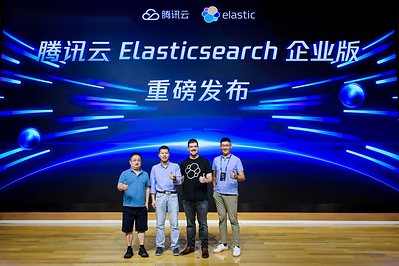
What the two companies announced
Tencent Cloud and Elastic expanded their partnership on August 31, 2026 with the launch of Tencent Cloud Elasticsearch Service Enterprise Edition, pitched explicitly as context infrastructure for the AI era rather than a routine search engine upgrade. The framing matters more than it might first appear: this release is less about full-text search for a public website and considerably more about giving large language models and agentic applications fast, relevant, well-ranked access to enterprise data precisely at the moment of retrieval, which is where most production AI systems quietly bottleneck today.
Tencent Cloud's Cheng Bin, general manager for the service, described AI search as evolving into infrastructure that connects enterprise data, models, and applications together, positioning search itself as a foundational layer every agentic system needs rather than a standalone product category sold on its own. Elastic's Han Xiao went a step further, arguing that search in 2026 is really about test-time compute for longer-horizon tasks, a framing that treats retrieval quality as a direct input into how well an agent ultimately reasons, not merely a lookup step performed before the real reasoning begins.
The performance numbers, and why they matter for agents
The headline claims from the announcement are specific rather than vague: up to 5x faster AI search performance in selected scenarios, a 60 percent reduction in hybrid search latency, and memory consumption cut by more than half in production workloads. Hybrid search, which blends traditional keyword matching with vector similarity search, is the pattern most enterprises are actually running today for retrieval-augmented generation, so latency improvements measured there translate directly into faster agent response times in production rather than into a synthetic benchmark that does not reflect how teams actually query their data.
Two real deployments back the marketing numbers with concrete production data rather than lab conditions alone. Tencent's own ima application saw a 71 percent reduction in memory use and a 58 percent improvement in retrieval performance after migrating onto the new service. Separately, automaker NIO reported that attack investigation time, run over security telemetry indexed in Elasticsearch, dropped from multiple hours down to roughly two minutes. That is the kind of specific before-and-after figure that is considerably harder to dismiss as vendor optimism, since it is tied to a named customer and a precise operational metric rather than an aggregate average.
Scale as the real proof point
Tencent Cloud says its Elasticsearch service already runs across 20,000 clusters and 100,000 nodes in active production, which places the performance claims in a materially different context than a startup announcing a brand-new search product with no operating history behind it. Enterprises adopting AI search infrastructure are rightly wary of vendors whose architecture has not been proven at genuine scale, since retrieval systems that perform well in a tidy proof of concept frequently fall apart entirely under real production query volume, uneven data freshness, and the messy edge cases that only show up at scale.
Elastic's Patrick Dixon summarized the underlying thesis in a single sentence: context is becoming increasingly important to enterprise AI applications. That is a fairly understated way of stating something CIOs are learning the hard way across this year's AI rollouts, that the quality of an AI agent's output is very often bottlenecked less by the underlying model itself and more by how well the surrounding infrastructure surfaces exactly the right enterprise data at exactly the right moment during a query.
What this signals for the search and vector database market
This announcement adds another data point to a trend that has been building steadily since retrieval-augmented generation became the default architecture for enterprise AI deployments: incumbent search and analytics engines like Elasticsearch are competing head-on with purpose-built vector databases by shipping hybrid search and raw performance improvements, rather than ceding the emerging category to newer, narrower entrants. A 60 percent latency cut on hybrid queries functions as a fairly direct answer to the common pitch that dedicated vector databases are inherently faster than general-purpose search platforms.
For enterprises that already run Elasticsearch for logging, observability, or conventional full-text search, this development meaningfully reduces the case for standing up a completely separate vector database purely for AI retrieval workloads. Consolidating retrieval infrastructure onto a platform teams already operate day to day is a considerably easier operational story to sell internally than adding an entirely new specialized system, provided the performance claims actually hold up under a given team's real workload rather than the vendor's carefully chosen benchmark scenario.
Where scrutiny should focus next
The performance figures are described throughout as achieved in selected scenarios, which is standard vendor language but also a fairly clear signal that results will vary considerably by data shape, query pattern, and index configuration across different customers. Enterprise buyers should treat the 5x and 60 percent figures as a ceiling worth validating against their own specific workloads rather than as a guaranteed outcome, particularly for hybrid search setups involving large, frequently updated document sets with complex filtering requirements.
The more durable signal in this announcement is directional rather than numerical: both Tencent Cloud and Elastic are now explicitly building for agentic workloads first, not treating search and observability as the primary use case with agents bolted on afterward. Enterprises building internal AI agents on either platform should expect a noticeably faster cadence of retrieval-specific features going forward, and should budget real evaluation time to keep pace with a market that is now optimizing hard for precisely this emerging use case.