The quarter Wayfair needed
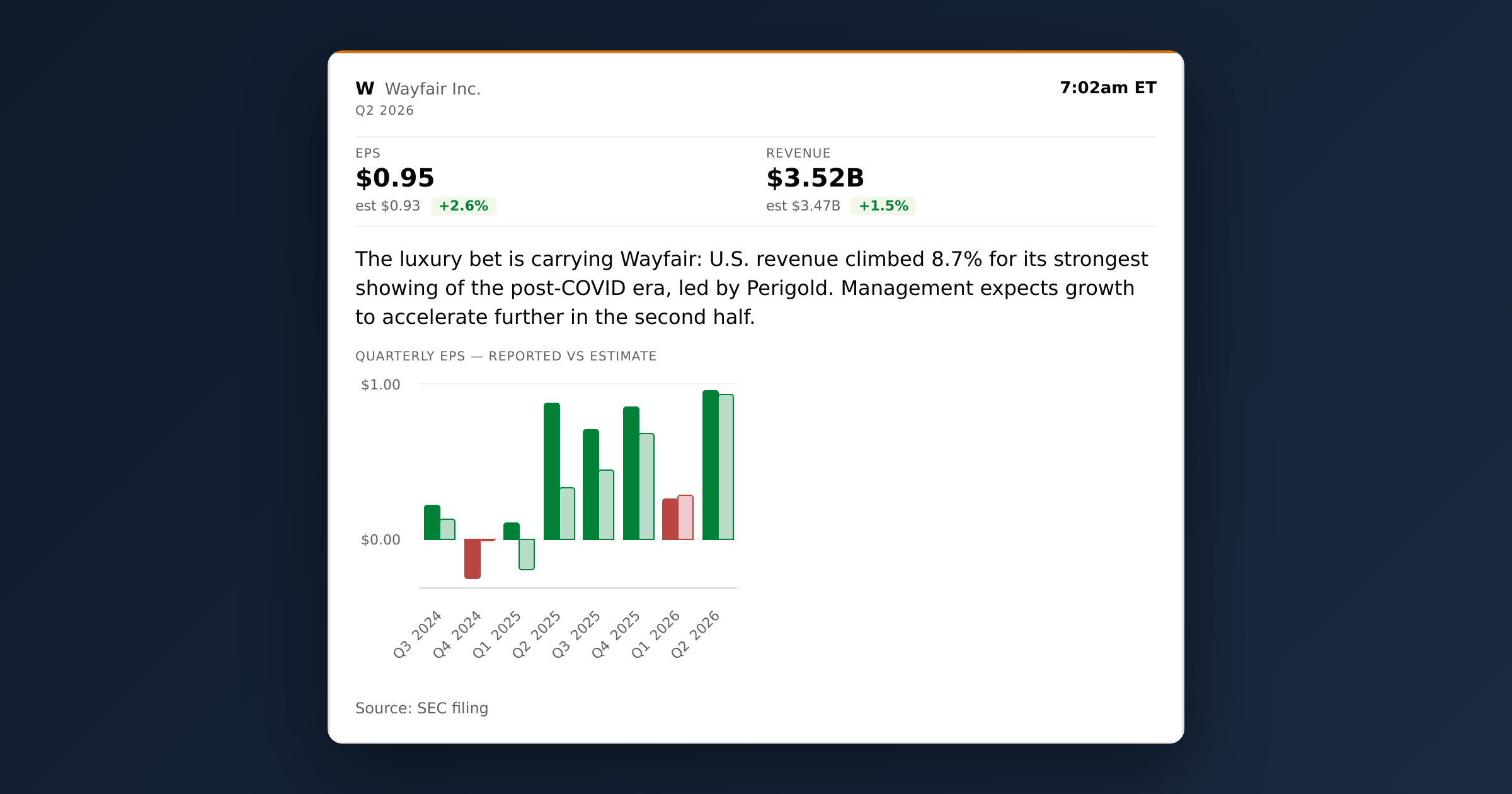
Wayfair reported second-quarter 2026 results on August 4 that mark its strongest performance in years, arriving after several years of investor skepticism about the company's path to durable profitability. Net revenue grew 7.5% year over year, with U.S. revenue up 8.7% while international revenue slipped 1.3%, showing that the growth is heavily concentrated in Wayfair's home market rather than spread evenly across its global footprint. Adjusted EBITDA reached $242 million, a 6.9% margin that the company called its best since 2021, back when pandemic-driven home spending was still propping up furniture and home goods demand across the industry.
Orders grew 6% year over year, with new order growth accelerating to its highest rate since the pandemic-era surge in home goods spending. Free cash flow climbed 30% year over year to $301 million, and gross margin held at 30.0% of net revenue even as the company continued investing in customer experience. For a company that spent much of the past few years fighting doubts about its ability to sustain profitability, a quarter combining accelerating order growth with expanding margins is the exact combination investors have been waiting years to see.
The number that stands out
Buried inside the earnings commentary was a specific and striking figure: Wayfair built a proprietary AI pipeline for product imagery that reduced production costs from roughly $2 million to less than $10,000, a reduction of more than 99%. Product photography at Wayfair's scale, hundreds of thousands of SKUs spanning furniture, decor, and home goods, has historically required physical studios, staged shoots, and significant post-production work for every single item added to the catalog, an expense that scaled directly with how many new products the company wanted to list.
Replacing that pipeline with AI-generated or AI-assisted imagery does not just cut cost, it removes a structural bottleneck that has limited how fast new suppliers and products could get listed with production-quality photos ready to publish. For a marketplace business where catalog breadth is a direct competitive lever against Amazon and specialty retailers, collapsing the cost and time required to onboard new inventory is a genuine strategic advantage, not just a line-item win buried in a cost-accounting footnote somewhere in the filing.
Growth Wayfair says it built, not borrowed
CEO Niraj Shah was explicit that the quarter's strength came from initiatives Wayfair controls directly, including loyalty programs, its physical store expansion, and product-led growth work, rather than from any improvement in the broader home goods spending environment that the company does not control. That framing matters because it positions Wayfair's turnaround as durable and repeatable rather than a byproduct of a macro tailwind in consumer spending that could reverse just as quickly as it appeared without much warning at all.
CFO Kate Gulliver reinforced that framing, noting that investments in customer experience are generating strong returns and that gross margin pressure from those investments has been offset by reduced advertising spend elsewhere in the business. In other words, Wayfair is spending less to acquire new customers while spending more to keep the ones it already has satisfied and returning, a mix shift that shows up directly and favorably in the company's margin line each quarter.
Perigold and the higher end of the catalog
Wayfair's luxury brand Perigold grew more than 35% in the quarter and now generates over $400 million in annual sales, while the company's specialty retail brands collectively grew nearly 20% over the same period. Active customers grew 3% year over year, a modest but genuinely positive number for a business that spent the past two years working to stabilize its customer base after pandemic-era home spending demand normalized back down to more typical long-run levels across the industry, and one that suggests the AI-driven margin gains are arriving without sacrificing the underlying customer growth investors watch most closely.
The strength at the higher end of Wayfair's portfolio suggests the AI-driven cost efficiency in product imagery is not coming at the expense of catalog quality or brand presentation, an important detail for a segment where buyers expect polished, high-fidelity photography before they will commit to a large furniture purchase online without ever seeing or touching the actual piece in person beforehand. That combination of lower production cost and maintained visual quality is precisely what skeptics of AI-generated imagery have questioned, and Perigold's growth this quarter is early evidence the tradeoff has not materialized.
What it means for ecommerce operators
Wayfair's imaging pipeline is a concrete data point in a broader shift already underway across ecommerce: generative AI is moving from marketing experiments into core operating cost lines that show up directly in gross margin rather than sitting off to the side as an innovation project. A 99% reduction in a specific, well-defined cost center is the kind of number that gets cited in board decks well beyond Wayfair's own, and it raises the competitive bar for any retailer still running traditional photography studios at scale in 2026.
For enterprise retail and ecommerce leaders, the lesson is less about photography specifically and more about where else in the catalog and content pipeline similar reductions might be hiding, unnoticed, inside an existing fixed cost budget. Wayfair's Q2 results suggest that companies willing to rebuild a supposedly fixed cost center around AI tooling can convert that savings directly into margin expansion, without having to wait for a friendlier demand environment to show up first before results follow. Category descriptions, size and fit guides, and installation instructions are all reasonable next candidates for the same treatment.


