A billion dollar bet on one Georgia county
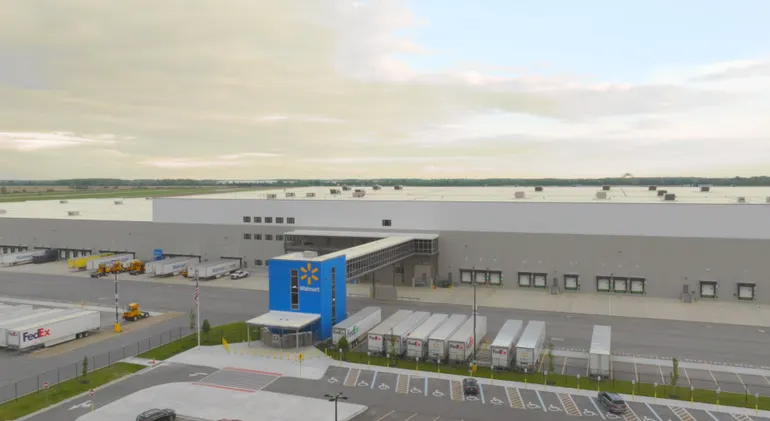
Walmart is putting 1.3 billion dollars into a new 1.5 million square foot fulfillment center in Carnesville, Georgia, according to a Georgia Department of Economic Development announcement covered by Supply Chain Dive. Construction is slated to begin in late 2026, and the project is expected to create 1,000 jobs. The company already runs 209 stores and Sam's Club locations in the state plus 11 supply chain facilities, which makes this a capacity expansion layered onto a market Walmart has already committed to heavily for years, arriving well after the retailer secured its physical footprint there rather than as a first entry into it.
The press language calls it a next generation automated fulfillment center built to expand same day and next day shipping across the country. That framing is the part worth sitting with. Walmart is describing a node in a national same day network, and the figure attached to it, 1.3 billion dollars, is a statement about how much the company will spend per node to keep that promise intact as delivery expectations keep compressing toward same-day defaults across every category it sells.
The number that matters more than the building
The detail buried in the coverage is more useful to a technology leader than the announcement itself: more than half of Walmart's e-commerce fulfillment volume already moves through automated systems, and the company plans to retrofit 23 of its 42 regional distribution centers with automation technology. That is not a pilot program running in a corner of the network. That is a majority of a Fortune 1 retailer's fulfillment volume already converted, with a stated, numbered plan to convert the rest of the network on a defined schedule rather than an open-ended aspiration.
For anyone benchmarking automation maturity against Walmart, this reframes the comparison. The Carnesville facility is a new build, which is the easier case, because greenfield sites let you design automation in from day one without disrupting live operations. The harder and more instructive number is the retrofit count, because retrofitting a live distribution center without shutting it down is the actual engineering problem most enterprises face, and Walmart is running that process at a scale that should recalibrate what a realistic three year roadmap looks like for everyone else.
Same day delivery is the real battlefield
Retail Dive's own coverage this week noted Walmart is simultaneously expanding 30-minutes-or-less delivery and rolling out Apple Pay and Google Pay acceptance system-wide. None of these moves stand on their own. Faster checkout, faster last mile delivery, and faster fulfillment infrastructure are three pieces of the same competitive thesis: speed has become a retention lever for the entire customer base, not a differentiator reserved for a premium membership tier or a handful of dense urban markets where fast delivery has always been easiest to justify economically.
Amazon set this expectation over more than a decade of Prime investment, and the retailers now catching up are discovering that speed cannot be bought as a bolt-on feature layered over an existing network. It has to be built as infrastructure from the fulfillment layer up, which is exactly why Walmart's announcements keep pairing dollar figures with automation percentages rather than delivery time promises alone. The promise only holds if the network behind it holds under real order volume, not demo conditions.
The AutoStore deal is the same story from a different angle
Days before the Carnesville announcement, Amazon signed a global supply framework with AutoStore, the cube storage robotics provider, notably without any binding purchase commitment attached to it. AutoStore's CEO Mats Hovland Vikse described the market shift plainly: customers are taking ownership of their automation because it has become strategically important enough to control directly, rather than something to hand off entirely to a single managed vendor relationship the way automation procurement often worked a decade ago.
Read together, the Walmart and Amazon moves describe an industry where the largest players increasingly treat warehouse automation as core infrastructure worth owning, financing, and iterating on directly. Supply chain consultant Brittain Ladd's read on the AutoStore deal, that it should push Target, Walmart, and Kroger to accelerate their own automation adoption, looks less like speculation and more like a plain description of a shift that was already underway across the largest fulfillment networks in the country before either deal was announced.
The jobs math CTOs should not ignore
A 1.3 billion dollar facility producing 1,000 jobs works out to 1.3 million dollars of capital per job, and that ratio is the tell worth flagging to your own board before they ask why headcount requests keep shrinking relative to capital budgets. This reads as an automation investment carrying a labor line required by the state incentive package attached to it, and any technology leader modeling headcount alongside automation capex should expect this ratio to keep climbing as the industry standardizes on facilities built this way rather than treating it as an outlier tied to one announcement.
That does not mean headcount collapses across the network, it means the roles shift upstream toward the people who maintain, program, and continuously improve the automated systems rather than operate forklifts and pick carts on the floor. If your workforce planning still treats warehouse automation purely as a productivity multiplier layered on top of an unchanged labor model, this announcement is evidence that the underlying model itself, not just its output per worker, is the thing actually changing.
What this means for the reader's roadmap
If you run infrastructure or supply chain technology at a retailer that is not Walmart, the lesson worth taking is the sequencing, not the dollar figure. Walmart did not automate everything at once and did not wait for a perfect blueprint before starting either. It proved the model on a majority of its network by volume first, then committed to a retrofit plan on a defined timeline against the remainder, while simultaneously funding new automated capacity for growth in markets where demand justified it, running all three phases in parallel rather than sequentially.
That is a build versus buy versus retrofit decision made explicit and sequenced against a calendar, which is the part worth stealing regardless of your available budget. The retailers who lose the next three years of the delivery speed race will not be the ones who spent less money overall. They will be the ones who never turned automation into a phased plan with a completion date attached to it, and kept treating each facility decision as an isolated one-off rather than a rolling program with its own internal deadlines.


