A warehouse built for automation from the blueprint stage
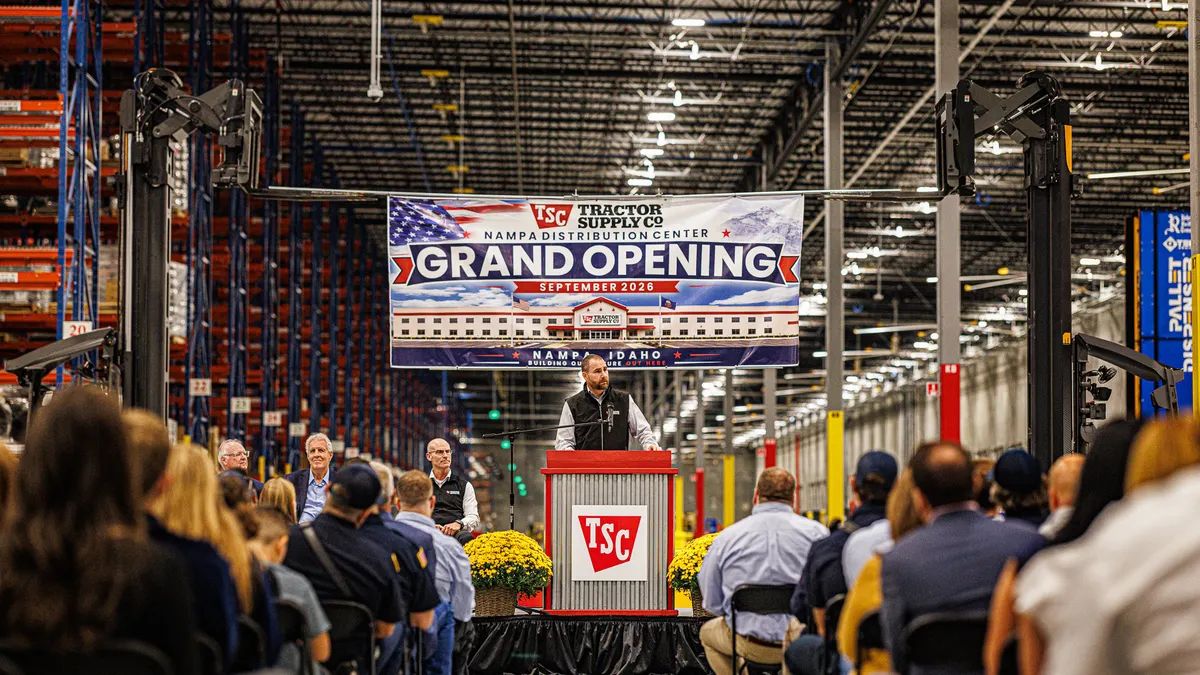
Tractor Supply opened its 11th distribution center in Nampa, Idaho this week, and the facility is notable less for its size than for what was designed into it from the start. At 865,000 square feet with room for further expansion, the site represents an investment of more than $200 million and includes 80 truck docks. Chief supply chain officer Craig Ledbetter said the facility will set a new standard for how products move through the company's supply chain, language that signals this is meant as a template, not a one-off.
What separates Nampa from a standard big-box warehouse expansion is the automated storage and retrieval system supplied by Knapp, the first deployment of its kind at any Tractor Supply location. The system handles storing, sequencing, and moving products through automatic conveying, described by the company as fully integrated across the facility's operations. For a retailer whose core business is rural and suburban hardgoods, agriculture supplies, and pet products, that level of automated sequencing is a meaningful step up from the manual and semi-automated processes that have run the rest of its network. It also means the facility's software stack, not just its racking and conveyors, had to be production-ready before the October launch, since a Knapp system of this scale lives or dies on how well its sequencing logic handles real order variability.
The AI team is infrastructure, not an afterthought
The detail that should catch a CIO's attention is the dedicated AI innovation team embedded at the facility, with a stated purpose of applying practical artificial intelligence to operational needs. Tractor Supply has disclosed neither the team's size nor its reporting line, yet the framing still matters. This team sits physically inside the operation it is meant to improve, working against live throughput data rather than publishing guidance from a distant corporate center of excellence. That is a structural choice about where AI capability lives in the organization, and it carries real implications for how fast lessons travel back to headquarters.
Embedding an AI function into a new facility at launch, rather than retrofitting one in after the automation has already proven itself or stalled, changes the adoption curve. Most retailers still treat warehouse AI as a layer added to existing automation two or three years after a facility opens, once the baseline systems are stable and the business case for optimization is clear. Tractor Supply is skipping that sequencing and betting that having AI talent present from day one will surface higher-value use cases sooner, even if the near-term output is modest. The upside of that bet is a shorter path from raw throughput data to tuned sequencing rules, since the team debugging the automation's edge cases is the same team building the models meant to predict and smooth them.
Capacity math tells its own story
The facility will serve 123 stores across nine states in its first year, giving Tractor Supply a genuine Northwest presence it lacked before. But the stated capacity, more than 200 stores at full operation, is the more revealing number. That gap between initial and full-scale throughput means the company built for roughly 1.6 times its near-term need, a common pattern in distribution center planning but one that only pays off if the automation and AI layers can absorb the volume increase without proportional headcount growth.
About 500 full-time jobs are expected at the site, which cuts against the narrative that heavy automation investment necessarily means fewer people. Tractor Supply's approach instead pairs the capital investment in Knapp's systems with meaningful hiring, at least at the outset. Whether that ratio holds as volume climbs toward the 200-store capacity ceiling, or whether the AI team's optimization work starts to compress labor needs per unit shipped, is the question worth watching over the next two or three years.
A compressed timeline from groundbreaking to live shipping
The facility began receiving inventory in August 2026 and was set to begin outbound shipping in October, a tight window between initial stocking and live fulfillment. That compression matters operationally: it means the Knapp automated storage and retrieval system and the embedded AI team had to prove reliability under real inventory conditions within roughly two months, rather than the longer shakeout periods some automated facilities use before going live to customers.
For retail supply chain leaders evaluating similar automation investments, that timeline is a useful data point on how quickly a vendor-integrated automated storage system can move from installation to production reliability when the retailer commits to a hard launch date. It also suggests Tractor Supply's internal teams, including the new AI group, were testing against live inventory flows well before the official October 12 opening announcement, rather than waiting for a ribbon-cutting to start learning. Any CIO who has watched a warehouse management system slip its go-live date by a quarter will recognize how unusual a two-month stocking-to-shipping window is for a facility carrying a brand-new automation vendor and a newly formed internal team at the same time.
What this signals for mid-size retail automation spend
Tractor Supply is not Amazon or Walmart scale, and that is exactly why this facility matters as a signal. Mid-size specialty retailers have historically automated more cautiously, often years behind the big-box leaders, because the capital outlay is harder to justify against a smaller store base. An eleventh distribution center north of $200 million, with a first-of-its-kind automation system and a built-in AI team, shows that the threshold for committing to this combination has dropped meaningfully.
The company frames the investment around growth, with Ledbetter noting the center will be vital to getting customers the products they need as Tractor Supply opens new stores. That framing centers expansion capacity, and it is likely to be the template other mid-size chains use when they pitch similar combined automation and AI investments to their boards. The pitch reads as infrastructure for sustaining store growth without proportional supply chain complexity, with any headcount efficiency arriving as a secondary benefit rather than the stated goal. Boards weighing a nine-figure distribution center tend to respond better to a growth story than a cost story, and Tractor Supply's public messaging reflects that lesson.