The number that reframes cloud budgets
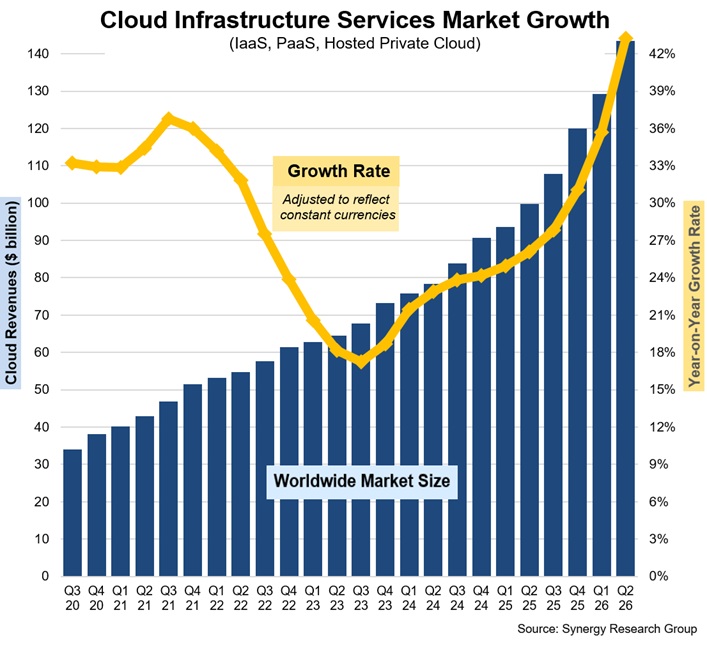
Synergy Research Group reported on July 30 that worldwide enterprise spending on cloud infrastructure services reached 143.4 billion dollars in the second quarter, a 43 percent jump from a year earlier and the highest growth rate the market has posted in eight years. It marked the 11th consecutive quarter of accelerating growth, a streak over which the market has doubled in size. Trailing twelve-month revenues have now passed 500 billion dollars, putting the sector on a half-trillion-dollar annual run rate.
We think the acceleration itself is the story. Cloud was already a mature, large market, and a business of this scale reaccelerating to 43 percent growth is unusual. Chief Analyst John Dinsdale put it plainly, saying AI technology has lit a fire under the cloud market and is now driving unprecedented growth. For finance and technology leaders, a market growing this fast means the pricing, capacity, and vendor dynamics you budgeted against a year ago are already stale.
GenAI is the engine, and it is loud
The single clearest driver is generative AI. GenAI-specific cloud services grew 165 percent year over year, far outpacing the broader market and pulling overall growth up with it. Public IaaS and PaaS climbed 47 percent, and the US market led all regions at 49 percent growth. The pattern shows AI workloads moving from experiment to production at scale, consuming compute, storage, and networking in volumes that are visibly bending the whole industry's growth curve.
For enterprise leaders, the 165 percent figure is a warning about cost trajectory. If your organization is expanding AI usage, your cloud bill is likely riding that curve, and the run rate you saw last quarter understates where you are heading. We would push teams to model AI-driven cloud spend separately from baseline infrastructure, because blending them hides the compounding growth that GenAI consumption creates. Budgets built on last year's cloud growth assumptions will be wrong by a wide margin.
The big three hold, and the neoclouds arrive
At the top, the order is familiar. Amazon holds 28 percent of the worldwide market, Microsoft 20 percent, and Google 15 percent, together commanding roughly two-thirds of global cloud infrastructure spending. Those shares have proven durable even as the market has doubled, which tells us the incumbents are capturing their proportional share of the AI surge rather than losing ground to it.
The more interesting development sits just below. Synergy notes that nine neocloud firms, including CoreWeave, OpenAI, Oracle, Crusoe, Nebius, Anthropic, and Nscale, now rank among the top 40 cloud providers, and the fastest-growing names on the list come from that group. These GPU-focused specialists have carved out real share by offering dense AI compute the incumbents could not supply fast enough. For buyers, that expands the vendor field, and it introduces suppliers with different risk profiles than the hyperscalers.
What the neocloud surge means for buyers
The rise of neoclouds inside the top 40 gives enterprise buyers genuine new options for AI compute, often at prices or availability the big three cannot match during capacity crunches. For teams that cannot get GPU allocation from AWS or Azure, a CoreWeave or Nebius can be the difference between shipping an AI product and waiting. That optionality is real, and it strengthens negotiating leverage against the incumbents.
We would pair that opportunity with clear-eyed diligence. Several of these providers are spending far ahead of revenue and carry financing and concentration risk that a hyperscaler does not. A neocloud is a viable supplier for burst capacity and specific training runs, and we would think hard before routing mission-critical, long-lived workloads onto a balance sheet that depends on continuous capital raises. Diversifying across a hyperscaler and a neocloud, with clean data portability, is the prudent posture.
The capacity and pricing squeeze
A market growing 43 percent while every major provider reports being capacity-constrained is a recipe for tight supply and firm pricing. The hyperscalers are collectively spending more than 700 billion dollars on capex in 2026 to catch up, and they are still selling out capacity as fast as they build it. For buyers, that means the leverage dynamics have shifted, and the era of aggressive discounting on committed spend is under pressure as demand outstrips supply.
We advise treating capacity as a procurement risk to manage actively. Lock reservations early for known AI workloads, keep a secondary provider qualified for overflow, and build architectures that can move between regions and vendors when one runs dry. In a market this hot, the organizations that plan capacity 12 to 18 months out will consistently outperform those that assume compute is available on demand at a predictable price. That assumption no longer holds.
Our read for infrastructure leaders
Synergy's Q2 numbers confirm what infrastructure teams already feel: cloud has reaccelerated, GenAI is driving it, and the market is compounding faster than most budgets anticipate. The half-trillion-dollar annual run rate and the 43 percent growth rate are not abstractions, they are the backdrop to every capacity conversation and every cloud invoice landing this year. Planning against a slower, more predictable cloud market is planning against a market that no longer exists.
Our guidance is to rebuild cloud financial models around AI-led growth, qualify at least one neocloud alongside your primary hyperscaler, and treat capacity as a scarce resource to reserve rather than a utility to draw on demand. The providers are spending hundreds of billions to serve this demand, and buyers who match that seriousness with disciplined multi-vendor planning will control cost and availability far better than those who wait for the market to cool. It is not cooling.