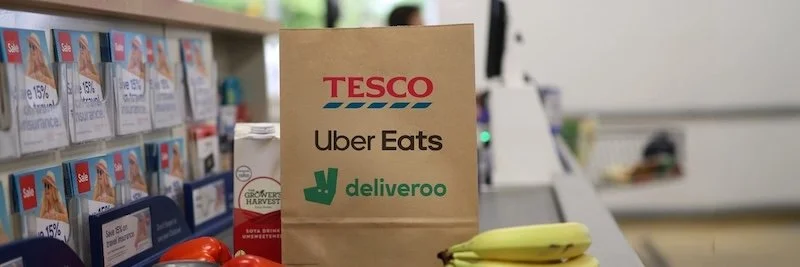
Britain's Biggest Grocer Joins the Aggregators
Tesco confirmed on July 22 that it will start selling groceries through Uber Eats from August, with Deliveroo following later in the summer. Shoppers will be able to order thousands of Tesco products, including fresh food and household essentials, without opening Tesco's own app. The grocer keeps running its rapid service Whoosh through its app in parallel, so this is an addition to the distribution mix rather than a replacement. Tesco UK CEO Ashwin Prasad said Whoosh has transformed how millions shop with the company, providing speed, convenience, and value through Clubcard benefits.
The context explains the move. Tesco says on-demand sales grew about 51 percent last year, and roughly 1.5 million customers now use Whoosh. That is a real business, and it is growing fast enough that Tesco does not want to cap it at the ceiling of its own app's reach. Putting inventory in front of the tens of millions of people who already open Uber Eats and Deliveroo every week is the fastest way to capture demand it would otherwise never see. The question is what it costs in margin and control.
The Reach Gap Is the Whole Point
Whoosh reaches around 70 percent of the UK population from roughly 1,800 stores. Uber Eats reaches closer to 90 percent. That 20-point gap is the asset Tesco is renting. Building it organically would mean opening or wiring up more stores, expanding delivery zones, and spending years acquiring app installs against platforms that already own the on-demand habit. Riding the aggregators buys that reach immediately. For a category as impulse-driven as convenience grocery, being present at the moment of intent matters more than owning the pixels around the transaction.
This is a classic build-versus-rent decision expressed in physical distribution. Tesco could keep pouring capital into its own last-mile footprint, or it could accept that two platforms have already solved the demand-aggregation problem and pay to sit inside them. Uber Eats VP Saskia De Jongh framed it as bringing Clubcard prices to a wider customer base, and Deliveroo's Rob Harris called on-demand grocery increasingly important. Both are happy to supply reach. The strategic cost lands on Tesco, and it is not primarily about delivery economics.
Clubcard on Someone Else's Rails
The genuinely new element is that Clubcard Prices and Clubcard points will apply on Uber Eats and Deliveroo orders, a benefit previously confined to Tesco-owned channels. Clubcard is Tesco's crown jewel, the loyalty and data engine behind its media business and its personalization. Extending it onto third-party platforms keeps the incentive intact for customers who cross over, which protects basket value and repeat behavior. Without it, aggregator orders would be lower-margin, lower-loyalty transactions that quietly erode the program's gravity.
But putting Clubcard mechanics on rails you do not own is a consequential choice. The transaction, the interface, and a slice of the customer relationship now sit inside Uber and Deliveroo. Tesco has to negotiate how much order and identity data flows back, how promotions render, and who owns the moment of discovery. For any retailer with a valuable loyalty asset, this is the crux: you can extend the program's reach, and in doing so you hand a partner influence over the very relationship the program exists to protect.
What Retail Media Loses When the Storefront Is Rented
Tesco has spent years building a retail media network on Clubcard's first-party data, and that business depends on owning the digital shelf where ads and sponsored placements appear. Orders that happen inside Uber Eats or Deliveroo happen on someone else's shelf, with the aggregator's own ad inventory competing for the same attention. Every basket that migrates off Tesco's app is a basket where Tesco's media monetization is weaker or shared. That is a real cost that rarely shows up in the launch press release.
For technology and commercial leaders, this is the trade-off to model explicitly. Incremental reach and sales sit on one side. Diluted media monetization, thinner first-party signal, and partner-controlled discovery sit on the other. Tesco is betting the incremental volume outweighs the erosion, and at 51 percent on-demand growth that bet is defensible. The lesson for peers is to price the media and data impact before chasing reach, because the aggregator revenue and the retail media revenue are drawing from the same well.
The Fulfillment Reality Behind the Deal
None of this works without stores that can pick and stage orders fast. Whoosh runs from roughly 1,800 locations already set up for rapid fulfillment, which is why Tesco can bolt on two more demand channels without rebuilding operations. The stores become dark-store-adjacent fulfillment nodes serving multiple front ends: the Tesco app, Uber Eats, and Deliveroo. That multi-channel picking model is the operational hard part, and Tesco's existing Whoosh footprint is what makes the aggregator deals feasible rather than aspirational.
For operators, the takeaway is that channel expansion is only as good as the fulfillment layer underneath it. Adding marketplaces to a store network that cannot pick accurately at speed just multiplies failure points and refunds. Tesco earned the option to expand by first proving Whoosh at scale. Retailers eyeing similar aggregator tie-ups should be honest about whether their stores can serve three masters at once without degrading availability, pick accuracy, or delivery times on any of them.
The Decision Every Retailer Now Faces
Tesco's move crystallizes a choice that is coming for every retailer with scale and a loyalty program. Aggregators own convenience-scale demand, and fighting them purely with a first-party app means accepting a hard ceiling on reach. Joining them unlocks that reach at the price of sharing the customer relationship, the data, and the media surface. There is no clean answer, and Tesco is choosing reach while trying to carry Clubcard along to soften the loss of control.
The roadmap implication is to build the plumbing before you need the decision. Retailers that keep their loyalty identity, order data, and media logic portable can extend onto third-party rails without surrendering the assets that matter. Those that treat their app as the only home for loyalty will face a worse version of Tesco's choice later, with less leverage. The winning position is optionality: strong enough first-party channels to matter, and clean enough data architecture to ride partner platforms without being absorbed by them.