Key Takeaways
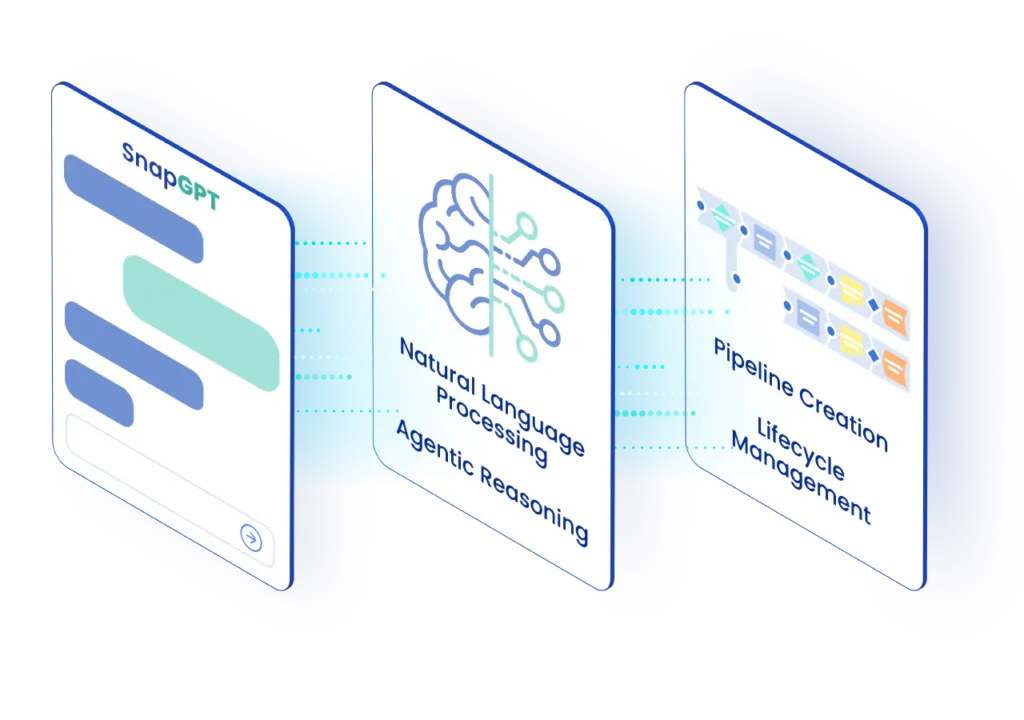
SnapLogic released an upgraded SnapGPT on July 29, 2026, moving it from an AI copilot to an agentic assistant that spans the full integration lifecycle.
The four modes, Plan, Build, Understand, and Operate, target requirements validation, pipeline generation, documentation, and production troubleshooting respectively.
Barnard College's enterprise applications director says her team now builds and tests integration workflows in under an hour, down from multiple days.
The release adds an Activity Log for development visibility now, with production-focused Monitor Insights following in August.
The decision for integration leaders is whether agentic tooling changes headcount planning for integration teams or simply shifts where senior engineers spend their time.
What changed in SnapGPT
SnapLogic released an updated version of SnapGPT on July 29, describing the shift as moving from an AI copilot into what it calls an agentic assistant for the integration lifecycle. The distinction the company is drawing matters operationally: a copilot suggests code or configuration inside a workflow a human still drives, while an agent is meant to plan, execute, and validate steps with less continuous human direction. SnapGPT now spans four modes: Plan, which validates requirements and flags implementation risks before any pipeline gets built; Build, which generates production-ready integrations across multiple pipelines at once; Understand, which reads existing integration assets and explains what they do; and Operate, which surfaces diagnostics when something breaks in production.
SnapLogic CTO Jeremiah Stone framed the release as bringing the company's original AI vision "forward into the era of Agentic Integration, helping teams across the entire engineering lifecycle." The release also made SnapGPT's Activity Log generally available, giving teams visibility into what the assistant changed and why during development, with a companion Monitor Insights feature for production diagnostics scheduled for broader availability in August. SnapLogic positions itself as clients including AstraZeneca, Adobe, Verizon, and Sony use the platform for enterprise integration work.
The Understand mode is the more interesting bet
Most agentic tooling announcements this year have focused on generation: write the code, build the pipeline, ship the workflow. SnapGPT's Understand mode does the opposite job, reading existing pipelines and producing documentation and explanations of what they do. That is a less glamorous capability, but it addresses a problem every integration team actually has: undocumented pipelines built by an engineer who left the company two years ago, sitting in production, with nobody confident enough to touch them without breaking something downstream.
Integration debt of that kind is a real cost center. Teams pay for it either by keeping tribal knowledge concentrated in one or two people, or by spending engineering hours reverse-engineering legacy pipelines before making any change. A tool that can explain a pipeline's logic on demand does not replace the judgment needed to modify it safely, though it removes a meaningful chunk of the archaeology work that currently precedes any change to inherited integration logic.
What the customer evidence actually shows
SnapLogic's headline customer proof point comes from Nancy Mustachio, Director of Enterprise Applications at Barnard College, who said her team used SnapGPT to create and test integration workflows in under an hour, compared to days previously. Aragon Research CEO Jim Lundy, cited in the release, framed the broader demand this way: organizations want AI that combines domain expertise with automation to improve both productivity and business outcomes, rather than generic AI bolted onto an existing tool.
A single customer quote from a higher-education IT team is a useful directional signal, not proof of enterprise-wide results. Barnard's integration complexity is unlikely to match a multinational retailer running hundreds of pipelines across ERP, commerce, and data warehouse systems. Data and integration leaders evaluating SnapGPT should treat the days-to-hours claim as an upper bound achievable on simpler workflows, and push SnapLogic for benchmark data on higher-complexity, multi-system pipelines before building it into a build-versus-buy business case.
Where this fits in the broader agentic data tooling race
SnapLogic joins a wider push to move integration and pipeline tooling toward agentic execution. Airbyte has been building write-back capabilities that let agents take action on enterprise systems like HubSpot under governance controls, and Databricks has shipped Genie Code for agentic data engineering work inside its own platform. The common thread across all of these releases is a bet that the next competitive line in data tooling runs through how much of the integration lifecycle an agent can own without a human in the loop at every step, rather than through connector count or raw pipeline throughput.
That bet carries risk that vendors tend to underplay in launch announcements. An agent that builds a pipeline in an hour still needs someone accountable for what happens when that pipeline moves customer data, financial records, or PII between systems incorrectly. SnapLogic's Plan mode, which validates requirements before generation, is clearly designed to catch that class of error early, but no vendor has yet published data on how often agentic pipeline generation introduces errors that a human-built pipeline would have avoided.
The decision for integration and data leaders
The practical question this release raises is what it changes about how integration teams are staffed and where senior engineers spend their time. If Plan, Build, Understand, and Operate genuinely compress the lifecycle the way SnapLogic claims, the likely near-term effect is a shift toward more integrations being attempted by smaller teams, with senior engineers spending more of their week on governance, review, and edge cases rather than first-draft pipeline construction. That is a different outcome than the headcount-reduction story vendors often lead with, and a more believable one given how much judgment integration work still requires.
For CTOs and CIOs currently running integration backlogs that outpace available engineering capacity, that shift is worth testing on a bounded, non-critical workload before committing production systems to agent-built pipelines. The Activity Log gives a starting point for auditing what the agent actually did, which is close to the minimum governance bar any enterprise should require before letting an AI agent touch systems of record, and it should not be treated as optional even for pilot deployments.


