A mixed quarter that still raised guidance
ServiceNow's third-quarter 2026 results sent a genuinely mixed signal on their face: revenue of $4.1 billion, up a strong 20.5 percent year over year, alongside non-GAAP earnings of $1 a share that came in below the $1.02 Wall Street expected. GAAP earnings were $277 million, or 27 cents a share. That combination, strong top-line growth paired with a bottom-line miss, is the kind of result that typically generates cautious market reaction, and indeed the quarter has been described elsewhere as mixed on balance.
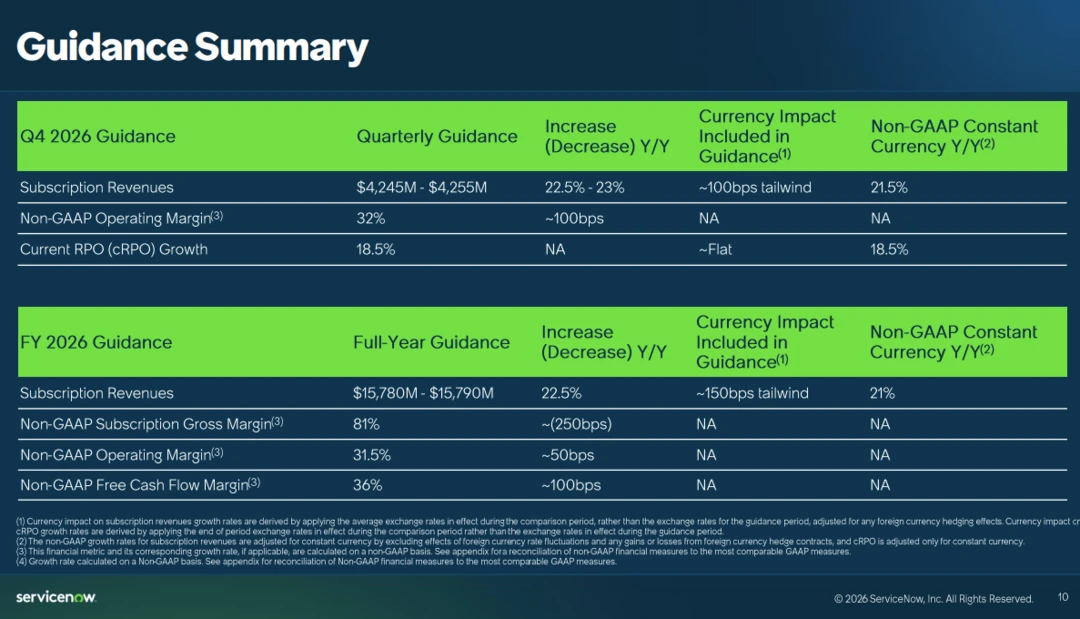
Despite the earnings-per-share miss, ServiceNow projected subscription revenue of $4.24 billion to $4.25 billion for the next quarter, implying growth of about 23 percent, and raised its full-year guidance rather than pulling back. That combination of a near-term miss alongside raised forward guidance suggests management views the earnings shortfall as a timing or investment issue rather than a signal of weakening underlying demand.
The deal sizes tell a different story than the EPS miss
Underneath the headline numbers, ServiceNow's large-deal metrics look considerably stronger than the earnings miss alone would suggest. The company closed 19 deals each worth more than $5 million in net new annual contract value during the quarter, and now counts 680 customers with more than $5 million in total annual contract value, a customer base of genuinely large enterprise accounts rather than smaller trial-sized deployments.
CFO Gina Mastantuono tied that deal activity directly to AI agent consumption, saying customers are increasing how much they actually use the agents they have purchased. That distinction, between selling agent capability and customers actually consuming it at scale, is the one enterprise software vendors across the industry are increasingly being judged on, since usage-based revenue depends on genuine adoption rather than initial contract signing alone.
Rebranding the Control Tower, and recruiting a coalition around it
ServiceNow renamed its AI Control Tower product to the Super Intelligence Control Tower during the quarter, and built out a Control Tower Alliance ecosystem spanning cloud infrastructure, security, and governance partners. The founding member list is notable for including companies that might otherwise be viewed as ServiceNow's competitors in parts of the AI stack: Anthropic, AWS, Cisco, Nvidia, OpenAI, and Okta all signed on as founding members.
McDermott's own framing of the strategy was direct: he described ServiceNow as aiming to be 'the single harness for enterprise intelligence and security,' positioning the company as the governance and orchestration layer sitting above multiple AI providers and infrastructure vendors, rather than competing to be the AI model or infrastructure provider itself. Recruiting Nvidia, AWS, and OpenAI as alliance members rather than treating them purely as competitors is a bet that enterprises want a neutral governance layer spanning multiple AI vendors, not a single-vendor stack.
The 'not compute constrained' claim, and why it matters
McDermott's assertion that ServiceNow is 'not compute constrained' and has no capital constraints is a notable claim given how much of the current AI infrastructure conversation, across hyperscalers and AI labs alike, centers on capacity and power limitations. If accurate, it suggests ServiceNow's business model, which layers governance and workflow orchestration on top of infrastructure it does not need to build itself, insulates the company from the capital intensity problem facing the hyperscalers and model providers it partners with.
That positioning matters strategically: a software company that does not need to fund its own data center buildout can grow margin and deploy capital differently than a company racing to build physical AI infrastructure. McDermott's claim, if it holds up over subsequent quarters, would support the argument that the orchestration and governance layer of enterprise AI is a structurally more capital-efficient business than the infrastructure layer underneath it.
What CIOs evaluating platform consolidation should take from this quarter
McDermott's warning about customers going through a 'token maxing phase' before learning that sprawl and poor integration were the bigger risk is a pointed message aimed directly at enterprise buyers who adopted multiple overlapping AI tools early and are now consolidating. His claim that CRM deployments can now take 30 to 60 days rather than years, and that six ServiceNow business lines have each surpassed $1 billion in run-rate revenue, is the evidence the company is offering that consolidation onto its platform specifically delivers faster time-to-value than a fragmented multi-vendor approach.
For CIOs currently managing a sprawling portfolio of point AI solutions acquired during the initial adoption rush, ServiceNow's pitch, and the growth of its $1 billion-plus business lines, is worth weighing directly against the real cost of platform lock-in that any single-vendor consolidation strategy carries. The quarter's numbers suggest enough large enterprises are making that trade already that it is becoming a mainstream rather than contrarian choice.