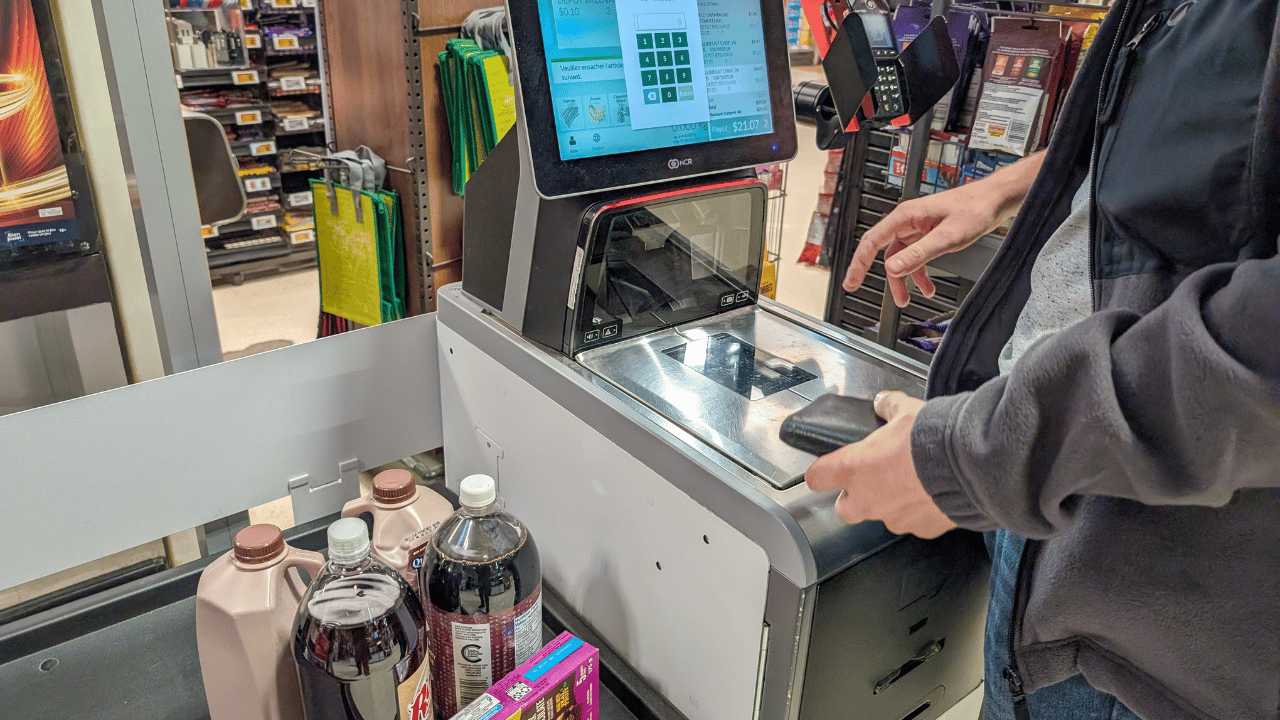
The self-checkout tradeoff grocers are now quantifying
VoCoVo's 2026 survey of 250 US retail decision-makers, alongside 500 consumers, put a specific number on a tradeoff retailers have long suspected but rarely quantified this precisely: food retailers reported shoplifting rose 61.9 percent and grocery retailers 58.8 percent after introducing self-checkout. Those are retailer-reported figures rather than independently audited shrink data, but the consistency between food and grocery segments suggests the pattern is not isolated to one retail category's particular checkout design.
That finding reframes self-checkout's labor-saving benefit against a theft cost that was, for years, treated as a secondary consideration behind the staffing efficiency self-checkout was originally sold on. A nearly 60 percent increase in reported shoplifting is large enough that any retailer still evaluating self-checkout purely on labor-cost grounds is almost certainly underestimating the technology's true total cost of ownership.
AI adoption for theft is already past the early-adopter phase
42.9 percent of food retailers and 41.2 percent of grocery retailers surveyed already use AI specifically for anti-theft purposes, putting adoption well past the experimental pilot stage for a large minority of the industry. Among retailers not yet using AI for this purpose, 38.1 percent of food retailers and 44.1 percent of grocery retailers said they plan to add it within the next year, which would push total adoption past 80 percent in both segments within twelve months if those stated plans hold.
That adoption trajectory matters because it suggests AI-based theft detection is heading toward becoming a baseline expectation at self-checkout rather than a differentiating investment. Retailers still relying purely on staff vigilance or exception-based reporting at self-checkout stations are increasingly the outliers, not the norm, among the 250 decision-makers this survey captured.
A second, less-discussed problem: abuse of frontline staff
Alongside theft, the survey surfaced a workplace safety concern that gets considerably less attention in retail technology coverage: verbal and physical abuse directed at employees. All food retailers surveyed, and 79.4 percent of grocery retailers, said they are concerned about this specifically, and grocery workers reported averaging 58.7 hostile incidents a year, more than double the 28.9 average reported in food retail.
The consequence of that abuse shows up directly in staffing. In the past 12 months, 57.1 percent of food retailers and 32.4 percent of grocery retailers said employees had resigned specifically because of customer abuse, a retention cost that sits alongside, and is arguably more serious than, the shoplifting losses driving most of the industry's AI investment conversation.
Why retailers expect AI to help with abuse, not just theft
Over 70 percent of food retailers and 88.2 percent of grocery retailers say they expect AI to play an important role in reducing workplace abuse within the next year, a notably high confidence level given how much harder abuse detection is than theft detection in a purely technical sense. Theft detection can rely on relatively well-defined visual patterns, items not scanned, hands obscuring a barcode, but abuse detection requires interpreting tone, escalation, and context in ways computer vision and audio analysis tools are still maturing toward.
That gap between technical maturity and retailer confidence is worth watching closely. Retailers may be extrapolating optimism from AI's demonstrated success at theft detection onto a genuinely harder problem, and the next year of deployment data will reveal whether abuse-detection AI can actually deliver results proportional to the high expectations this survey captured.
Why food and grocery retailers are choosing different tools
The survey also found a meaningful split in which specific AI tools each segment is prioritizing. Food retailers favor AI-powered CCTV at 60 percent, a tool suited to monitoring discrete, often fast-moving incidents at counters and registers. Grocery retailers instead emphasize smart shelves and inventory sensors at 46.7 percent and automated incident alerts at 30 percent, tools better suited to a larger physical footprint where theft and incidents can occur across many aisles rather than concentrated at a handful of checkout points.
For any multi-format retail chain evaluating AI investment across different store types, that split is a useful planning signal: the right AI tool for a given location depends heavily on store layout and incident patterns specific to that format, meaning a single AI procurement strategy applied uniformly across food service and grocery footprints is likely to underperform relative to a format-specific approach matched to how and where incidents actually occur in each setting.