The number retailers have been avoiding
Self-checkout has quietly become the default way to pay at grocery, now representing 54% of transactions where it is available. That adoption curve outran the loss prevention tooling built for staffed lanes, and the bill has come due. The 2026 Self-Checkout Loss Report from ECR Retail Loss puts a hard figure on what many operators already suspected: stores see losses climb by an average of 22% in the first year after they roll out self-checkout, whether from deliberate theft, scanning mistakes, or produce misidentified at the wrong price point.
That gap is why some chains pulled self-checkout back in the past two years, betting that staffed lanes were the safer economics. The data suggests the better move is fixing the technology rather than retreating from it. A 22% first-year increase is a tooling and process failure, not proof that unattended checkout is structurally unworkable. Retailers that treat it as the latter are leaving a lower-cost format on the table for the wrong reason.
What Everseen is actually catching
Everseen, the vision AI company behind loss prevention at 11 of the world's top 20 grocery retailers, now processes 15 million transactions a day across its platform, according to the company. Its system uses real-time computer vision to spot missed scans, mis-scans, and checkout errors as they happen, rather than reconciling losses after the fact through end-of-week inventory counts that arrive far too late for a store manager to act on any individual incident. The camera watches the scan itself, not just the register total, which is the difference between catching a problem in the moment and discovering it as an unexplained variance three weeks later.
Bruno Rothgiesser, Everseen's chief architect, frames the technology as pattern recognition trained on millions of real shopping transactions, tuned to separate an honest fumble, an item stuck under a cart, a barcode that will not scan, from a deliberate switch or a skipped item. That distinction is the entire product. A system that cannot tell the difference either lets real loss through by staying too lenient, or accuses paying customers by flagging every hesitation, and both failure modes cost the retailer more in the long run than the shrink the system was built to stop in the first place.
Nudges beat confrontations
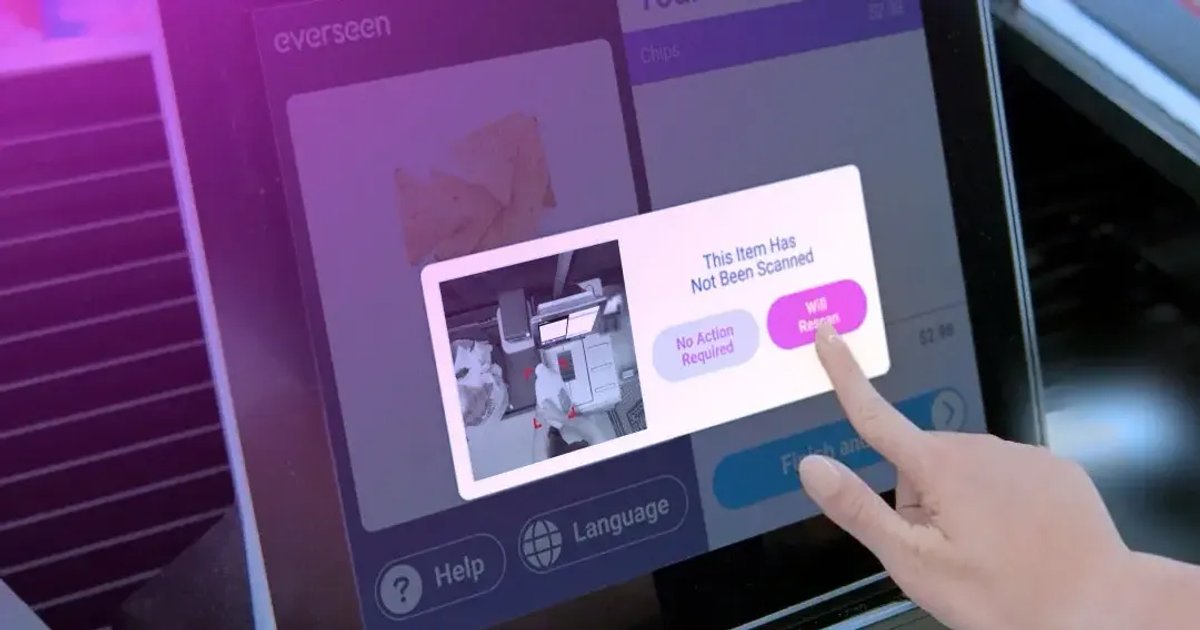
The intervention model matters as much as the detection model, and this is where the data gets specific. Everseen's numbers show soft on-screen prompts, paired with a video replay of the exact moment an item was missed, trigger in only 3% to 10% of self-checkout transactions across its retailer base. That low trigger rate is itself a signal of a well-tuned system: most shoppers never see an intervention at all, which is exactly the point for a format built to move people through the lane faster than a staffed register.
Of the transactions that are flagged, 80% to 97% resolve through the shopper simply correcting the scan themselves after seeing the replay, with no staff escalation required. That is a deliberate design choice against the instinct to harden self-checkout with more friction, more ID checks, more visible cameras pointed at customers. Shrink control and customer experience are not separate line items competing for the same budget here. A system that resolves the overwhelming majority of incidents without a human confrontation preserves the labor savings self-checkout was supposed to deliver in the first place, which is the entire business case for the format.
The pattern is showing up outside the US too
The same instinct is playing out at convenience chains abroad. BGF Retail, which operates South Korea's CU convenience stores, is piloting an AI camera add-on built with Shinsegae I&C starting in September that flags unscanned items as a customer attempts to leave the store. The design goal is explicitly minimal: one compact camera with an onboard vision processing unit bolted onto existing terminals, no new servers, no rip-and-replace of the checkout stack that a chain with thousands of locations could never fund in a single cycle.
That constraint, retrofit over rebuild, is the practical lesson for any retailer evaluating this category regardless of geography. The vendors gaining traction are the ones that plug into existing point-of-sale hardware rather than demanding a fleet-wide terminal swap before a single store sees a benefit. For a CFO weighing the capital case, that difference determines whether a pilot can scale to a full store network inside one budget cycle or gets stuck as a permanent proof of concept that never earns a line in next year's plan.
What this means for the loss prevention budget
The evidence now argues against the binary choice retailers have been debating for two years: rip out self-checkout entirely and go back to staffed lanes, or leave it running unmonitored and absorb the shrink as a cost of the format. Vision AI vendors are demonstrating a middle path backed by hard numbers, transaction-level detection, calibrated intervention thresholds, and resolution rates that keep the overwhelming majority of incidents out of a manager's hands entirely, which is the outcome retailers actually wanted from self-checkout when they first deployed it.
For retail CTOs and loss prevention leaders, the diligence question is no longer whether vision AI works. The ECR and Everseen data both say it does at scale, across a base large enough to be credible. The real question is which vendor's false-positive rate and integration footprint match your existing point-of-sale estate, and whether the intervention design respects the customer relationship as much as it protects the P&L. Get that wrong and you trade shrink for churn, and churn is the more expensive number on every retailer's income statement.