Agents Move to the Center of Commerce
Salesforce made its biggest Agentforce Commerce release generally available in early July, and the timing is deliberate. The Shopper Agent, Buyer Agent and Merchant Agent are now live, with native ChatGPT integration reaching general availability in July 2026 and Google Search AI Mode and Gemini app integrations following over the summer. Salesforce is shipping this ahead of the 2026 peak shopping season for a reason. As Nitin Mangtani, EVP and GM of Agentforce Commerce, put it, the brands that win will have their Shopper Agent live on their own properties for the 2026 shopping season.
The release reframes what commerce software is for. For two decades, ecommerce platforms optimized pages, search and checkout flows for human browsers. Agentforce Commerce assumes a different primary actor: an AI agent that discovers, compares and transacts on the shopper's behalf, or that represents the brand directly in conversation. That is not a cosmetic shift. It changes what the software must do, from rendering catalogs for people to exposing capabilities that agents can invoke, and Salesforce is betting the transition is happening now, not in some distant roadmap.
Three Agents, Three Jobs
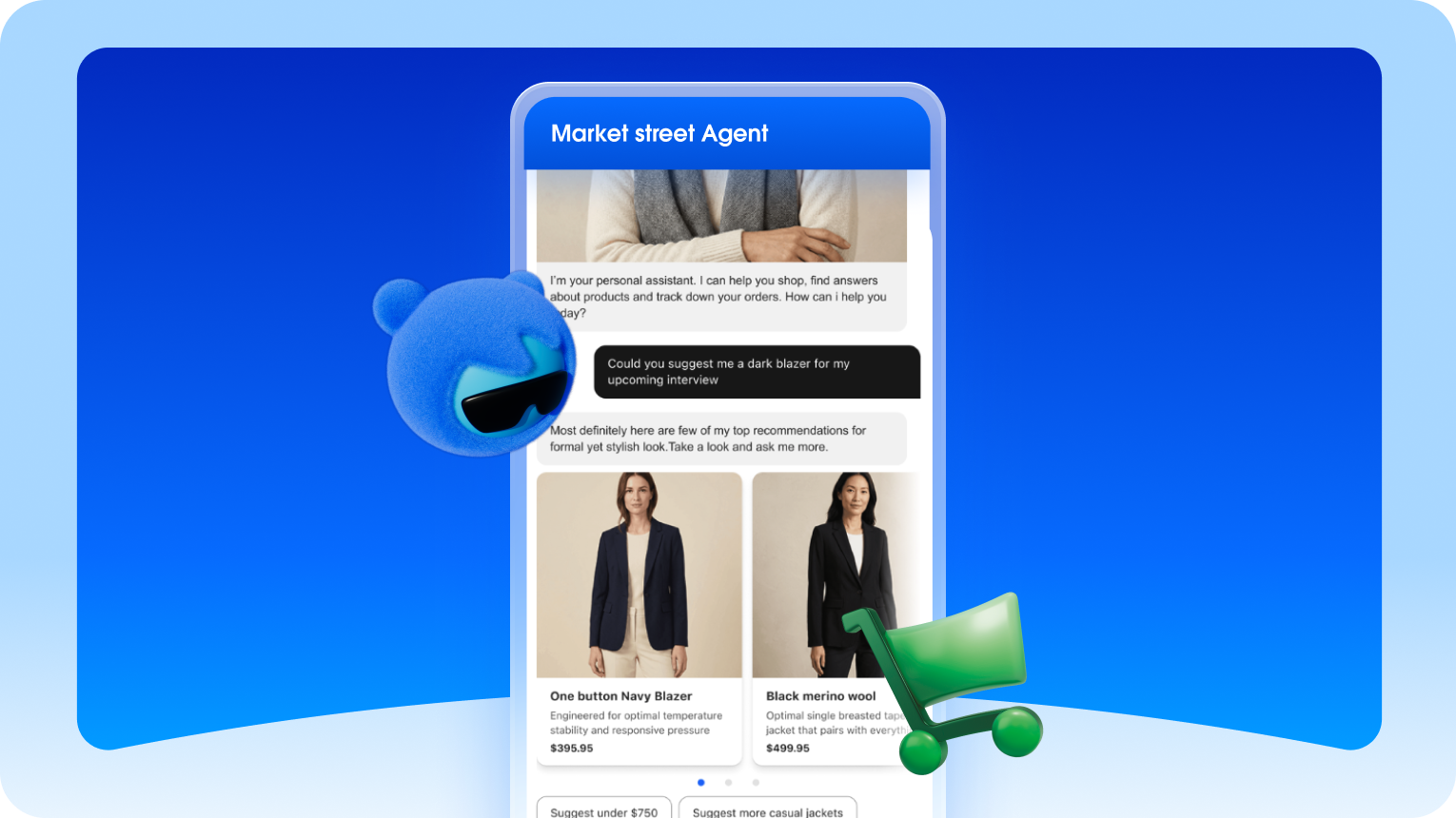
The release is organized around three distinct roles. The Shopper Agent carries the customer conversation from discovery through checkout and into service, speaking in the brand's voice on its storefront. It is the consumer-facing agent, the one meant to replace or augment the traditional browse-and-buy flow with a conversational experience the brand controls. For B2B, the Buyer Agent meets buyers inside WhatsApp and SMS, extending agentic commerce into the messaging channels where business purchasing increasingly happens.
The third agent runs the back office. The Merchant Agent lets a retailer's team organize catalogs, sort products and respond to trends in plain language, turning merchandising tasks that once required specialist tooling into natural-language operations. Around these three agents, Salesforce shipped a wider set of features, including Storefront Next with 30-minute deployment, Agentic Commerce Search, Agentic Order Management, a Visual Merchandising Workspace and a modern point of sale for Android and Windows. The intent is a full stack where agents operate across the customer-facing and operational sides of commerce.
The Numbers Behind the Urgency
Salesforce is backing the launch with data meant to convey urgency. The company says AI influenced 20 percent of global online sales during the 2025 year-end holiday season, worth 262 billion dollars, and that retailers running their own shopper agents grew sales 59 percent faster than retailers still on the sidelines. It also claims AI-referred traffic converts at eight times the rate of social. Whatever the precise methodology, the thrust is clear: agentic commerce is already moving meaningful revenue, and the gap between adopters and holdouts is widening.
We would treat vendor statistics with appropriate skepticism, but the underlying dynamic is real and observable across the industry. AI-assisted shopping is shifting from experiment to material channel, and the conversion advantage of agent-referred traffic, if it holds even partially, is the kind of number that reorganizes marketing budgets. The 59 percent growth differential is the sentence designed to make a retail executive nervous about waiting, and it captures the competitive logic Salesforce is selling: early agent adoption compounds.
Own the Agent or Lose the Customer
The strategic argument underneath the product is the part worth dwelling on. Salesforce's pitch is that brands must own the agent that represents them, deploying a Shopper Agent they control on their own properties, rather than ceding the customer conversation to a third-party assistant like a general-purpose chatbot. If the agent that shoppers interact with belongs to someone else, the brand loses the relationship, the data and the ability to shape the experience. The Shopper Agent is positioned as the brand's answer to that disintermediation threat.
This is the central tension of agentic commerce. As consumers increasingly start purchases inside general AI assistants, brands face the prospect of becoming interchangeable suppliers behind an agent they do not control. Salesforce's counter is to give brands their own agent with full context of customer relationships, proprietary data and business logic, plus the ability to connect to external AI apps like ChatGPT on the brand's terms. Whether brands can hold the relationship, or whether the general assistants ultimately own the customer, is the defining question of this cycle.
What Retail Leaders Should Weigh
For retail and commerce executives, the release forces a decision that can no longer be deferred. The question is not whether agentic commerce is coming but whether the organization will enter the peak season with its own agent live or watch competitors do so. The 30-minute Storefront Next deployment claim is Salesforce lowering the barrier deliberately, because the company's interest is in getting agents deployed before the season starts. Leaders should scrutinize whether the fast path delivers a genuinely brand-controlled experience or a thin veneer over a generic one.
The harder work is organizational, not technical. Deploying a Shopper Agent means deciding how it speaks, what data it can access, how it handles service and returns, and where the human handoff lives. It also means confronting the data and catalog quality that agents expose ruthlessly. The brands that benefit will be those that treat the agent as a strategic customer interface worth investing in, not a checkbox. Salesforce has supplied the tooling and the urgency. What the agent actually represents to customers is still the brand's to define.