A Marquee Customer Changes the Conversation
At its Investor Day in New York, Qualcomm announced a multigenerational agreement under which Meta will use Qualcomm's data center CPUs for its next-generation server fleet, and the company projected over 15 billion dollars in annual data center revenue by fiscal 2029. CEO Cristiano Amon framed the ambition plainly, saying the company is building a data center platform and that it is a comprehensive portfolio of solutions. Meta CEO Mark Zuckerberg reinforced the significance, calling the work with Qualcomm critical, even as Meta noted it maintains a flexible, portfolio-based approach that blends multiple hardware partners with its own MTIA silicon.
The customer name is what makes this more than a roadmap reveal. Meta operates one of the largest server fleets on the planet, and its processor choices ripple through the entire supply chain. When a buyer of that scale commits to a new entrant for next-generation CPUs, it validates that the data center processor market, long dominated by a small set of incumbents, is genuinely contestable. For enterprise leaders, the headline is not that Qualcomm has a chip, it is that the most demanding hyperscale buyers are now willing to diversify their silicon, which over time should mean more competition, more architectural choice, and less single-vendor dependency.
Dragonfly and the Agentic AI Pitch
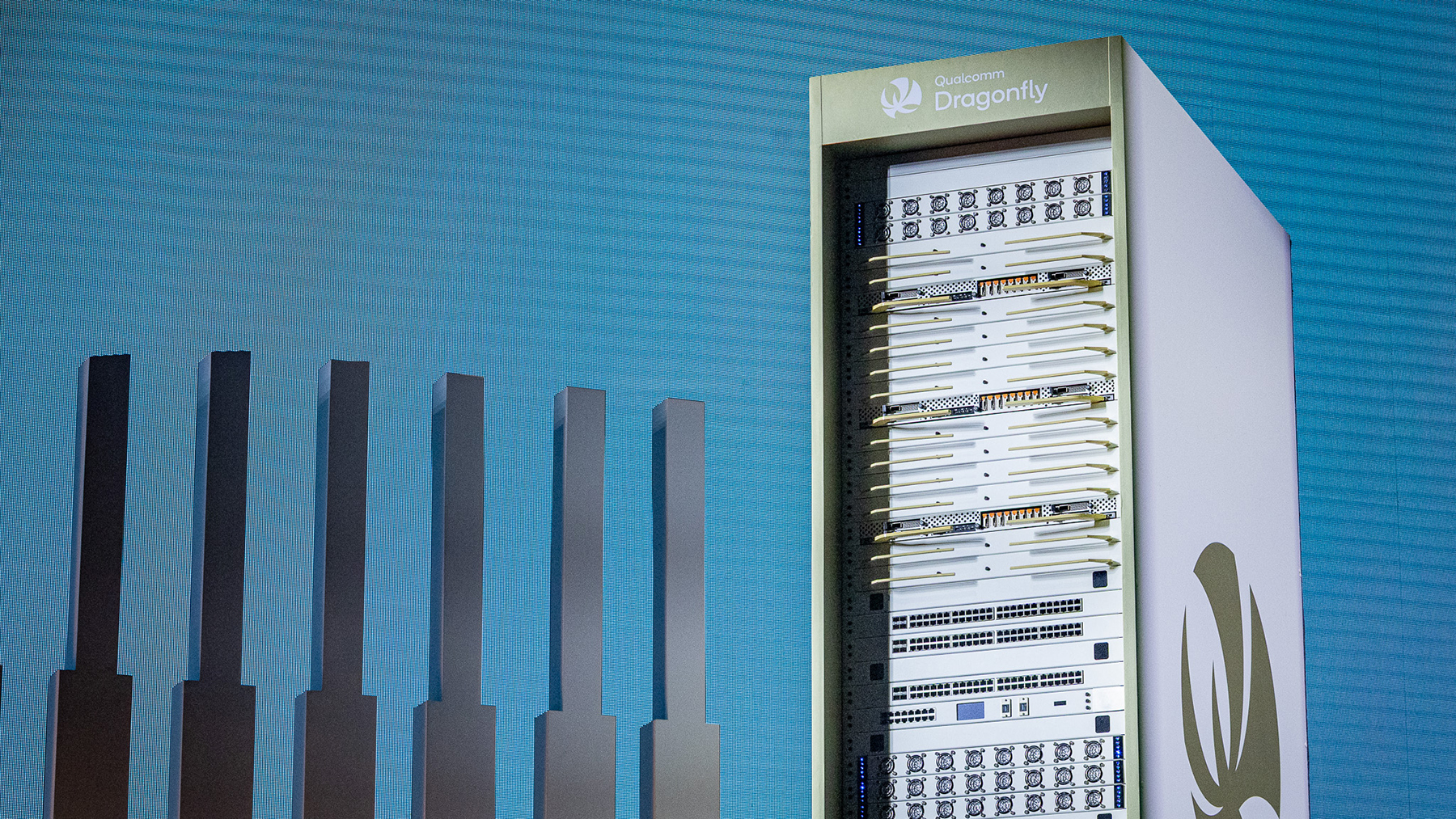
At the center of the announcement is the Dragonfly C1000, a data center CPU that Qualcomm says Meta will deploy when it enters production in 2028. Qualcomm positioned the chip explicitly for agentic AI, emphasizing compute performance without excessive power draw, which speaks to the operational pain point hyperscalers feel most acutely. As inference workloads shift from single model calls to long chains of agentic reasoning, the efficiency of the CPUs orchestrating that work becomes a meaningful line in the power and cost equation. Qualcomm is selling not just raw performance but performance per watt, the metric that increasingly governs data center economics.
We read the agentic framing as a deliberate strategic wedge. The incumbents own the general-purpose server CPU, so a challenger needs a story about where the workload is going next, not where it is today. By tying Dragonfly to the rise of agentic AI and power efficiency, Qualcomm is betting that the next refresh cycle will be shaped by inference economics rather than legacy compatibility. For CTOs planning infrastructure into 2028 and beyond, the message is that the criteria for choosing server silicon are shifting toward efficiency and AI orchestration, and the vendors who win that argument may not be the ones who won the last decade.
The Accelerator Roadmap and Its Bandwidth Bet
Beyond the CPU, Qualcomm laid out an accelerator line built on its High-Bandwidth Compute memory architecture, which the company says combines SRAM-class performance with HBM-class capacity to attack the inference memory bottleneck. The AI250 is claimed to deliver an 18-fold improvement in bandwidth over the initial AI200, and the AI300, arriving with a second HBC generation, is positioned for a further leap, both targeting commercial availability in 2028. The pitch is squarely aimed at inference, the workload that scales with every user query rather than every training run, and therefore the one that dominates long-run operating cost.
Memory bandwidth is the right battlefield, because for inference it is often the true constraint rather than raw compute. If Qualcomm's HBC approach delivers anything close to the claimed gains, it could meaningfully change the cost per token for serving large models, which is exactly the number that determines whether AI features are profitable at scale. We would caution that vendor bandwidth claims need independent validation, and 2028 is far enough out that roadmaps can slip. But the direction is clear and credible, and enterprises should treat the inference accelerator market as one that is about to get more crowded and more competitive, with real downward pressure on serving costs.
What It Means for Enterprise Buyers
Qualcomm also disclosed that it has secured two major hyperscalers, one of which remains unnamed, with shipments beginning at the end of 2026 and expected to generate at least 1 billion dollars in revenue within a year. Stacked against the 15 billion dollar 2029 target, that early traction matters because it shows the strategy is converting into committed orders, not just slideware. For an industry where data center silicon has been a near-duopoly story for years, a credible third force with hyperscale customers and a multi-year roadmap is a structural change worth tracking closely.
For CIOs and CTOs, the practical implication is leverage. More viable silicon vendors means more negotiating power, more architectural options, and less exposure to any single supplier's pricing or supply decisions. Even enterprises that never buy a Qualcomm chip directly benefit, because the cloud providers they rely on gain a new bargaining chip with incumbents, and those savings can flow downstream into instance pricing. The Meta deal is a single data point, but it is a loud one. The data center processor market is no longer a settled question, and that uncertainty, for buyers, is good news.