Palm Beach County Rejects Project Tango and Signals a Harder Path
Palm Beach County commissioners voted 5 to 1 on July 15 to deny the development order amendment for Project Tango, a hyperscale AI data center proposed on 202 acres along Southern Boulevard in the county's western reaches. The applicant, PBA Holdings, had sought approval for 3.6 million square feet of buildings, including a 1.03 million square foot data center, 2.35 million square feet of warehouses, and 216,000 square feet of utility structures. The county's own Zoning Commission had recommended denial unanimously. For a project once described as among the largest planned campuses in the country, the outcome marks a decisive local rejection of AI infrastructure at this scale.
The vote reflected a proposal that never fit the county's comprehensive plan. Commissioners questioned why the application required such an extensive, customized list of conditions to proceed. Vice Mayor Marci Woodward captured the mood when she said the county was straining to make the project fit a code that simply did not accommodate it. Only Commissioner Maria Marino supported approval, noting that the developer had accepted every condition offered to protect the neighboring Arden community and its school. We read the decision as a clear statement that accepting conditions no longer guarantees approval when a project sits fundamentally at odds with local land use expectations.
The Numbers That Sank the Application
The physical scale of Project Tango overwhelmed its rural setting. The site sits roughly 900 to 1,200 feet from Saddle View Elementary School and directly borders the Arden residential community, a proximity that shaped every argument against it. A projected power draw near 600 megawatts sat at roughly 12 times the regulatory threshold that triggers heightened state review in Florida. Numbers of that magnitude turn an abstract infrastructure debate into a visceral local one. Residents could see the substation, the cooling equipment, and the truck traffic that 3.6 million square feet of buildings would bring to a semi-rural corner of the county, and they organized around those concrete impacts.
The water figure sharpened the opposition further. Critics cited a claimed 100,000 gallons of daily potable water consumption, a striking number in a region already sensitive to aquifer stress. Independent acoustic analysis added to the case, with expert Santiago Lattanzio warning that the cooling load would require roughly 180 modules and disputing the developer's noise estimates. Each of these details gave commissioners a concrete reason to vote no. We see the pattern repeating across the country, where the specific figures on power, water, and noise become the ammunition that organized communities use to defeat projects at the hearing stage.
Water and Noise Turned Neighbors Into Opponents
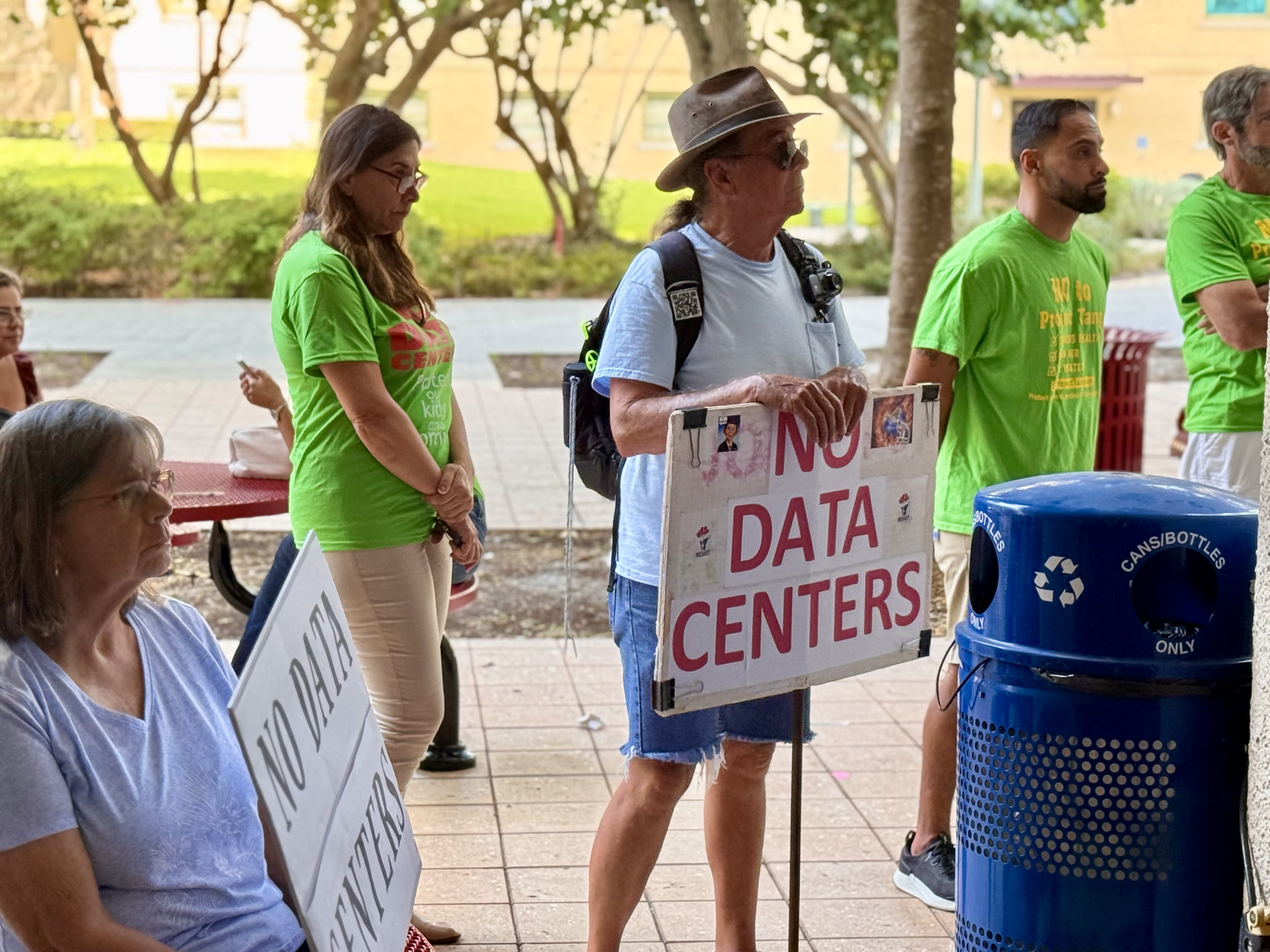
Community opposition has matured into a sophisticated force that operators underestimate at their peril. The Project Tango hearing drew crowds large enough to require overflow rooms, and residents arrived armed with independent expert testimony and specific technical objections. That level of organization changes the calculus for every developer eyeing a site near homes and schools. A campus that pencils out financially can still fail on the strength of a well-prepared neighborhood coalition. The days when a data center could be sited quietly on cheap land near a growing metro have closed in many jurisdictions, and the western Palm Beach vote is the latest proof.
The technical rebuttals carried unusual weight in this case. When an acoustic expert quantifies the number of cooling modules and challenges the applicant's own noise modeling, commissioners gain defensible grounds to deny. When water figures collide with aquifer concerns, the environmental argument writes itself. We advise operators to treat these technical objections as the real battleground, because vague reassurance no longer survives contact with expert testimony. The projects that succeed now arrive with independent studies, closed-loop cooling commitments, and non-potable water sourcing already documented, closing off the exact lines of attack that ended Project Tango.
The $130 Billion Backlash Is Now a Planning Variable
Project Tango is one entry in a rapidly lengthening list. A July report found that roughly $130 billion of AI data center projects have been blocked or delayed in 2026, with the first three months alone accounting for at least 75 projects, the largest single-quarter figure recorded. Those numbers turn local opposition into a material variable for anyone planning national capacity. A pipeline of announced gigawatts means little when a meaningful share of it stalls in zoning hearings and permit challenges. The gap between announced capacity and delivered capacity now widens at the exact moment AI demand accelerates across every enterprise workload category.
We treat this backlash as a structural feature of the current cycle. Communities have learned that hyperscale campuses bring heavy power draws, water usage, noise, and traffic, and they have organized to extract concessions or block projects outright. The financial consequence lands on timelines and cost, since every delayed project pushes capacity further into the future and raises the price of the megawatts that do come online. For CIOs modeling AI infrastructure availability through 2028, the blocked-project data belongs in the forecast. Announced supply and deliverable supply have diverged, and planning around the announced figure invites disappointment when leases come due.
Siting Risk Belongs in Every Region Strategy
Siting risk has become a first-order input to region strategy. An enterprise selecting where to place capacity now inherits the permitting exposure of its chosen operators and locations. A campus tied up in litigation or denied at the county level delivers no compute, regardless of how attractive its economics looked on paper. We advise infrastructure teams to diligence the permitting status of any site they depend on, distinguishing sites with final approvals from those still navigating hearings. The difference determines whether promised capacity arrives on schedule or evaporates in a commission vote like the one Project Tango just lost.
Geography now sorts into welcoming and resistant jurisdictions, and the distinction drives real cost. The Texas Panhandle, rural stretches of the Midwest, and other power-rich areas court large loads and move projects through approval quickly. Dense suburban counties near schools and established neighborhoods increasingly say no. Operators have read this map and shifted capital toward the welcoming regions, which is why gigawatt campuses cluster where land is open and communities want the tax base. Enterprises should align their own region strategies with this reality, favoring locations where the permitting path is proven and the local politics support long-term operation.
How Operators and Buyers Should Respond
For operators, the Project Tango defeat offers a clear playbook. Arrive with independent studies on power, water, and noise. Commit to closed-loop cooling and non-potable water sourcing before the first hearing. Choose sites with genuine distance from schools and dense housing. Engage communities early with concrete economic commitments and enforceable guardrails. The developers winning approvals in 2026 treat community consent as an engineering requirement with its own budget and timeline. Those that arrive expecting cheap land and a quiet approval process are the ones filling the $130 billion column of blocked and delayed projects that now shadows the entire sector.
For buyers, the response is disciplined diligence. We recommend that enterprises request the full permitting status of any campus underpinning their capacity plans, model the probability of delay into their timelines, and diversify across sites and jurisdictions to limit exposure to a single adverse vote. The Project Tango rejection near Mar-a-Lago demonstrates that even well-capitalized, condition-laden proposals can fail. Treating regulatory approval as a settled formality is the mistake that leaves a workload roadmap stranded. The enterprises that plan around siting risk today will hold a durable advantage as AI capacity grows scarcer and the fights over where it lands intensify.