What Oracle Shipped on July 15
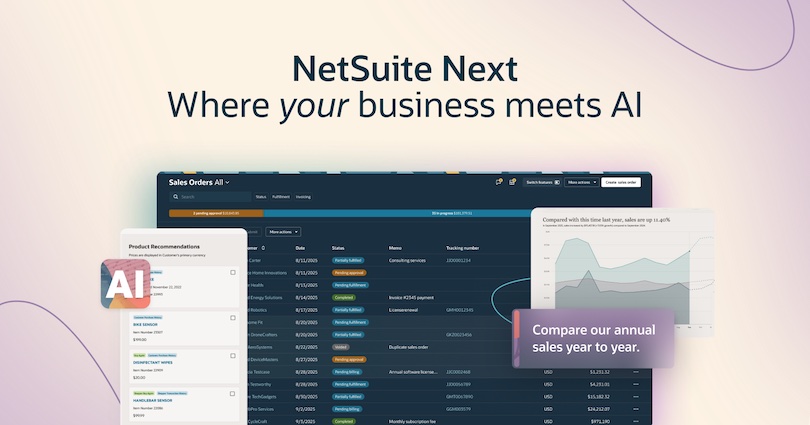
Oracle NetSuite has begun the North American rollout of NetSuite Next, its next-generation AI ERP experience, delivering it to customers in the United States and Canada as part of release 2026.2. The company is also making Ask Oracle, its conversational assistant, available to existing NetSuite customers in the region as a companion inside their current accounts. Additional countries are slated to follow shortly after, according to reporting from ERP Today, which covered the launch. The timing continues Oracle's steady push to fold AI into the core NetSuite experience rather than sell it as a separate add-on that customers have to seek out and configure themselves.
The framing is deliberate. NetSuite Next is presented as a new experience layered onto the existing suite, with customers able to enable it and switch users at their own pace rather than all at once. That is a meaningful design choice for a platform whose users run payroll, close the books and file taxes on it every period. A next-generation interface that forced an abrupt migration would meet resistance from finance teams that cannot tolerate downtime, so Oracle is packaging the change as an opt-in upgrade. That caution is a sign the company understands who actually depends on this software day to day.
Ask Oracle Enters the Finance Stack
The center of gravity is Ask Oracle, a conversational interface that lets users query and act on ERP data in natural language. Placing it inside live NetSuite accounts, rather than a separate sandbox, is the move that turns a demo into daily utility. Finance staff can interrogate ledgers, chase variances and pull operational detail without navigating deep menu trees, which is where the time savings accumulate across a monthly close. The value shows up in the mundane moments, the quick question a controller would otherwise route through an analyst, multiplied across a whole department and every reporting cycle in the year.
We view this as the practical face of agentic ERP for the mid-market. NetSuite's base is tens of thousands of growing companies that lack the integration budgets and internal data teams of large enterprises, and they have historically inherited automation last, long after the Fortune 500. Shipping an assistant into those accounts as part of a standard release compresses that gap considerably. The competitive read is that AI-native ERP experiences are becoming table stakes, and vendors that gate them behind expensive premium tiers will feel pressure as buyers come to expect conversational access as a baseline feature of the platform they already run.
The 2026.2 Features Target the Close
Release 2026.2 concentrates on finance operations. It introduces Intelligent Flux Analysis to explain period-over-period variances, AI Transaction Matching and a Suggestions Workspace to accelerate reconciliation, and bank reconciliation workflow improvements. There is also AI-powered labor cost insight, an ADP Workforce Now connector that syncs payroll to finance, a healthcare dashboard that consolidates financial and operational metrics, and a renewal and retention workspace aimed at software companies. The breadth of the list shows Oracle spreading AI across the everyday finance calendar rather than concentrating it in a single marquee capability that demos well but touches few users.
The pattern in that list is telling. Oracle is aiming AI at the repetitive, reconciliation-heavy tasks that dominate a controller's month, rather than at flashy generative features that photograph well in a keynote. Flux analysis and transaction matching are exactly the chores where automation pays back quickly and where manual errors are costly and hard to trace. By instrumenting these steps now, NetSuite is building the substrate that later agents will act on, since an agent that reconciles accounts autonomously needs the matching logic, the variance explanations and the audit trail sitting underneath it before anyone will trust it to run unattended.
Preview Accounts Lower the Switching Risk
Oracle is giving North American customers the option to try NetSuite Next in a dedicated preview account and then enable users to switch to the new experience when ready. That staging matters for ERP, where a botched change can stall invoicing, delay payroll or corrupt a close. A parallel environment lets finance and IT validate reports, test integrations with connected systems, and train staff before anyone depends on the new interface for a live period. It converts a potentially disruptive platform shift into a controlled evaluation that teams can run on their own schedule.
For technology leaders, the preview mechanism is the detail worth acting on immediately. It creates a low-cost window to assess whether Ask Oracle and the 2026.2 automations hold up against real data and real processes before committing the whole user base. Teams that treat the preview as a structured evaluation, with defined success criteria and named owners, will make a far better call on timing than those that either rush the switch to chase the AI headline or ignore it until Oracle pushes the change more broadly. The disciplined path is to test against the messiest month, not the cleanest demo dataset.
The Mid-Market Gets Agentic by Default
The strategic significance is distribution. When an AI ERP experience ships inside a mainstream release to an entire regional customer base, autonomous and assistive features stop being a large-enterprise privilege reserved for those who can fund custom builds. NetSuite's customers are precisely the companies that could not previously afford bespoke automation, and they now receive a standardized assistant and a set of finance-focused AI tools as part of the platform they already pay for. That default inclusion does more to spread agentic capability than any number of premium announcements aimed at the enterprise tier.
This is how agentic capability actually reaches the broad market, through default inclusion in the systems of record that smaller companies run on every day. It also raises the baseline for every competitor selling into the mid-market, from horizontal ERP vendors to point solutions. Once buyers experience conversational access and automated reconciliation inside their ERP, that becomes the expectation they carry into every other software conversation and renewal. The durable shift underneath a single product release is a permanent reset of what a growing company assumes it should get from core business software.
What Finance and IT Leaders Should Do
The near-term action is evaluation, not celebration. NetSuite customers in the United States and Canada should spin up the preview, put Ask Oracle against their own ledgers, and stress-test the flux analysis and transaction matching on genuinely messy real data rather than clean samples. The value of these features depends heavily on data quality and process discipline, so the assessment doubles as a diagnostic of the finance operation's own readiness for automation. Where the tools struggle, the fault often lies in inconsistent coding and process gaps that no AI can paper over, and finding that out early is itself useful.
Beyond the immediate release, leaders should plan for consumption economics. As assistants and eventual agents execute more work, usage-based costs tend to follow, and ERP is no exception to that broader shift across enterprise software toward metering activity rather than seats. Building a view of expected agent activity now, and negotiating renewal terms with that trajectory in mind, will matter more over time than the current feature checklist. NetSuite Next is a preview of where mainstream ERP is heading, and the buyers who prepare for the pricing model will fare better than those who only admire the interface.

)