A Legacy System Being Retired Became the Breach Point
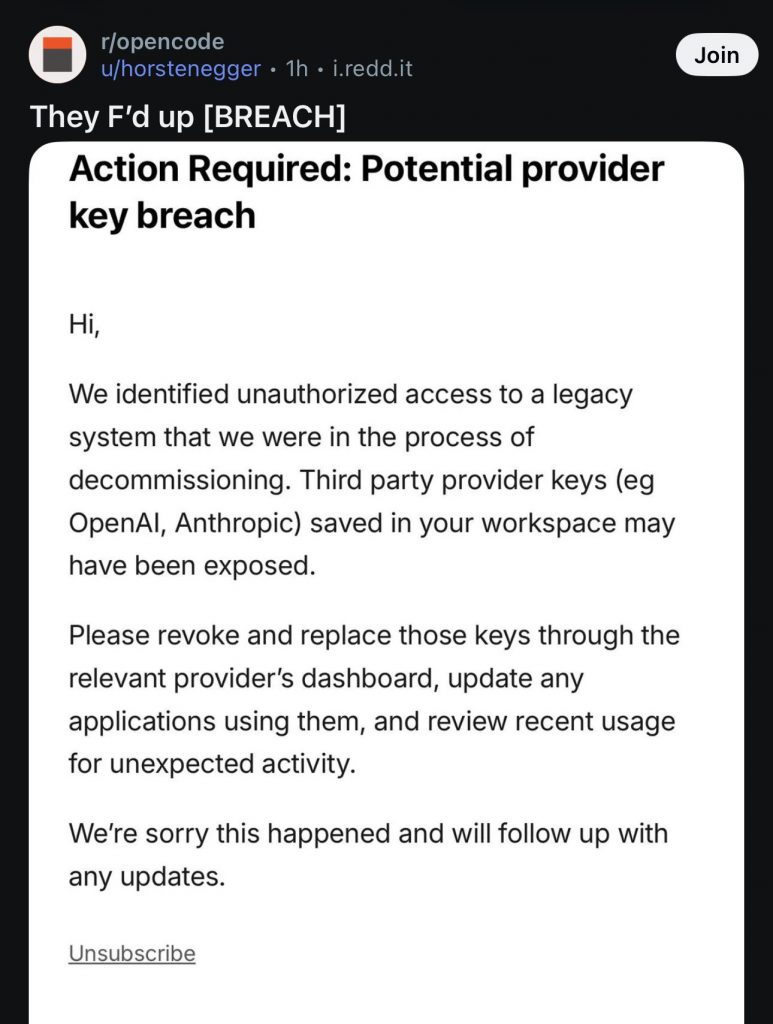
OpenCode, the open-source AI coding agent built by the team behind SST and Anomaly Innovations, disclosed a security breach on October 17, 2026 at 19:03 UTC. The company said attackers gained unauthorized access to a legacy system that was in the process of being decommissioned, and that this access potentially exposed third-party provider API keys, specifically for OpenAI, Anthropic and Google, that users had saved inside their OpenCode Console workspaces. OpenCode Console is the company's hosted dashboard for managing those linked model-provider credentials, which made it a concentrated store of exactly the kind of secret an attacker building out AI access would want.
The detail that this was a legacy system already being retired is worth sitting with. Decommissioning projects routinely slip in priority behind active development work, and systems in that limbo state, no longer the main product but not yet torn down, are a well-known category of overlooked risk. That a breach landed there rather than in OpenCode's current production stack suggests the attacker found, or was handed, a weak point precisely where attention had already started to move on.
OpenCode Is Calling This a Distillation Attack
OpenCode's own description of the incident as a large scale distillation attack is a notable choice of language, and it points to what the stolen API keys were likely wanted for: sustained, high-volume calls against OpenAI, Anthropic and Google models using someone else's paid credentials, potentially to extract model outputs at scale. That framing distinguishes this from a simple credential-dumping breach where keys are sold or used opportunistically, and instead points toward a more deliberate, resource-intensive use case for the stolen access.
OpenCode has said the incident is ongoing and that this status is limiting how much further technical disclosure it can provide right now. That is a reasonable operational security posture during an active investigation, but it also means the public record on exactly how the legacy system was accessed, and exactly what the attacker did with the keys it obtained, remains incomplete as of this report. Readers should expect more detail once containment is further along.
The Scope Was Real but Not Universal
OpenCode reported that about 1.4 percent of OpenCode Console users were affected by the breach. On a platform with any meaningful user base, even a fraction that small represents a concrete number of real developers and organizations whose model-provider API keys may now be in an attacker's hands, each of which carries its own billing exposure and potential data-access risk depending on what that specific key was scoped to do, and depending on how actively its owner was using it when the legacy system was compromised.
Importantly, OpenCode did not rely on a general announcement alone, it notified each affected user individually by email. That is the right default for this kind of incident, since an API key compromise is actionable at the individual account level, keys can be rotated, provider-side anomalous usage can be checked, billing alerts can be set, in a way that a broad public post does not prompt someone to do on its own. Any OpenCode Console user who has not received such a notification has reasonable grounds to assume they were not among the 1.4 percent affected, though confirming directly with OpenCode and checking provider-side usage logs is still the safer, more thorough move for anyone running sensitive workloads through those keys.
Three Model Providers Are Now Part of the Response
OpenCode says it is working with Anthropic, OpenAI and Google on remediation. That three-way coordination reflects a structural reality of the current AI tooling ecosystem: a breach at an AI coding agent vendor is rarely contained to that vendor alone, because the actual value sitting in its systems is often other companies' API credentials, which means the model providers whose keys were exposed have their own incentive and ability to help detect and shut down anomalous usage.
For an enterprise evaluating this kind of tooling, that multi-vendor remediation process is worth understanding concretely rather than taking on faith. It means rotating a compromised key is not solely OpenCode's job, the provider side also needs to flag and potentially revoke or rate-limit anomalous usage tied to that key. Any organization affected by this breach should confirm directly with each provider, not just with OpenCode, that its own keys have been fully invalidated and reissued.
A Founder's Own Account Being Targeted Signals Something Beyond Opportunism
OpenCode co-founder Dax Raad said his own personal accounts were also targeted in connection with this incident, and he characterized the moment with a line worth repeating directly: it is a whole new world with AI-powered hacking. Coming from someone who builds AI developer tooling professionally, that carries real weight as an acknowledgment that the tooling and tactics available to attackers targeting AI infrastructure specifically have moved fast enough to catch even an informed insider off guard, and his comment reads as a genuine warning rather than a polished public-relations line.
A founder being individually targeted alongside a broader platform breach also suggests the attacker had enough reconnaissance to identify and pursue specific high-value individuals well beyond the Console's general user base. That pattern, breadth across 1.4 percent of users combined with pointed targeting of a key insider, is consistent with an attacker who understood the organization well enough to go after both the system and the people around it, and it argues against treating this purely as an automated, opportunistic credential sweep.
What This Means for Every AI Tool Holding Your Provider Keys
This incident is a direct warning about a category of risk that is easy to underweight: any AI coding agent, orchestration platform or developer tool that stores your OpenAI, Anthropic or Google API keys on your behalf is now a credential custodian, with all the same scrutiny that implies for a password manager or secrets vault. A legacy, half-decommissioned system was enough to expose that data here, which means the real question for any similar tool in your own stack is whether every system that has ever touched those credentials, current or retired, has been properly secured and eventually destroyed, regardless of whether it is still actively maintained today.
The concrete action for any CTO or CIO with developers using AI coding tools is to inventory which of those tools hold live API keys to your model providers, confirm each vendor's key-storage and key-rotation practices in writing, and set a policy of scoping and rotating those keys aggressively rather than issuing broad, long-lived credentials that stay valid for months. A 1.4 percent exposure rate sounds small until your organization is the one receiving the individual notification email.


