OpenAI enters hardware with a Codex controller
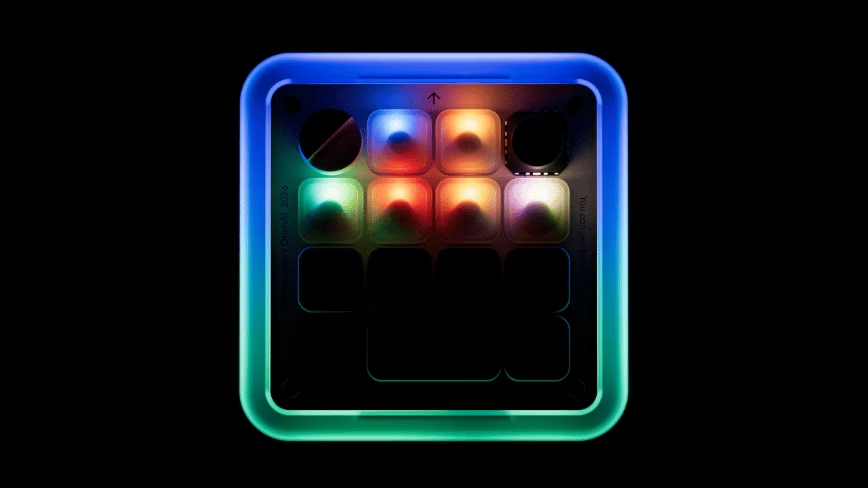
OpenAI put its first commercial gadget on sale on July 15, 2026. The Codex Micro is a compact programmable macro pad priced at 230 dollars, built in collaboration with Work Louder, a boutique manufacturer that has made custom controllers for design teams including Figma. The device shares the chassis of Work Louder's Creator Micro 2 and targets the audience OpenAI has spent a year building: developers who run Codex, the company's coding agent platform. This is an input peripheral for an existing software product, and it is worth noting the restraint in that framing.
OpenAI was careful to keep the Codex Micro separate from its more ambitious hardware ambitions. The company is developing a consumer AI companion device with former Apple design chief Jony Ive, and the macro pad has nothing to do with it. The Micro adds no model, no new capability, and no consumer surface. It is a limited-edition accessory for professional users, and reading it as anything larger misses the point. What makes it interesting is what the hardware implies about how coding work now happens.
What the keys, dial, and joystick do
The device carries 13 mechanical keys, a joystick, a rotary dial, and a touch sensor, with six illuminated keys reserved for live status. Those status keys light up to show the state of a Codex task, indicating whether an agent is running, awaiting feedback, has completed a job, or has hit an error. Developers assign the remaining keys to common actions such as push-to-talk, sending a prompt, and accepting or rejecting the agent's proposed code changes. Every mapping is configurable from within the ChatGPT desktop application, which is where the pad draws its context.
The two analog controls are the tell. The rotary dial modulates an agent's reasoning level, turning a parameter that used to live in a config file or a dropdown into a physical knob you can twist mid-task. The joystick triggers saved workflows. Taken together, the layout treats agent supervision as a set of recurring physical gestures: dial up the reasoning for a hard problem, glance at the status lights, tap to approve a diff, push to talk when a written prompt is slower than speech. The interaction model is closer to a mixing desk than a keyboard.
The base it is built for
Codex crossed five million weekly active users by June 2026, and that scale is the commercial logic behind the peripheral. When a coding agent has millions of daily operators performing the same handful of supervisory actions thousands of times a week, dedicated hardware for those actions starts to make sense. OpenAI spokesperson Dominik Kundel described the device as one designed to supercharge people's Codex usage, and the teaser that preceded it, posted by the OpenAI Developers account, read simply that your favorite Codex shortcuts are getting an upgrade.
A limited-edition 230 dollar accessory will not move OpenAI's revenue in any material way, and it does not need to. The value is in signaling and lock-in. A developer who reorganizes muscle memory around a Codex-specific controller is a developer who has made a small, physical commitment to one agent platform over its rivals. In a market where Codex, Claude Code, Cursor, and Copilot are competing for the same terminal, a piece of desk hardware branded to one of them is a quiet retention play dressed as a developer perk.
Hardware as a statement about the job
The most telling thing about the Codex Micro is that it can exist at all. A macro pad only makes sense when a workflow has enough distinct, repeated actions to fill its keys, and agent supervision now clears that bar. Start and pause the agent, escalate its reasoning, review a diff, approve or reject, fire a saved prompt, speak an instruction: these are becoming the primitive verbs of software work. Two years ago the equivalent device would have mapped to editor shortcuts like cut, paste, and find. The vocabulary has changed.
We read this as a physical marker of a shift engineering leaders already feel in their teams. The developer's hands are moving less over source and more over controls that direct an agent to write it. The locus of skill is relocating toward specification, review, and judgment about when to trust an agent's output, with no drop in the number of engineers or the depth of skill required. A dedicated controller for those actions is a small artifact of a large change, and the fact that it ships as a real product is the point worth sitting with.
Whether your teams should care
For most engineering organizations, the Codex Micro itself is a curiosity rather than a procurement item. A 230 dollar limited-edition pad is not going to appear in a standard hardware refresh, and the productivity gain from mapping keys to Codex actions is real but modest. The teams likely to benefit are heavy agent operators who spend most of their day in a supervise-and-approve loop, where shaving a second off each approval across hundreds of daily interactions compounds into something noticeable. For everyone else, keyboard shortcuts in the desktop app deliver most of the value at no cost.
The strategic read matters more than the buying decision. When a frontier lab decides its coding agent has enough recurring physical actions to justify a hardware accessory, that is data about the maturity of agent-driven development. Leaders planning tooling budgets and workflow standards for 2027 should treat the Codex Micro as a signpost: the interaction patterns it hardwires, escalate reasoning, review, approve, reject, are the patterns your developers will be doing all day regardless of which agent wins. Design your review processes and your metrics around those verbs now.
The bottom line
OpenAI shipping a physical controller for Codex is a minor product and a meaningful signal. The device is well made, tightly scoped, and honest about being an accessory rather than a platform play, and its 230 dollar price and limited-edition status keep expectations sensible. Nothing about it changes what Codex can do, and OpenAI has been clear that it is separate from the consumer hardware it is building with Jony Ive. Judged as a gadget, it is a well-considered thing for people who already live inside the agent, and its restraint is part of why it lands cleanly.
Judged as a barometer, it reads higher. The Codex Micro is a working thesis about how software gets built now, expressed in mechanical keys and a reasoning dial. The through line from OpenAI's advertising slogan, that you can just build things, to a desk controller for supervising the thing that builds, is the story worth telling internally. The hardware is optional, and adoption of it will stay niche. The workflow it encodes is arriving whether or not a single Codex Micro ever reaches your office, and that is the part leaders should plan around.